
Everyone loves the alley oop. How could you not? It’s basketball’s most sensational play, a coordinated two-man trapeze act, the sexiest way to score two points, never failing to make us pause in anticipation. Trusting the ball will reach its intended hands, holding our breath until it does.
It’s the ultimate expression of faith between two teammates. Mavericks center Daniel Gafford describes it as “a relationship between you and the guard,” one which requires conviction from both sides. When that faith is absolute, there’s nothing that can stop it.
“You can start throwing them without even looking,” says Devin Harris, who played 15 years in the league. “And that’s when it really becomes fun.”
Basketball teammates have been throwing and dunking lobs almost since the NBA’s existence. It was a novelty in the early days, a circus act that awed spectators, a feat that Bill Russell was documented as accomplishing even playing collegiately in the early ‘50s. It morphed from a specialized play to a fast break spectacle to what it has become today: an integral action deeply embedded in this sport’s fabric.
We’re fortunate: Basketball’s evolving nature has allowed us to witness oops more often than ever before. Go back about a decade, and teams attempted lobs, on average, about 0.8 times each game. This season, that number has risen to 1.4 soaring passes every time teams step onto the court, the most ever seen in the tracking era.
This can largely be credited to the 3-point revolution. The players’ increasing levels of skill has expanded the basketball court without changing its dimensions. Because more space must be guarded, more room’s now available near the rim. Which means more lobs, more aerial feats, more thrills from the sport’s coolest play.
Just throw it at the rim. That’s the simplest explanation for this play’s mechanics, one echoed by players representing both sides of this acrobatic bond conducted above the planet’s surface. When asked, however, they all share insight into a deeper mastery for how, when, and what must be done to turn this delicate couplet performance into the show we hope it’ll be.
For the throwers, it always starts with who. “It depends on the catcher,” says Harris, speaking about where the technique begins. Harris threw 135 lob passes in his final six seasons, which is how far back the statistical databases accurately tracking them go. It makes him the 15th-most prolific lob thrower, when measured on a per possession basis, in the modern era.
Harris didn’t have the teammates to immediately develop this skill when he began his career with the Dallas Mavericks, whose rosters were filled with more groundbound big men and none of the league’s most athletic wings during his first three-and-a-half years. “We didn’t really have a lot of threats like that,” Harris explained. Then, when he was traded to the New Jersey Nets in 2008, he became Vince Carter’s point guard. The franchise drafted Brook Lopez that summer, too, providing him the leapers he required to hone this geometric skill.
When Harris later returned to Dallas, he teamed up with Brandan Wright, a soaring backup big man who became the favorite target of his career. “I was so locked in,” he recalls, “(but) I sat out half the season. So it’s just me sitting there watching in my mind, like, When I get back, this is what we’re gonna be able to do.” In the two tracked seasons they played together, that duo connected 36 times, the most for any target in Harris’ career.
“I was trying to overthrow him,” Harris says, “and there wasn’t a play where I did.”
Every passer immediately names their favorite catcher: Sacramento’s Malik Monk loved throwing to DeAndre Jordan; Ryan Nembhard, now with the Mavericks, recalls his high school days with Jalen Duren. These players, athletes who elevate quickly and extend into the sky, are the ones who make this look easy. “Some guys, you feel like you can put it anywhere in the gym,” Memphis’ Cam Spencer says, “and they’ll make you look good.” What really requires skill, of course, is arcing these passes to mere mortals, which is most everyone else.
For those passes, most players aim for the backboard. “For a 101 kind of lob,” Spencer says, “I’d throw to its bottom left side, just above it.” Monk aims for the bottom corner of the square behind the rim, putting it beside the rim and in front of that marker. Only then does he toggle the pass’ height, throwing it higher or lower based on his recipient’s hops.
Timing’s important. “Learning how the other guys jump, where they like the ball, all those things kind of come into play,” says Harris, who would note whether his teammates were two-footed jumpers or elevated off one. It, surprisingly, isn’t something that can be mastered just by practicing. Every guard says that the chemistry needed for this play comes from actual games even if some guards, like Monk, feels it takes no more than “two or three times messing up” before he and the catcher are on the same page.
It depends on the context, too. Lobs most commonly come from pick-and-rolls, and Monk looks for the teammate rolling to the rim beside him to be touching the free throw line circle inside the paint when he lofts them up. In transition, it’s often necessary to give them more space.
“You actually want to lead them to it,” Harris says for those. “You’re going to throw it early so they can run underneath it (and) get the timing down in their steps.”
It’s not always about perfect placement. “I’m trying to put it above the defender,” Nembhard says, “and then closest to the rim.” Nembhard, who’s listed at 5-foot-11, emphasizes it comes in that order: first over, then close. The second objective doesn’t matter without the first. For Harris, he often threw lobs using the same shooting mechanics he shot floaters. “They’re engaging with me, trying to block the shot,” Harris recalls. “And then I just put it up high enough over so it’s an uncontested dunk.” Monk does that, too, but he doesn’t believe there’s any correct way to toss them.
“I’d throw it behind my back if I could,” says Monk, flinging his arms in various directions as a demonstration. “I do it like this, do it like this, yeah, anything it takes.”
Some players simply don’t adapt well to this skill. “I think there are some guys who can throw lobs,” says Drew Eubanks, Monk’s Kings teammate, “and some guys can’t.” In the pre-game locker room, his teammate Doug McDermott confesses that he’s one of them.
“I can’t throw those,” McDermott admits. “I know that. Whenever I’m in that situation, I try to shoot a jump shot at the rim.”
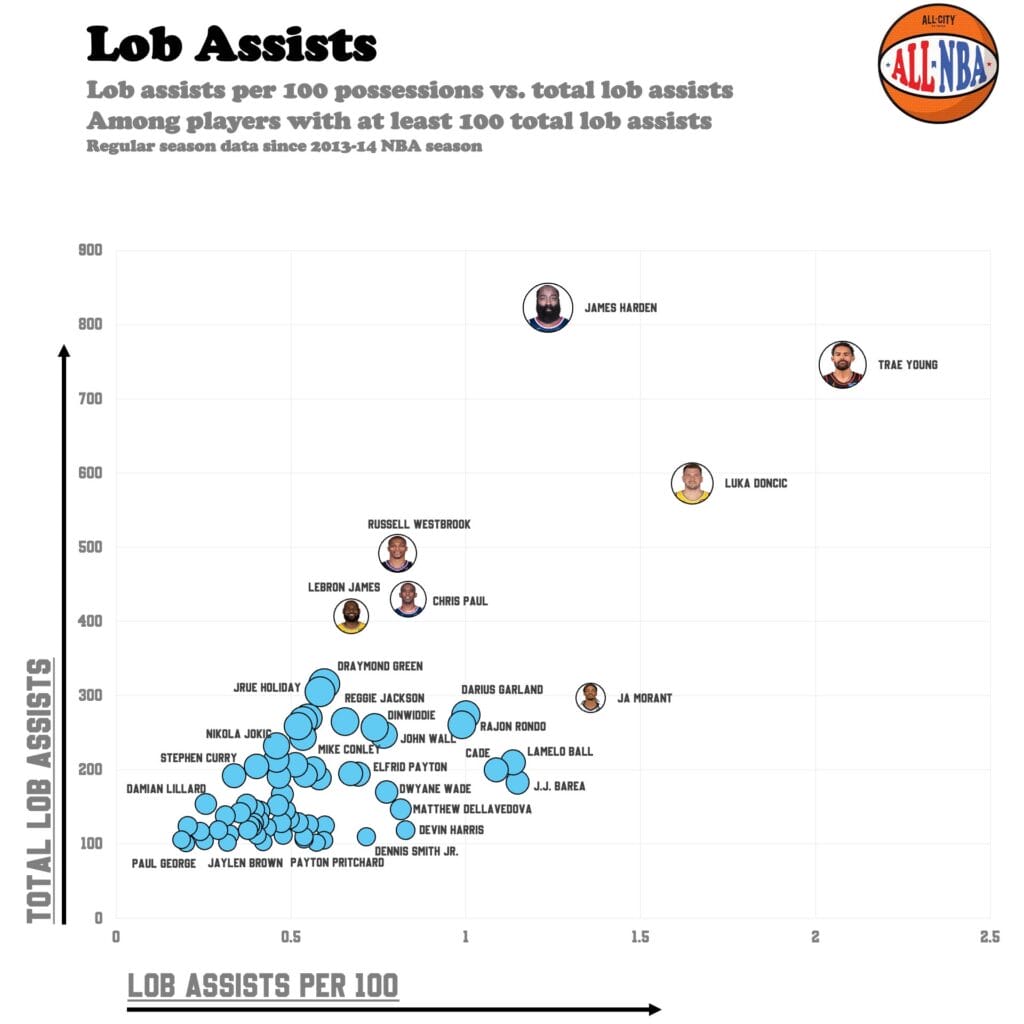
It comes down to quick processing ability, Eubank believes, which some guards have better than others. “The guys that can’t are more so the guys who don’t see it right away,” he says. “Then there are guards — I don’t know how they do it ‘cus I’m not a guard — but they can just see the spacing and see the angles and know when to throw it.” He brings up James Harden as an example, which makes sense. Harden has thrown the most lobs (1,104) in the league since the 2013-14 season, followed by Trae Young (982), Luka Dončić (783), and Russell Westbrook (649).
Even then, the 6-foot-3 Monk believes throwing lobs to big men is a slightly different skill than throwing them to players more his size. “(Westbrook) can’t throw them to guards,” he says, needling the future Hall of Famer who’s now his teamamte. “He just (threw them) to a lot of bigs.” Monk would know. He’s one of the players who both with some regularity, throwing 159 and catching another 74 thus far in his nine-year career.
Monk isn’t the average lob recipient, of course, and most big men feel they have the slightly easier task for this equation. They also have different perspectives than the guards about how this play works. For them, the timing of the pick-and-roll lob isn’t about where they are on the court, but rather where there defender is.
“I like the ball to be thrown when I get behind the (center) guarding me,” Dallas’ Marvin Bagley III says. “I’ve set the screen, I get a good hit, and I’m rolling out. I try to get behind. Once I do that, throw it up.”
That screen matters. Big men know that’s where any alley oop really starts on this play. “It’s about getting the guard downhill,” Gafford says. “As long as we do our job, we get rewarded in the end.” Bagley loves when he sees his defender backpedaling, knowing they won’t turn without losing sight of the ball but can’t elevate to meet it from that footwork. “Above whoever’s guarding me,” Gafford agrees. “I don’t think there’s a significant place you can throw it.” If he has clean space to time his steps, there’s no pass Gafford won’t chase.
Eubanks isn’t the leaper those two are. “I need a runway to go on, too,” he says. He remembers one recent pass he had to stop and wait for, which prevented him from attempting to finish it in the same moment. “Those are the hardest ones, at least for me, because your momentum stops,” Eubanks says. “You gotta go vert(ical) and catch it.” In some instances, those kind of plays can turn into lob layups, which has the same two-point currency but far less of the flair. Other times, that’s an option chosen from necessity.
“The only time I turn one into a layup,” Gafford says, “is when I’m tired.”
Dunks hurt, and lobs sometimes make players more prone to the fleshy slams into the metal rim because they have less awareness while tracking the ball. Bagley always tries getting two hands on the rim. “I get a good grab on it,” he says, “and it relieves that pain.” But it’s basketball’s coolest play, after all. Even when it hurts, “Sometimes, you just don’t care,” Gafford says. “Sometimes, those are statement dunks.” For the dunkers, it’s the best play there is.
Harris, speaking in his role as a thrower, never tried to steal their thunder despite the inherent duality needed for this play. “I got more joy from how the dunkers celebrate,” Harris says. “It’s just my job to get it to them.” But that job still involves all this skill they hone and master throughout their careers. This reciprocal relationship does require that faith: Both players knowing the intricacies they’ve learned about their role and trusting the other has done the same. That’s what required to make this feat happen up in midair.
Well, almost.
After explaining the secrets he uses to throw lobs, Monk is asked whether those same lessons apply when he’s the being thrown to. “One thousand percent,” Monk first says. Then, quickly, he reconsiders.
“Actually, no,” he decides. “I don’t care. Just throw that motherfucker.”