

There has been a lot of talk recently about how profitability and sustainability regulations have improved the finances of football clubs, so I thought it was worth exploring whether this was actually the case in England.
Given that potential investors will be looking at clubs at all levels of the English pyramid, today’s analysis will look at the average results for clubs in the top four divisions, ranging from the mighty Premier League down to EFL League Two.
As there are significant differences within the top two divisions, I have further split these into two more groups: the Big Six and the other clubs in the Premier League; and the parachute payment clubs and the rest in the EFL Championship.
The review will see how finances have developed in the five years since 2018/19, i.e. the last full season before COVID, taking us up to 2023/24, which is the most recent season when the accounts have been published by all clubs.
Not all of the clubs in League One and League Two produce detailed accounts, so the information in those divisions comes with a health warning, though the trends should still be reasonably clear.
For each financial metric, we will show the following:
-
Graph comparing 2018/19 and 2023/24 for the four divisions (plus the further split in the top two leagues).
-
Table listing the values for each of the six seasons between 2018/19 and 2023/24, highlighting the growth across this period, both in absolute and percentage terms.
-
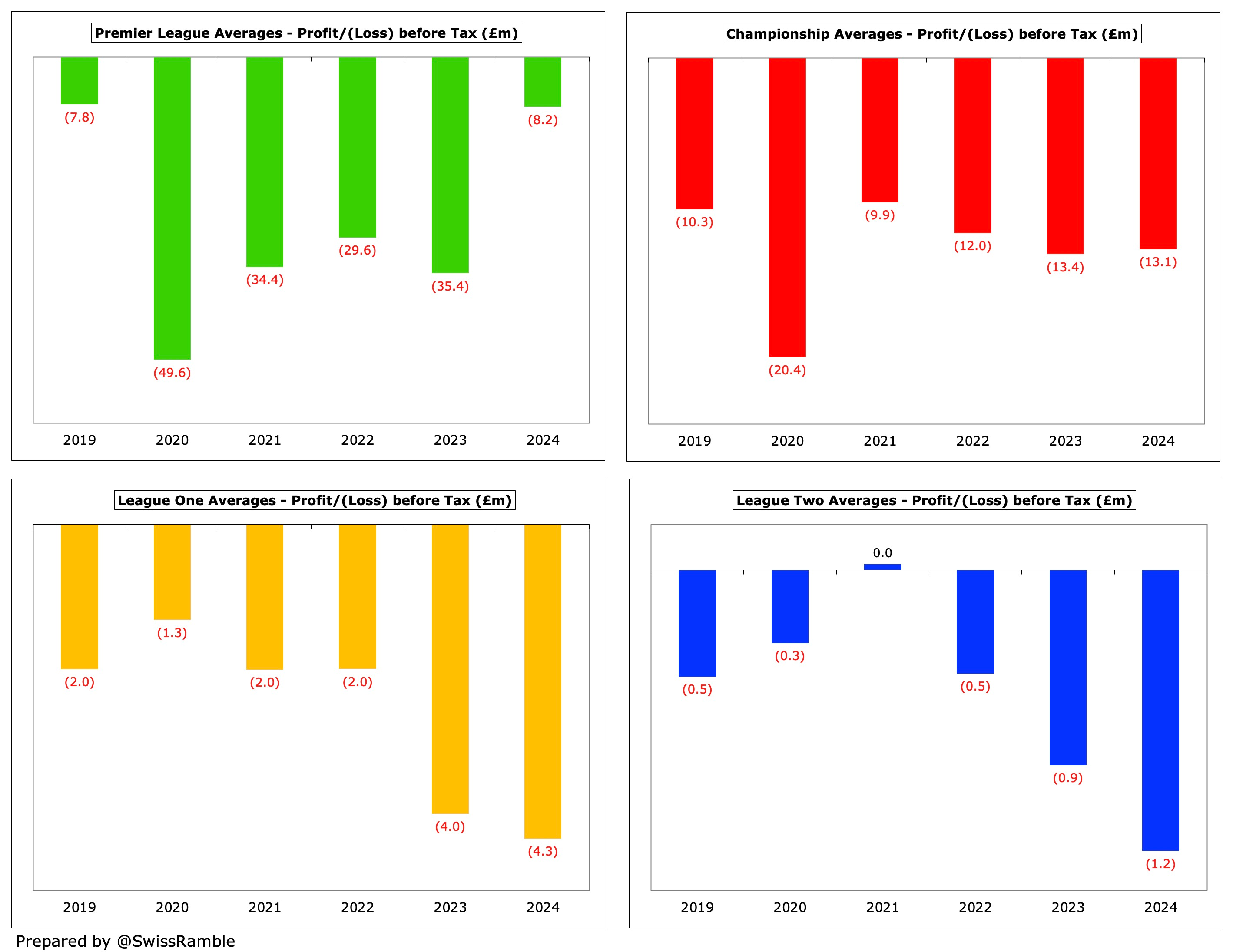
Graph showing this trend, split between each division, giving a more visible scale, as the values are significantly lower outside the Premier League.
We will start with the profitability measures, followed by metrics for revenue, expenses and finally the balance sheet, before ending with an overview for each of the four divisions.
In the five years since 2018/19 the loss before tax in the Premier League has hardly changed, averaging £8m per club. However, this disguises a steep decline in the Big Six, which swung from a £5m profit to a £13m loss, while the loss at the other 14 clubs in the top flight narrowed from £13m to £10m.

The pre-tax loss is even higher in the Championship – and it’s getting worse, as this widened from £10m to £13m. The average is pretty much the same for clubs receiving parachute payments and the other clubs, but this has significantly worsened for those without parachutes.
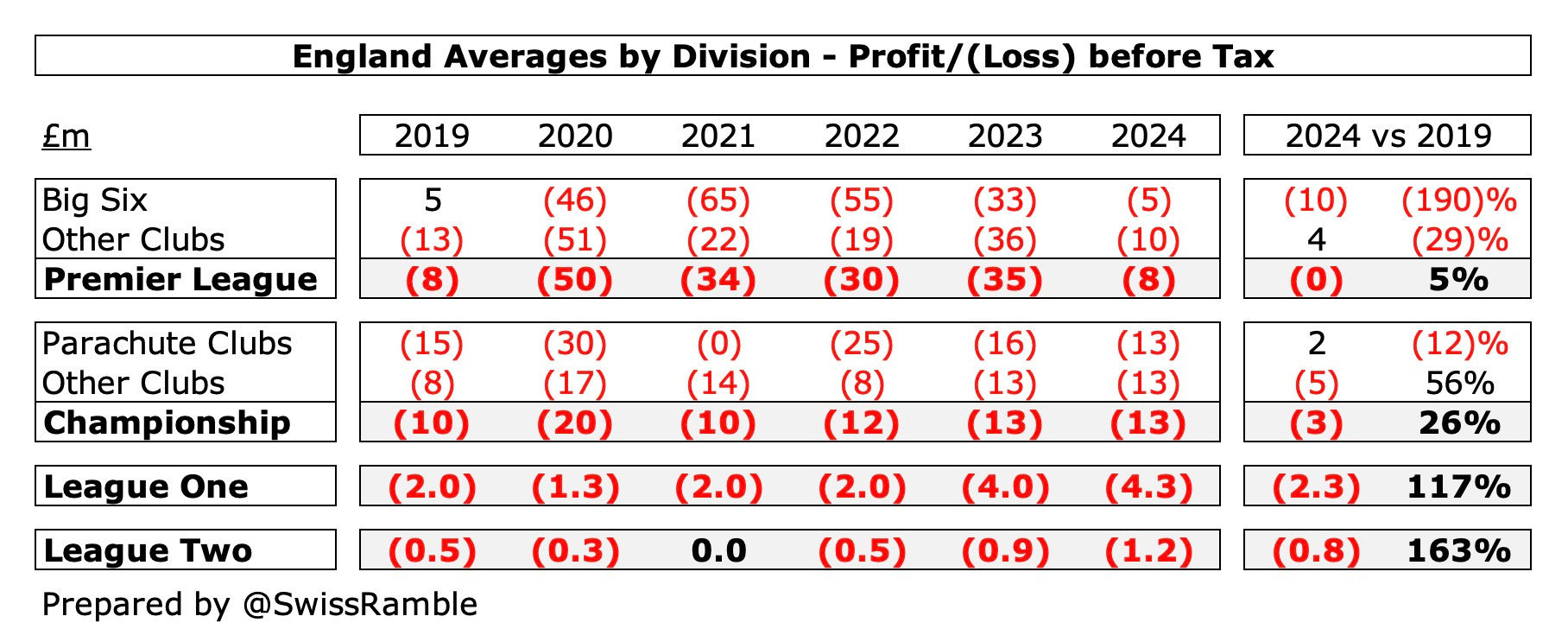
Although losses are much smaller in the lower leagues, it is striking how much they have increased in the last five years. In fact, they have more than doubled in both League One, up from £2.0m to £4.3m, and League Two, up from £0.5m to £1.2m.
It’s worth noting the significant impact of exceptional items on the top two leagues.