
‘Cultural cringe’, that lovely Aussie coinage, perfectly describes the Roman attitude towards Greece. The curators don’t say so, but it is the theme of this inspired exhibition.
By the time the Romans finally took control of mainland Greece in 146 BC with the Battle of Corinth, they had long admired everything Greek. That date marks roughly the middle of the Hellenistic period, during which Greek culture and language dominated the Mediterranean and the Middle East. In comparison with Greeks, Romans were oafs – and knew it.
In comparison with Greeks, Romans were oafs – and knew it
After the battle, Corinth was flattened – quite an oafish thing to do – and emptied of all its works of art, which were sent to Rome. The droll story went round that the commander, Lucius Mummius, was such a prize oaf that he told the carriers if any works of art were lost they would have to replace them with new ones. But the effect was dramatic: the trickle of Greek goodies reaching Rome had turned into a flood.
From then on, aspirational Romans defined themselves by how many Greek works of art they could acquire. They also imported Greek philosophers, teachers and doctors, and as many artists and architects – not so easy – as possible. A reverse traffic developed, as the Roman upper classes sent their sons to Greece to be properly educated: Julius Caesar went, and so did Brutus (‘Et tu, Brute?’). Athens was the Eton of the ancient world, Rhodes more a kind of Winchester.
The paradox of the conqueror conquered was recognised by Horace in the 1st century BC: ‘Graecia capta ferum victorem cepit et artes intulit agresti Latio’ (‘Conquered Greece charmed her coarse conqueror and carried the arts to rustic Rome’).
It is a recurring phenomenon in human history, and was later exemplified in the relationship between England and France, as that great classicist Alexander Pope realised in his ‘Imitation of Horace’ of 1737, in reference to the Duke of Marlborough’s victories:
We conquer’d France, but felt our captive’s charms;
Her arts victorious triumph’d o’er our arms.
Just as educated Romans proved their sophistication by speaking Greek, so posh English people in the 18th century spoke French. Both were adopting the language of what they perceived as a more civilised society.
Athens was the Eton of the ancient world, Rhodes more a kind of Winchester
That grim old republican, Cato the Censor, spent his long life moaning about the decline of Roman virtue under the corrupting influence of the Greeks (and he didn’t trust their doctors). But by the time he died in 149 BC such doubts were being voiced by only a handful of other grumpy old men in the public baths. It is a measure of the cultural dominance of Greek – and, to be fair, of Cato’s own genius – that his writings in Latin were critical in having, by a whisker, prevented that language being supplanted by Greek as the literary medium of Rome.
This elegant exhibition is very large (1,800 things to look at), and so it is fitting that one of the first works you see is a colossal gilt-bronze statue of Hercules, discovered in the Forum Boarium (the Roman cattle market) and dating from the end of the 1st century BC. Nearby are two bronzes of the 5th century BC, a life-size horse and the hindquarters of a giant bull, both found in Trastevere. They are followed by an astonishing array of marble sculptures, most of them Greek originals. This alone makes the exhibition special, since Roman collectors quickly discovered that there were not enough originals to go round, so that home-made copies of Greek masterpieces were churned out to meet demand. Telling the difference between the two has bedevilled the appreciation of Greek art ever since.
Among so many treasures I would single out ‘Two girls playing ephedrismos’ (piggy-back), carved in the 2nd or 3rd century BC and found in Piazza Dante. It displays the most complex carving of the figures, executed with consummate skill. Then there are three early statues of fine quality (5th century BC) from the famous group showing the destruction of Niobe and her children (see below).
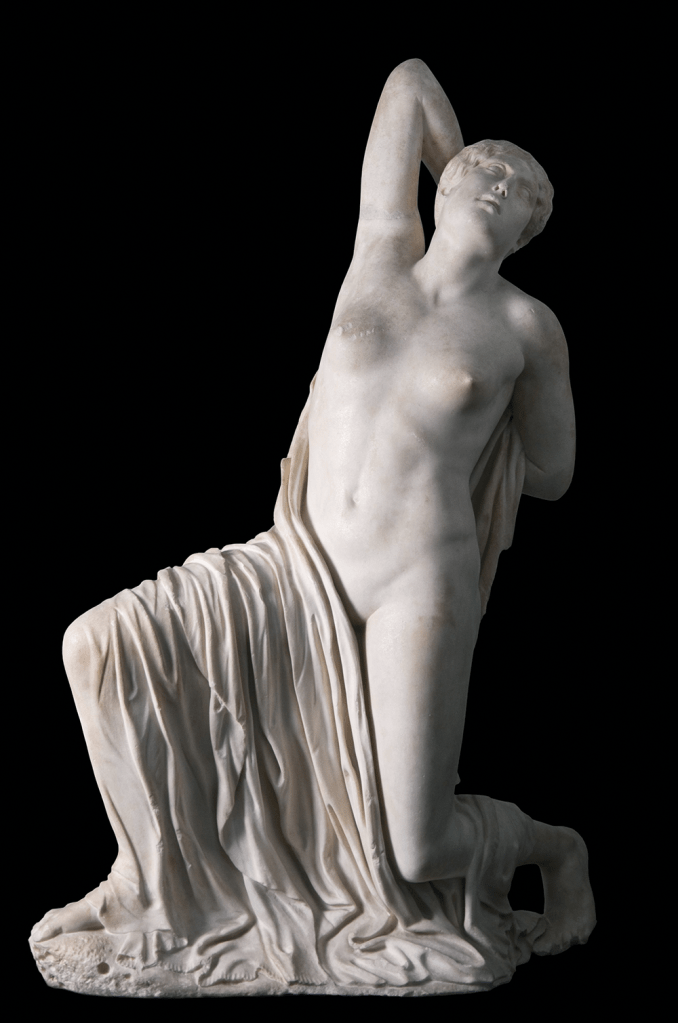 ‘Statue of wounded Niobid’ c.430 BC. MUSEO NAZIONALE ROMANO, PALAZZO MASSIMO
In the 18th century there was a complete set of these figures at Villa Medici in Rome, which formed the basis of Johann Winckelmann’s glorification of all things Greek in his influential writings. When he first published his ideas in 1755, Winckelmann hadn’t actually seen them, which suggests that he was not easily embarrassed. Nonetheless, it was perhaps a mercy that he was murdered before his great friend, the painter Anton Mengs, worked out that these hitherto iconic statues were only Roman copies.
Augustus boasted: ‘I found Rome brick and left it marble.’ Once upon a time, in a land not that far away, marble had adorned Greek democracy. It became the face of empire.