
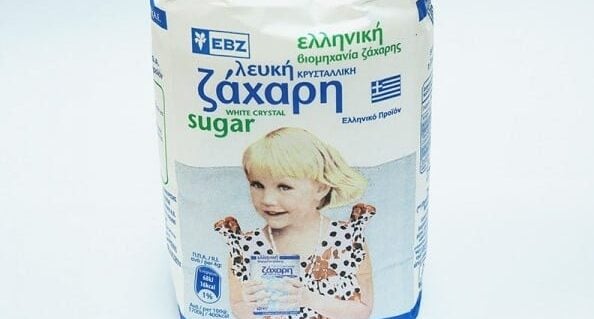
Greece’s sugar industry had long been one of the country’s most significant sectors in agriculture and food processing since the late 20th century. However, it has experienced a sharp decline over the past three decades.
Sugar production from beets once formed a substantial part of the country’s primary production. The Greek Sugar Industry (Greek: Ελληνική Βιομηχανία Ζάχαρης, ΕΒΖ) operated multiple industrial units across Greece, supporting both domestic consumption and export markets. In recent decades, however, sugar production has fallen significantly. As a result, Greece has shifted from being an exporter of sugar to relying on imports to satisfy domestic demand.
History of sugar production in Greece
Sugar production in Greece has a history spanning over a century, beginning with the establishment of the Christakis Zografos factory in Thessaly (1894–1909). This factory produced approximately eight thousand tons of sugar but eventually shut down due to intense competition and challenges in combating beet diseases.
The most significant period for Greece’s modern sugar industry began in 1960 with the founding of the Greek Sugar Industry (ΕΒΖ) in Thessaloniki under Prime Minister Konstantinos Karamanlis. EBZ gradually established five major production units: in Larissa (1961), Platy, Imathia (1962), Serres (1963), Xanthi (1972), and Orestiada (1975). These facilities, with substantial sugar beet processing capacities, supported rural communities across Thessaly and Northern Greece.
In the following decades, the Greek Sugar Industry became a cornerstone of sugar production, employing hundreds of workers while providing consistent demand for beet growers. The industry significantly contributed to the income of approximately twenty thousand farmers who cultivated sugar beets in Thrace, Macedonia, and Thessaly, making sugar production a vital component of Greece’s agricultural economy.
Τhe Common Market Organization Reform
The crisis for the Greek sugar industry began with the significant reform of the Common Market Organization (CMO) for sugar by the European Union in the 2000s. The CMO serves as the EU’s legal framework for managing agricultural and fisheries markets and is a central component of the Common Agricultural Policy (CAP). It regulates production, trade, marketing standards, and pricing to ensure stable farmer incomes, secure food supplies, and overall market stability.
In 2005, the EU implemented profound changes to the system of subsidies and intervention prices, reducing the price of sugar by 39 percent and sugar beet by 42.6 percent. These reductions were only partially offset through the Single Payment Scheme. The EU Sugar Reform merged various quota types into a single quota and replaced intervention prices with private storage mechanisms, aiming to make the sector more sustainable and reduce production. At the time, the head of EBZ warned that the reform would have “devastating” consequences for producers and farmers, as production costs would remain about the same while selling prices dropped sharply.
These reforms prompted a targeted redistribution of production quotas among EU member states and gradually dismantled market protection mechanisms. As a result, Greece—like other countries—was forced to reduce domestic sugar production and close industrial units to remain competitive in the new, liberalized European market.

Factors contributing to the decline of the sugar industry in Greece
According to a report by Capital.gr, EBZ was a subsidiary of the Agricultural Bank of Greece (ATE). Nikos Kezos, who began working with ATE in 1984 and oversaw its subsidiary companies, served as head of the department from 1994 until the end of 2010. Kezos attributed the decline of the Greek sugar industry to several interrelated factors.
First, only a small number of farmers cultivated sugar beets, and high summer temperatures and droughts increased the need for extensive irrigation. The use of pesticides was also necessary, and climate change further contributed to lower yields. Consequently, beet cultivation costs were high, while the sugar content of the beets remained relatively low.
Second, the state-owned EBZ, with ATE as its main shareholder, suffered from overstaffing, high salaries, and an excessive number of seasonal employees who were employed for six to eight months, even though two to three months of work were sufficient. The composition of its board of directors also changed frequently depending on the serving Agriculture Minister. Between June 2013 and July 2018, for example, the board changed 13 times, while 10 different ministers were involved in efforts to rescue EBZ during recent years.
Third, the state’s obligation to keep EBZ operating, even at a loss, led all five factories to produce a combined 317,500 tons of sugar, whereas in countries like Austria and Denmark, only three factories were operating to produce 500,000 tons.
Finally, the high cost of production increased the selling price of sugar beets, which at times amounted to €53 per ton, further undermining competitiveness and contributing to the industry’s decline in Greece.
Additional factors in Greece’s sugar industry decline
According to various reports, the Common Market Organization for sugar and the full implementation of its reforms led to the abolition of protective mechanisms, exposing Greek production to global competition. According to Kathimerini newspaper, the reduction of intervention prices and the easing of import restrictions caused Greek companies to lose their comparative advantage.
Another significant factor was the full activation of the EU’s “Everything But Arms” agreement, which allowed less developed countries to import sugar duty-free into the EU. This intensified competition in the Greek market and drove down domestic product sales prices, according to the Athens Stock Exchange (ATHEXGROUP).
Production and cultivation statistics
Official data reveals a dramatic contraction in sugar beet production and cultivated land in Greece over recent decades. In 2022, sugar beet production fell sharply, declining by 81.6 percent compared to the previous year to just five thousand tons. The cultivated area decreased by nearly 97.9 percent. Although average production per hectare slightly increased due to the limited area under cultivation, it remained far below historical levels.
The value of the Greek sugar beet market also dropped significantly, falling to approximately €32 million in 2022 (equivalent to $37.6 million now)—a decline of over 80 percent compared to the previous year. This sharp decrease reflects both reduced production and the low competitiveness of domestic output.
Historically, the Greek sugar industry produced hundreds of thousands of tons of sugar beets per season, but production collapsed in the early 2020s, leaving domestic production almost negligible. A 2025 parliamentary question further highlighted this decline, noting that sugar production fell from 157,383 tons in 2009 to only 38,265 tons in 2011, a reduction of roughly 75 percent in only two years, according to kavalanews.gr.
Gradual closing of factories
A key moment in the decline of sugar beet production in Greece came in 2014, when EBZ announced the closure of two production units in Orestiada and Serres, resulting in the loss of 106 permanent jobs and 506 seasonal positions, according to Eurofound. The decision was driven by the factories’ lack of viability resulting from low production levels and high operating costs.
At the same time, reports indicated that some facilities, such as the factory in Platy, were functioning essentially as packing plants rather than producing sugar from domestic beets. These plants relied on imported raw material, highlighting the practical cessation of domestic sugar production, Efsyn.gr noted.
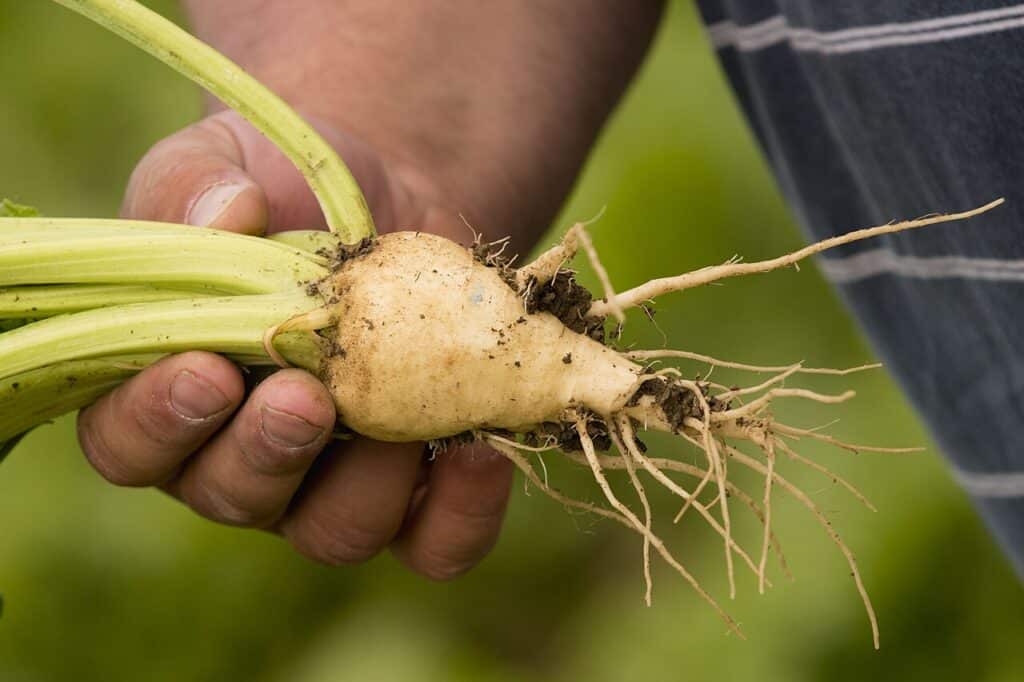
Production and sugar imports in Greece (2024–2025)
Greece imported significant quantities of sugar to meet domestic demand, reflecting the minimal domestic production in recent years. Estimates published by greekfarmer.com indicate that, in the 2024–2025 period, sugar imports reached approximately 413,000 tons. The main suppliers were Ukraine (around 21 percent), the United Kingdom (18 percent), Mauritius (17 percent), and various Balkan countries, depending on market fluctuations and tariff regulations. These figures highlight the Greek market’s reliance on imported sugar, as domestic production remains especially limited.
Currently, domestic beet sugar production in Greece is practically non-existent. Cultivated land for sugar beets is minimal compared to historical levels, with only a very small number of acres dedicated to sugar production. Moreover, most beets grown are used for animal feed rather than sugar processing. In years like 2022 and 2023, sugar beet cultivation covered only a few hundred acres, resulting in essentially no meaningful domestic sugar production.
In terms of trade value, the category “Sugars and sugar confectionery,” including white granulated sugar and sugar products, accounted for approximately €387 million ($455.5 million) in Greek imports in 2023, significantly higher than exports, which totaled €77 million ($90.6 million). This imbalance underscores Greece’s dependence on foreign markets for essential sugar raw materials, according to trendeconomy.com. Overall, sugar imports represented roughly 0.44 percent of Greece’s total imports by value in 2023, indicating that while sugar is a relatively small component of trade, it remains a stable and necessary product.
The impact of Greece’s sugar industry decline
The decline of sugar production in Greece has had profound effects not only on economic figures but also on local communities. Areas that were once centered on sugar beet cultivation and processing have experienced job losses, abandonment of agricultural land, and degradation of the countryside. Local economic cycles and community structures that depended heavily on sugar-related activity have suffered a significant blow.
At the same time, the shift toward imported sugar, despite strong domestic demand, has increased reliance on foreign markets. This dependence undermines agricultural self-sufficiency and introduces new risks to the supply chain, Efsyn.gr reported.
Can there be a revival of the Greek sugar industry?
The Greek sugar market, including sugar products and confections, reaches hundreds of millions of euros in imports, far exceeding exports and highlighting a significant trade imbalance in the sector.
The decline of the Greek sugar industry illustrates how international policies, structural weaknesses, and a lack of strategic planning can lead to the collapse of an important production sector. Once a pillar of the country’s primary and manufacturing economy through EBZ, Greece now has minimal domestic production, under-operating or closed factories, and relies heavily on imported sugar to meet demand.
Although political efforts have been made to support the sector, a sustainable revival would require a comprehensive strategic plan. This should include investment in technology, support for farmers, structural reforms in management, and broad measures to enhance competitiveness in the market. Without such coordinated actions, Greece’s sugar industry risks remaining in decline, leaving behind a historic agricultural-industrial activity, Eurofound reported.