
Published March 21, 2026 07:16AM
It is no secret that cyclists are obsessed with numbers. Everything from power output and heart rate, to hydration, blood glucose levels, and sleep tracking.
There are a million different devices that track your physiological data, but few that are able to predict your VO2 Max, the gold standard assessment of aerobic capacity.
Some smartwatches can estimate your VO2 Max, but can cyclists really trust that number, especially if it is calculated using run data?
If only you could calculate your VO2 Max using power data, wouldn’t that be nice…
But before we continue: What is VO2 Max?
VO2 Max is the highest rate at which you can take in oxygen and utilize it for energy at a given time, measured in milliliters per kilogram per minute (mL/kg/min). In cycling terms, the higher your VO2 Max, the higher your physiological (power) output in a given time frame.
Having a high VO2 Max isn’t only great for cycling but also your overall health. A higher VO2 Max is a sign of better cardiorespiratory fitness and is associated with reduced risks of cancer, cardiovascular diseases, and all-cause mortality.
Right.
Back to the study.
The 5-minute power VO2 Max equation
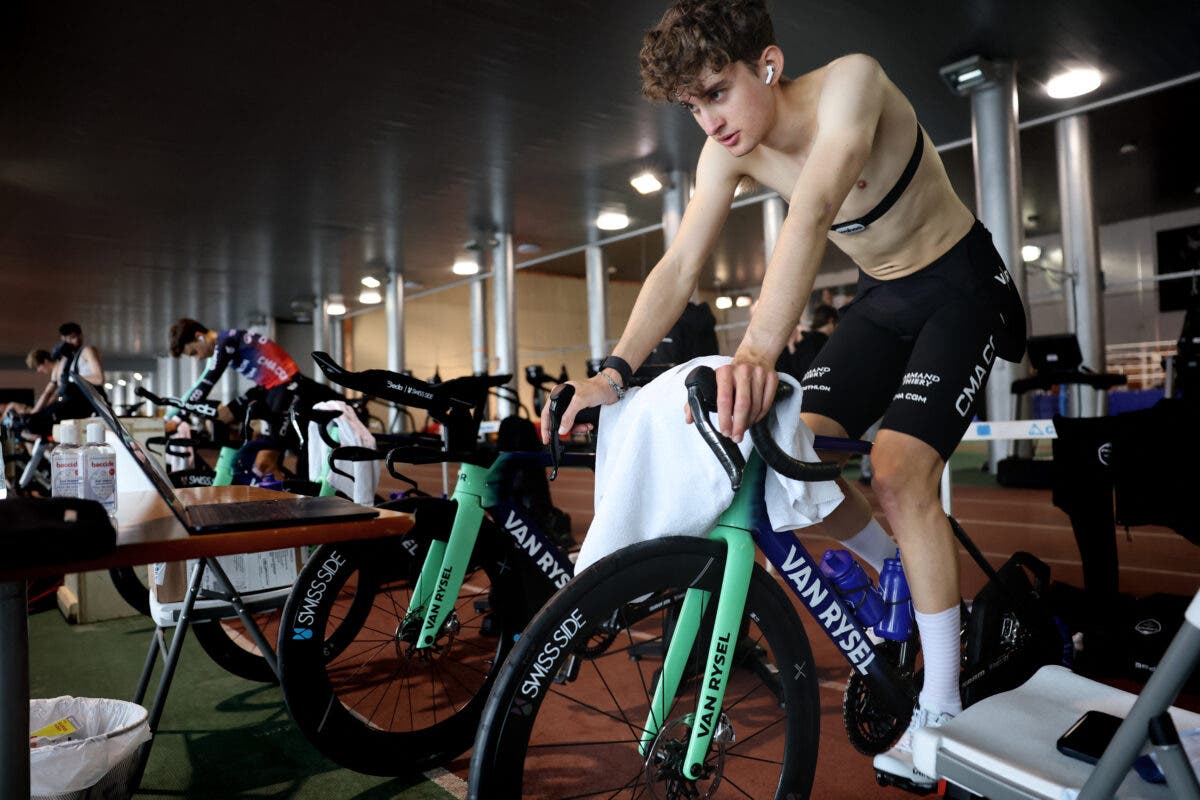
Introducing the VO2 Max equation from Sitko et al., from the International Journal of Sports Physiology and Performance.
This study was published in 2021, but for whatever reason, I only started hearing about it in 2023. Even then, I was only hearing mumblings from WorldTour coaches and physiologists. I hadn’t actually seen the equation in practice until I found this study.
The study is called, “Five-Minute Power-Based Test to Predict Maximal Oxygen Consumption in Road Cycling” and it was published by a group of Spanish scientists in July 2021. First, we’ll show you the equation, and then we’ll explain what it all means.
The 5-minute power VO2 Max equation:
VO2 Max = 16.6 + (8.87 × 5-minute relative power output)
“5-minute relative power output” is your 5-minute power output in watts per kilogram (w/kg), not your raw power output. To demonstrate, I’ll plug my own numbers into the equation.
Example VO2 Max = 16.6 + (8.87 x 6.8 w/kg) = 70.9 mL/ kg/min
What would Pogačar’s VO2 Max be using the equation?
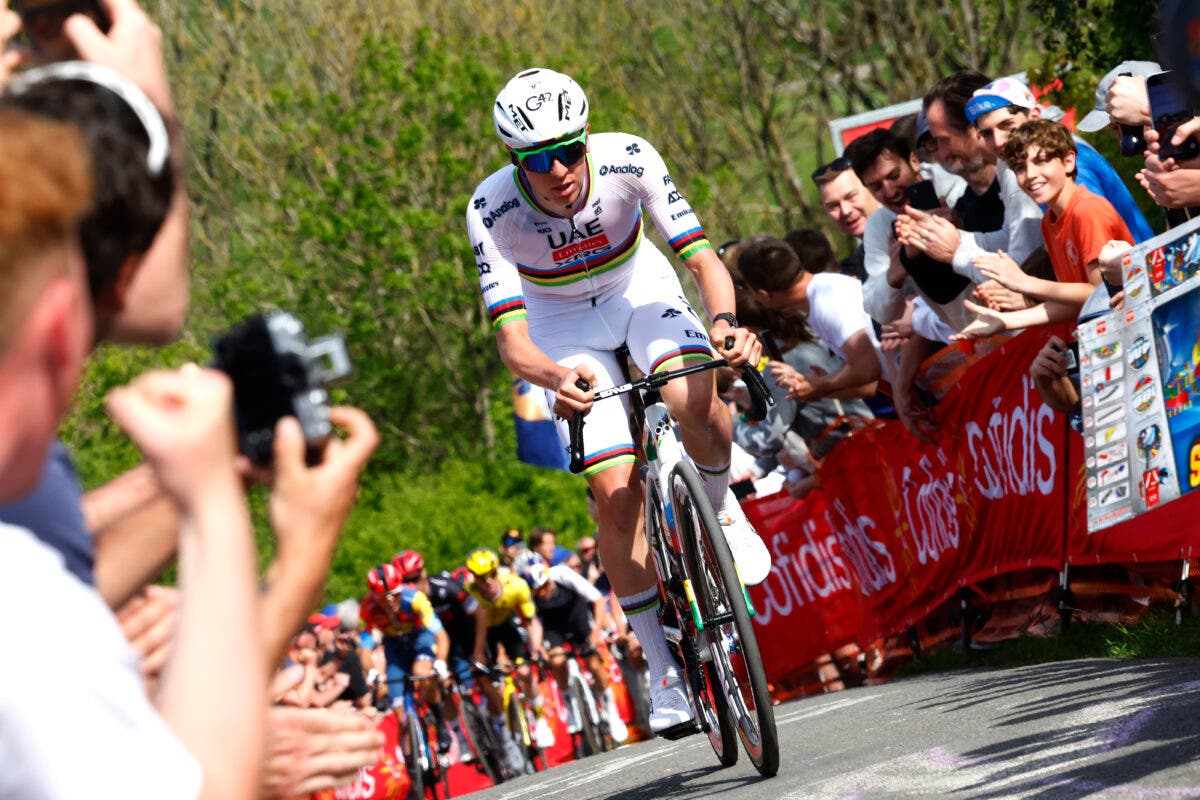
Before we dive into the data behind this equation, I’m sure you are wondering what Tadej Pogačar’s calculated VO2 Max is.
Of course, we’ll have to use some assumptions here, but we have a solid amount of data about Pogačar’s peak power outputs.
Of all the races we’ve covered, Pogačar’s effort on La Redoute in 2025 is the closest thing to a 5-minute power rest that we’ve ever seen him do. The world champion produced an estimated 550w (8.4w/kg) for 3:58 on La Redoute.
Of course, the numbers aren’t perfect for a 5min test, but we can make some educated guesses as to what Pogačar’s best 5-minute effort might be.
If we remove the fatigue of Liège-Bastogne-Liège – Pogačar had already been racing for more than five hours before his effort on La Redoute – we can assume that Pogačar can do more than 8.4w/kg for 4 minutes during a fresh power test.
Add on another minute to the effort, and we can estimate Pogačar can produce ~8.5w/kg for 5 minutes.
So what is his calculated VO2 Max?
Pogačar’s VO2 Max = 16.6 + (8.87 x 8.5 w/kg) = 92 mL/ kg/min
A VO2 Max value of 92 mL/ kg/min is absolutely absurd, but that is exactly what we would expect from the greatest cyclist of all-time: Pogačar. For reference, Greg LeMond’s VO2 Max in his racing days was a reported 92.5 mL/ kg/min.
Few athletes have ever recorded a VO2 Max higher than 90 mL/ kg/min, and many of them have come from sports outside of cycling.
VO2 Max calculations higher than 90 mL/ kg/min are always questioned. How accurate was the machine? Was the test done in abnormal conditions? Has this athlete been able to repeat this testing effort?
I don’t think there is any doubt that Pogačar’s VO2 Max is nearing triple digits.
How the equation works
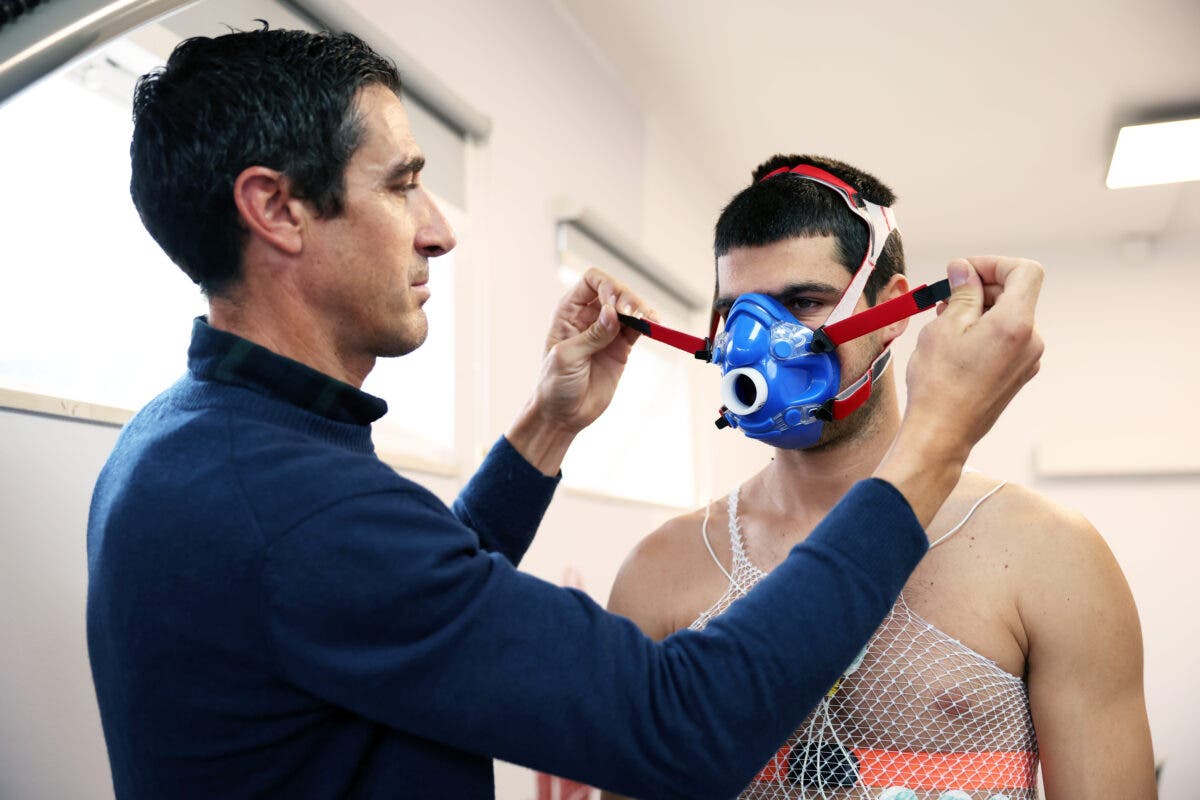
For decades, VO2 Max has been a lab-only study.
Instead of estimating your VO2 Max through physical or physiological data, you had to go into a lab, put on a face-covering mask, and run or ride to exhaustion. But things have changed, and now, if you’re reading this and you have a power meter, you can calculate your VO2 Max at home.
In fact, you can do it right now.
Just plug in your 5-minute peak power output into the equation.
Your VO2max = 16.6 + (8.87 x ___ w/kg) = ___ mL/ kg/min
You may be wondering how the publishers of this study pulled it off.
How did they turn VO2 Max estimation into a mathematical equation?
The answer lies in the details of the study. Without getting too deep into the math and science of it all, the authors of the study produced regression coefficients for their VO2 Max prediction model. They are extremely confident in the validity of the numbers, stating, “The VO2max obtained during the 5MT was statistically comparable with that attained in the GXT [VO2 Max graded exercise test], t(45) = −.73; P = .47, with an almost perfect linear correlation (adjusted R2 = .988, P < .0001).”
If you’d like to learn exactly how that works, you can find the full details of the study online.
Crucially, this study included 46 participants with varying fitness levels, all the way from recreational cyclists to WorldTour cyclists. In fact, nearly a quarter (11 of 46) of the participants were WorldTour riders, giving us a rare glimpse into data from cycling’s elite.
The biggest takeaway here is that VO2 Max is more accessible than ever.
If you want to calculate it, you don’t need to go into a lab for a maximal test. Instead, you can use the numbers you likely already have. When you’re ready to retest your VO2 Max, all you need to produce is a maximal 5 min effort (which is easier said than done), and then plug your numbers into the equation.
Let’s finish on a fun one.
Have you ever wondered how many watts it would take to follow one of Pogačar’s attacks? To give you an idea of how fast Pogačar is riding, take your weight in kilograms, and multiply it by 8.5.
That is what it would take for you to follow Pogačar for five minutes.