
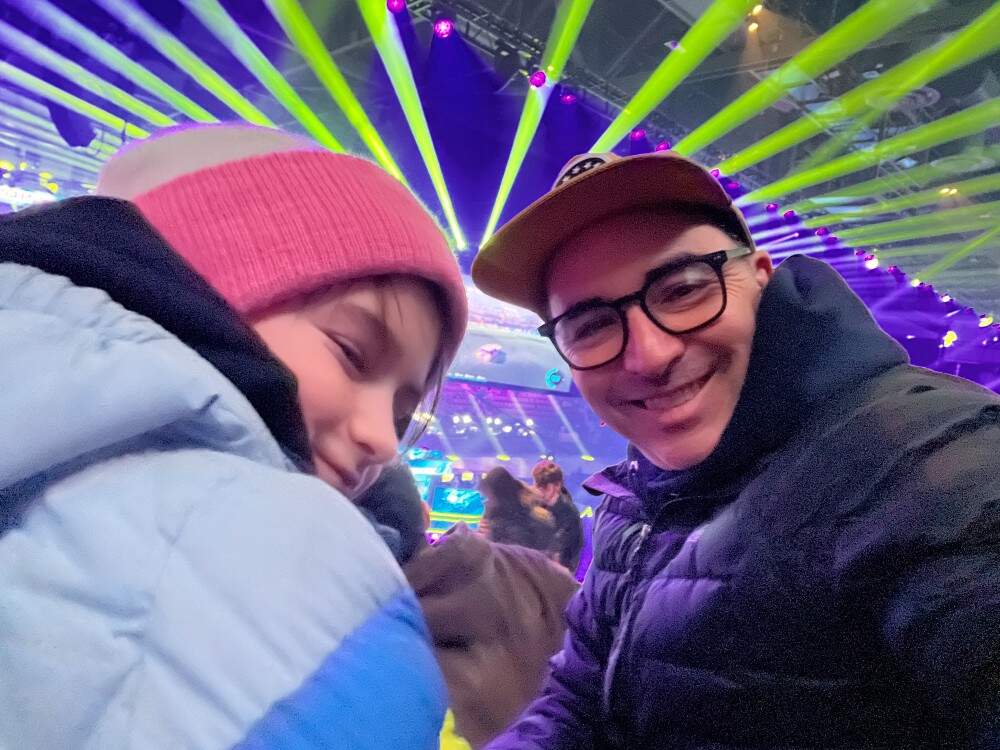
The Agganis Arena at Boston University reeked of body odor and buffalo sauce — it hit me in the face as my 10-year-old son Wes and I found our seats on day one of the two-day Rocket League Championship Series. For the uninitiated, this was a video game tournament — a first for both of us.
Readers of a certain age (mine) might remember the climactic scene of the 1989 Fred Savage movie “The Wizard” when little Jimmy Woods beats bad boy gamer Lucas in the debut appearance of Super Mario Bros. 3. If that absurdly specific reference isn’t doing it for you, you’re out of luck because I can’t think of any other movies that prominently feature video game competitions, likely because, when it comes down to it, a video game competition is just a room full of gamers watching other gamers on a stage playing video games competitively. For a weekend in February, on the eve of the Blizzard of ’26, Wes and I found ourselves among them.
Unlike a lot of contemporary video games, Rocket League is actually pretty easy to explain: it’s 3 vs. 3 indoor soccer with cars. You control a car and try to carry, pass and shoot a giant soccer ball into cavernous goals. Wes loves the game, and he’s good at it too; since my wife and I bought our kids a Nintendo Switch in 2021 and Wes’ teenage cousin introduced him to Rocket League shortly thereafter, I’ve never once even come close to beating him.
I used to be good at video games, I tell Wes by way of apology or excuse. When I was his age, I was a gamer too. I’m a child of the 1980s; I remember my dad’s Atari 2600, it’s faux wood paneling and sticky joystick, playing games like Pac-Man and Pitfall. In the late-80s I got the original Nintendo Entertainment System, and I learned to maneuver Mario through his side scrolling world. I traded up the Nintendo for a Sega Genesis and then the Genesis for the first iteration of the Playstation, which I brought with me to college.
Then, after college in the early aughts, I just kind of stopped playing. I went to grad school, got married and hardly ever thought of my past life as a gamer. Video games, for me, became linked to childhood, kind of like riding bikes — I know adults do it, but I just haven’t since I was a kid.
In the past couple of decades, however, gaming has grown up and gone mainstream. Video games have become more sophisticated with life-like graphics, complex stories and multiplayer modes over the internet. This led to the rise of electronic sports, or esports. People of all ages play, or watch others play, on streaming platforms like Twitch, which has hundreds of millions of monthly users and broadcasts esports events like the Rocket League Championship Series.
But if you know anything about gaming culture in the past couple of decades, it is likely that you know that it has also been mired in misogyny and sexism, culminating in the 2014-2015 online harassment campaign that targeted women in the video game industry, known as Gamergate. For this reason, and the attendant stereotypes of antisocial young men holing up in darkened basements playing games to avoid contact with the outside world, I’ve tried to hold gaming culture at arm’s length from my young son.
This has proven especially challenging because even though he doesn’t have a phone or access to any social media apps, Wes is still aware that there’s a whole world of connected gamers and streamers playing and discussing his favorite game. So, attending RLCS felt like a good — and controlled — way to see what it is all about.
I’m happy to report, having spent over 12 hours across two days inside the darkened arena watching round after round of Rocket League, I don’t think the old stereotypes still apply. True, the audience was mostly college-aged men, and the place did stink like a cross between a high school locker room and a Buffalo Wild Wings. But beyond the superficial, these young men (and substantially fewer, but still some, women) were not at all antisocial. In fact, they were there to be social!
As my kids grow up, a constant refrain in our house is that interesting people are interested in things.
Here were thousands of video game enthusiasts gathered to watch the best players play the game that they all love. They were excited and engaged, invested in their favorite players and teams, but respectful and polite throughout. They’d flown in from all over the world to see the competition, and they were not disappointed. When the crew of guys sitting behind us learned that they were stuck in Boston because their flight was cancelled due to the blizzard, they took it in stride. They’d just hang out in the hotel room and play video games, they said.
Even when the home team — NRG from North America — was eliminated, fans just moved on and cheered for other teams. Then, when the team that was less favored in the final match — The Gentle Mates — started winning thanks in part to a record-breaking performance from one of their players, the whole auditorium got behind them. It was like any sports fandom, but instead of cheering for the home team, they were cheering for the game itself.
As my kids grow up, a constant refrain in our house is that interesting people are interested in things. I’ve worked to pass on my passions — cultural touchpoints like Star Wars and Paul Simon as well as more serious life skills like a love for reading and a strong sense of morality based on empathy. And as they get older, Wes and his sister Nelly have shared their passions with my wife and me — first, Pokémon, then anime and manga, and, now, Rocket League. Over that weekend at the Agganis Arena, as I rose out of my seat beside my son to cheer an amazing save or an improbable goal, I felt, for the briefest moment, the young gamer I once was come surging back.
So, who’s up for a game of Pac-Man?