
Financial fraud is now one of the world’s most severe and rapidly evolving transnational crimes, with significant economic and human consequences.
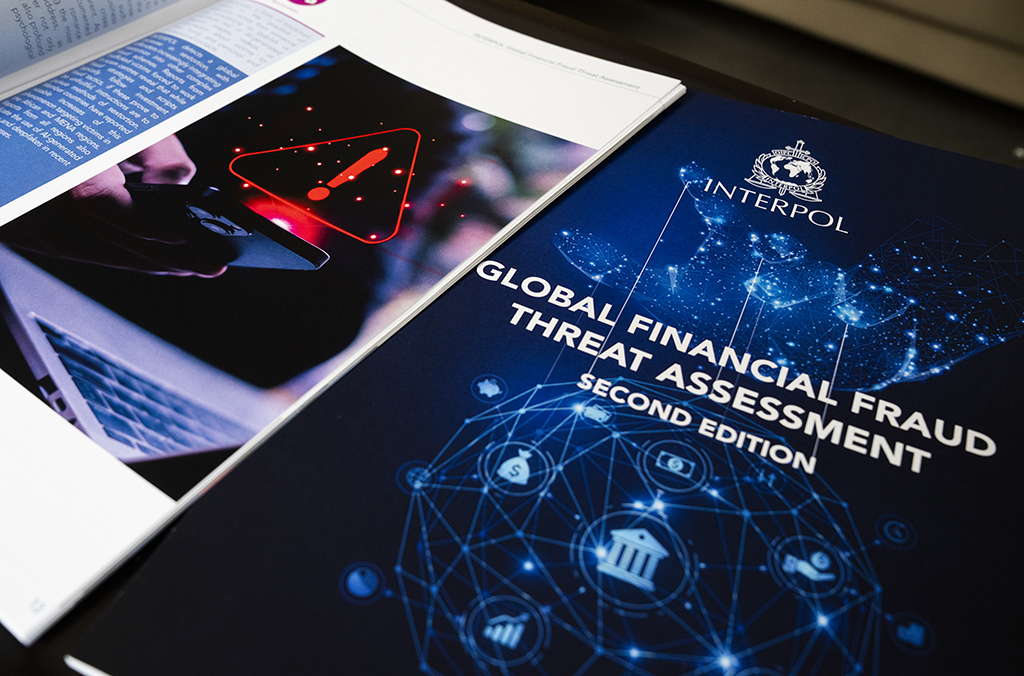
The 2026 INTERPOL Global Financial Fraud Threat Assessment warns that with increased global criminal collaboration, fraud is no longer a peripheral threat, it is at the centre of polycriminality, intersecting with organized crime, human trafficking and cybercrime.
Key findings include:
- AI-enhanced fraud is 4.5 times more profitable than traditional methods. “Agentic AI” systems can autonomously plan and execute complete fraud campaigns – from reconnaissance to ransom demands.
- Sextortion is now being systematically integrated into scams such as romance and investment fraud often using scripts and AI-generated content.
- Criminal networks are increasingly collaborating with specialized money laundering groups and sharing expertise and technology to scale up their operations globally.
- In parts of Africa, terrorist groups have been found to use fraud schemes, especially crypto-based scams, as a source of funding.
- Once a regional phenomenon, scam centres have now been identified worldwide, involving hundreds of thousands of individuals, many of whom are trafficked and forced to carry out online fraud.
However, the report also found that law enforcement authorities are collaborating more effectively.
Since 2024, the number of fraud-related INTERPOL Notices and Diffusions has increased by 54 per cent. Over the same period, INTERPOL supported member countries in more than 1,500 transnational fraud cases in lost assets valued at USD 1.1 billion.
INTERPOL Secretary General Valdecy Urquiza said:
“Enabled by artificial intelligence, low-cost digital tools and increased global criminal collaboration, we are witnessing the industrialization of fraud.
“It is vital to remember that the cost of financial crime is not just money – it is people’s life savings, their dignity, and in the worst case, their life.
“Strengthening cooperation between law enforcement, the private sector and raising public awareness is key in tackling this global security threat.”
Untangling the financial webs around scam centres
As highlighted in the threat assessment, scam centres are growing in number and scale, targeting ever greater numbers of victims.
Although these operations are regularly shut down, the criminal leaders behind them remain hard to identify, using intermediaries and shell companies to hide their tracks and avoid detection.
To close this critical gap, INTERPOL is launching Operation Shadow Storm, a new international task force funded by the United Kingdom’s Home Office as part of a unified, data-driven response.
Using INTERPOL’s network and tools such as I-GRIP, a stop-payment mechanism, the task force will target not only the financial frauds generated by scam centres, but also the links to cybercrime and human trafficking for forced criminality.
In parallel, INTERPOL is issuing new Guidelines on the Establishment and Operation of a National Anti-Scam Centre to encourage effective models in support of national efforts to detect, disrupt and dismantle scams networks and their activities.
Summarizing successful approaches adopted by law enforcement agencies worldwide, the guidelines highlight key considerations and best practices to strengthen and better coordinate the global response.
Global Fraud Summit
Launched on the first day of the Global Fraud Summit (16 and 17 March) – jointly organized by INTERPOL and the United Nations Office on Drugs and Crime (UNODC) – together these three initiatives aim to underpin the collective public and private sector response.
The event brings together more than 1,300 participants including government officials, law enforcement agencies, private sector leaders, tech companies and civil society organizations to explore how to work together and disrupt the systems that allow fraud to flourish.