
Millions of people first met Tyrannosaurus rex in a dark movie theater, watching the predator stomp through the rain in “Jurassic Park.” Now a new scientific study says that blockbuster image rests on a basic mistake about how long the real animal took to grow.
Researchers have re-examined the microscopic growth rings inside T. rex bones and found that this dinosaur kept growing well into its late thirties instead of stopping around age twenty five as many earlier studies suggested.
That means the film’s giant tyrannosaur would have been noticeably smaller at the age implied on screen, adding one more scientific slip to the most famous dinosaur movie of all time.
A dinosaur that took nearly forty years to grow up
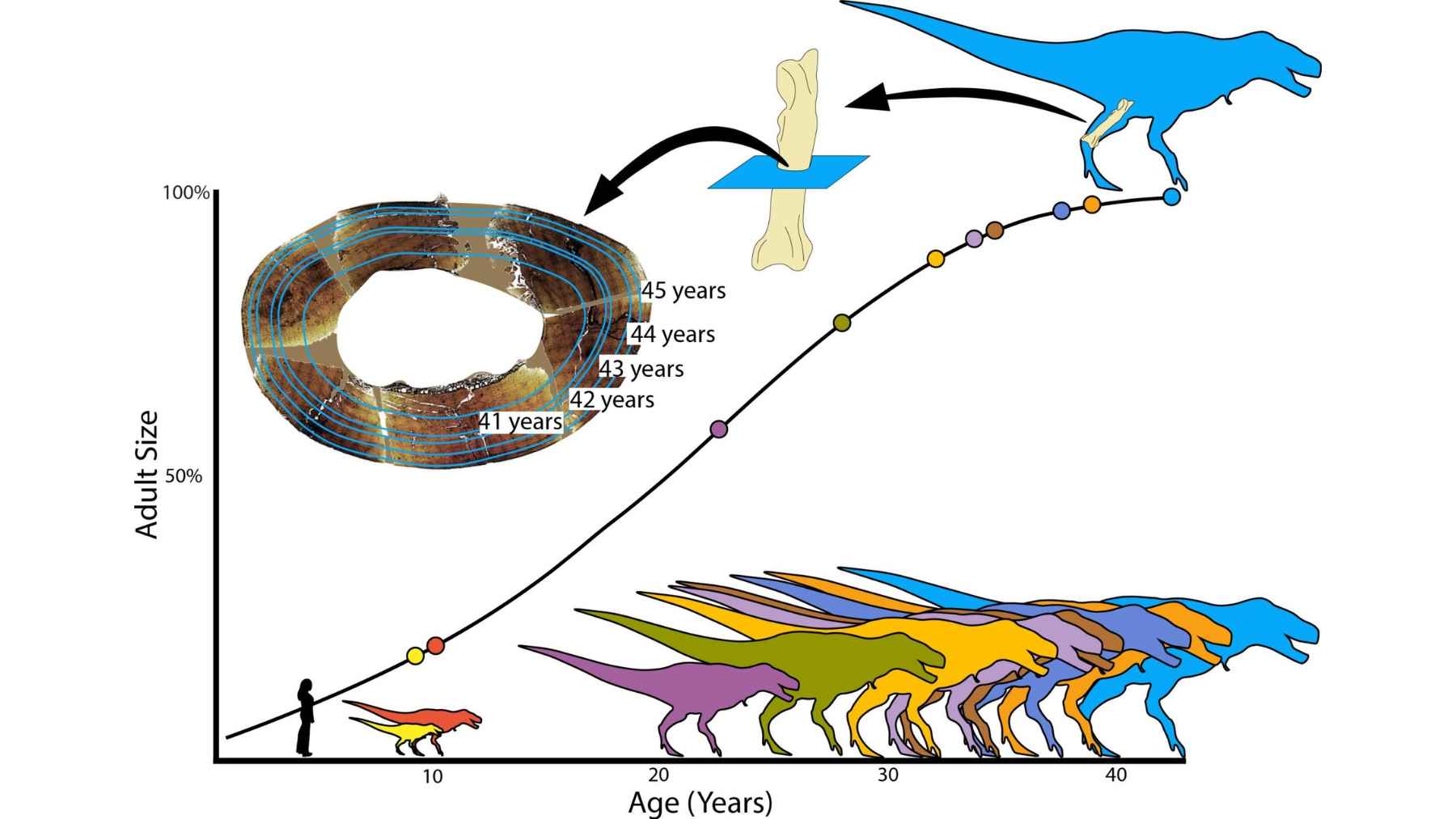
The new research is the largest analysis so far of Tyrannosaurus rex growth and uses thin sections from the leg bones of seventeen fossils that range from small individuals to massive adults. By counting and measuring the growth rings preserved in those bones, scientists reconstructed how the animals changed from year to year.
They found that T. rex needed close to forty years to reach its full size, far longer than the roughly twenty five years many paleontologists had accepted for decades. In practical terms that means a real tyrannosaur took a slow and steady route to becoming an eight-ton apex predator instead of racing through an oversized teenage growth spurt.
Growth rings work a little like the rings inside a tree trunk. Each band marks a year of life with wider gaps during growth spurts and tighter spacing in harder years when food was scarce. In T. rex bones only the last ten to twenty years of rings are visible so earlier work was always working from incomplete pages of the animal’s life story.
Reading dinosaur bones with polarized light
A key step in the new study was seeing more rings than anyone had clearly documented before. Lead author Holly Woodward Ballard of Oklahoma State University used polarized light under the microscope, a technique that makes very faint growth marks stand out inside fossil bone that can look almost blank in normal lighting.
If you have ever worn polarized sunglasses to cut the glare on a bright day you already know the basic idea. A filter blocks some directions of light and lets others through so tiny differences suddenly pop into view that were invisible before. Applied to a thin slice of dinosaur bone, that simple trick turns a dusty fossil into a detailed growth diary.
The statistical analysis, led by mathematician and paleobiologist Nathan Myhrvold, combined these partial records into what he calls a composite growth curve for T. rex.
As he put it, this curve gives “a much more realistic view of how Tyrannosaurus grew and how much they varied in size.” Together the methods reveal a long stretch of sub-adult life in which the animals kept growing but more slowly as they neared their forties.
Jurassic Park’s T. rex faces a new reality check
For many viewers the towering tyrannosaur in “Jurassic Park” still feels like the gold standard for what the animal looked like.
Paleontology has already pushed back on that picture with research that suggests raptors were smaller and feathered and that several movie dinosaurs move and sound in ways that are not supported by current evidence.
The new growth curve adds another issue for the film predator. If a real T. rex needed nearly four decades to hit maximum bulk then any individual still short of that age would stand shorter and weigh less than the movie monster towering over the park jeeps. In other words the on-screen “king of the dinosaurs” should probably look a bit more like a work in progress.
One of the co-authors, paleontologist Jack Horner of Chapman University, previously advised the Jurassic Park filmmakers on dinosaur behavior and anatomy. It is a neat twist that the new work he helped sign now undercuts yet another part of the franchise’s supposed realism and shows how fast dinosaur science has moved since the early 1990s.
A long adolescence and the Nanotyrannus puzzle
Beyond movie trivia the findings reshape how experts picture T. rex in its own ecosystems. A growth phase that can stretch across four decades likely let younger tyrannosaurs occupy different ecological roles from bulked up adults which may have helped the species dominate Late Cretaceous food webs for so long.
The study also revisits a long-running argument about small tyrannosaur fossils that some researchers assign to a separate genus named Nanotyrannus.
Two of the individuals in the new sample show growth patterns that diverge from the others which the authors say is compatible with the idea that they belonged to another species instead of being simply teenage T. rex skeletons.
To a large extent this work is a reminder that even the most famous dinosaur on Earth can still surprise us. The same mix of polarized light and advanced statistics can now be turned on other species so the next big correction to our childhood dinosaur picture may already be hiding in another museum drawer.
The main study has been published in the journal PeerJ.