
On December 27, 2025, Italian authorities executed a major counterterrorism operation resulting in the arrest of seven Palestinian individuals, with outstanding international arrest warrants for two others, and seizure of over €8 million (equivalent to more than $9.4M in USD) in assets linked to Hamas financing. The investigationexposed a sophisticated international fundraising network operating under the guise of charitable organizations.
The Italian State Police and the Guardia di Finanza (Financial Guard) carried out the arrests and seizures as part of an investigation supported by AISE (the External Intelligence and Security Agency) and coordinated by Genoa’s District Anti-Mafia and Anti-Terrorism Directorate. What became known as “Operation Domino” began before the Hamas-led attack on southern Israel on October 7, 2023, and eventually involved the collaboration of authorities in the Netherlands and other European Union states.
Key Points of “Operation Domino”
Network Members
The network was led by Jordanian-born Mohammad Mahmoud Ahmad Hannoun, 63, president of the Association of Palestinians in Italy and founder of the Associazione Benefica di Solidarietà con il Popolo Palestinese (ABSPP). Hannoun immigrated to Italy in 1983 and, while he has previously denied direct ties to Hamas, he has publicly expressed his support for them, stating, “I have always declared with utmost transparency that I am a Palestinian citizen and publicly support the legitimate resistance of the Palestinian people.”
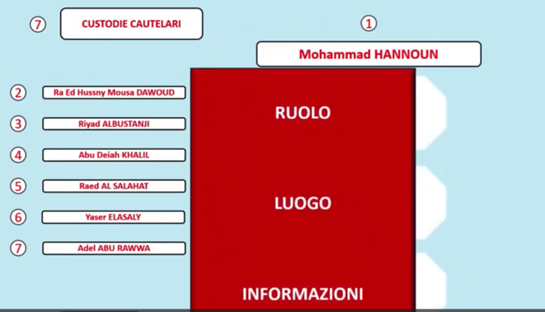
Seven of the nine suspects were identified as members of Hamas’ foreign operations wing, with two providing external support. Also arrested were: Yaser Elasaly, who allegedly co-managed the Milan branch of ABSPP; Dawoud Ra’Ed Hussny Mousa, Hannoun’s main counterpart in Italy; Raed Al Salahat, who allegedly operated as a regional contact in Florence and Tuscany; Albustanji Riyad Abdelrahim Jaber, said to be involved in fundraising activities tied to propaganda events; Abu Rawwa Adel Ibrahim Salameh; and Abu Deiah Khalil.
Scale of Financial Support
The network allegedly funneled approximately €7.3 million to Hamas through three Italian charitable associations based in Genoa and Milan. More than 71% of donations collected went to entities controlled by or linked to Hamas, despite the organizations’ stated humanitarian purposes.
Banking Evasion Tactics
When financial institutions including UniCredit, Crédit Agricole, and Poste Italiane closed accounts following alerts from Israeli and U.S. authorities, the suspects created new associations to circumvent controls. The latest entity, La Cupola d’Oro, was established in Milan in December 2023.
Turkey as the Logistical Hub
Turkey emerged as a critical transit point for funds and personnel. Hannoun frequently traveled to Turkey carrying cash and maintained contact with Hamas’s Turkey-based representative, Saleh Mohammed Ismail Abdu. Court documents indicate Hannoun met with senior Hamas foreign operations official Ali Baraka in Turkey in December 2025 and was planning to relocate there when arrested. One of the remaining suspects is believed to be in Turkey.
Direct Links to Hamas Leadership
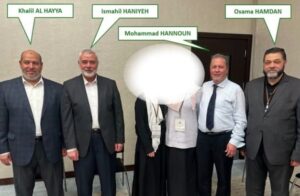
Electronic surveillance revealed Hannoun maintained direct contacts with senior Hamas figures, including the late Ismail Haniyeh, Osama Hamdan, and Khalil al-Hayya. On May 1, 2024, Hannoun sent a voice message directly to Haniyeh. Prosecutors also stated that funds were directly sent to Hamas members, including Osama Alisawi, who served as transport minister in Hamas’ de facto government in Gaza from 2008 to 2014.
Support for Terrorism Infrastructure
Funds were directed not only to Hamas-controlled entities but also to families of individuals involved in suicide attacks or imprisoned for terrorism offenses. Prosecutors argued this practice strengthened Hamas’s operational capacity by incentivizing attacks.
Prior U.S. Sanctions Ignored
The U.S. Treasury Department’s Office of Foreign Assets Control (OFAC) had designated Hannoun and ABSPP as terrorist financiers in October 2024 and again in June 2025. Despite these designations, the network continued operating in Italy until local authorities acted.
European Network Connections
The investigation revealed coordination with Hamas operatives elsewhere in Europe, including Austria, France, and the UK as well as Majed al-Zeer, a senior Hamas representative in Germany, who was also sanctioned by OFAC in October 2024. This indicates a broader European fundraising infrastructure.
Implications for U.S. Homeland Security
The Italian operation offers critical insights for U.S. counterterrorism and homeland security professionals:
Charitable Organization Exploitation
- The case demonstrates how terrorist organizations exploit charitable giving systems.
- The 71% diversion rate to Hamas-linked entities, while publicly collecting for civilian aid, illustrates the deceptive potential of front organizations operating within legitimate nonprofit frameworks.
Financial Intelligence Sharing
- The Italian investigation benefited from alerts provided by U.S. and Israeli authorities, underscoring the value of international financial intelligence cooperation.
Adaptive Banking Evasion
- The network’s response to account closures – creating new associations to restore banking access, for example – demonstrates the adaptive capacity of terrorist financing operations.
Turkey as a Center for Hamas Activity
- Turkey’s role as a logistical hub for Hamas operations in Europe – including as a transit point for funds, a meeting location for senior operatives, and a potential safe haven for fleeing suspects – is unsurprising given Hamas is not designated a terrorist organization by the Turkish government.
Domestic Radicalization Indicators
- Intercepted communications showing expressions of approval for terrorist attacks among the suspects highlight the intersection of material support and ideological alignment. U.S. agencies should consider such indicators when assessing domestic organizations with ties to foreign conflict zones.
Community Organization Responses
- The defensive responses from some Italian Islamic community leaders include characterizations of Hamas as “freedom fighters” rather than terrorists.
- Florence-based Palestinian preacher and former president of the Union of Islamic Communities and Organizations in Italy (an organization similar to the U.S.-based CAIR) Ezzedine Elzir defended Hannoun and Salahat: “I know all the people involved … this whole affair is a soap bubble.” Elzir also was reported to have stated in 2024, “…the large majority of Palestinians, including himself, regard Hamas warriors not as terrorists but as freedom fighters.”
- Rania Hammad, a representative for the Palestinian Community of Rome and Lazio, said in statement on Facebook: “Solidarity with the Palestinian people is not terrorism … regarding the recent arrests, which risk taking the form of repression against the Palestinian movement and solidarity with Palestine.” Understanding these narratives is important for effective community engagement and counter-messaging strategies.
Operation Domino represents a significant counterterrorism success that disrupted a well-established Hamas financing network operating within North Atlantic Treaty Organization (NATO) territory. For U.S. homeland security, the case reinforces the importance of robust financial surveillance, international intelligence cooperation, and vigilance toward charitable organizations linked to polarizing conflicts where ideological sympathies may obscure or enable material support for terrorism.