
Originally from Portland, Wade grew up observing the differences between what her mother, a hairdresser, and her father, a contractor, wore on the job. “My mom was very buttoned up, a very Commes des Garçons, Thom Browne type of dresser, and my dad’s wearing Dickies, Carhartt, Converse, and a tool belt,” Wade says. “Across every collection, I’m studying wardrobe and how wardrobe functions to a job, whether it’s a white-collar job where you need to wear a three-piece suit or you’re a blue-collar worker where the uniform needs to service what you’re doing at work.”

Jane Wade preparing the model for New York Fashion Week
© Hui Murray

Jaedyn Shaw at Jane Wade show for New York Fashion Week
© Faith Nguyen
Here, Wade discusses the importance of workwear functionality, corporate (and coastal) dress codes, and how the inclusion of Red Bull Zero on the runway naturally complemented the outdoor narrative of this season’s collection.
In the Jane Wade storytelling universe, every collection has explored the idea of what’s appropriate to wear to work. Tell us the story of The Summit and what inspired you this season.
This season was really about escaping into one’s desires to reconnect with nature. That was the storyline of The Summit. As the collection rolls out, you see these very teched out, office looks, and then the looks get deeper and deeper into gorpcore—these outdoorsy, tactile fabrics. There are these nuggets of how we can unravel our everyday job and reconnect with nature, reconnect with what matters, and reconnect with being outside.
You’re originally from the Pacific Northwest, and gorpcore plays a huge role in your designs this season, where garments are made of materials like nylon and paracord. Growing up, how did you incorporate high-performance gear and technical fabrics into your lifestyle?
In the Pacific Northwest, performance wear is a huge part of the active lifestyle. I grew up skiing on Mount Hood, and snow wear is deep coded with performance functionality, things like having zippers in your armpits so when you get sweaty or your undergarments get wet, you can let them dry out. And I think it’s so fascinating how clothes directly communicate with the need, with the source of how they’re being used and how those functionality details perform for the user. Up until this point, every collection is really toeing that line between blue collar, white collar, and all the corporate hierarchies and the storytelling that comes along with that. This season, with The Summit, it’s pivoting it back to my roots in performance wear, how garments serve us, and bringing that to more of an outdoor setting.
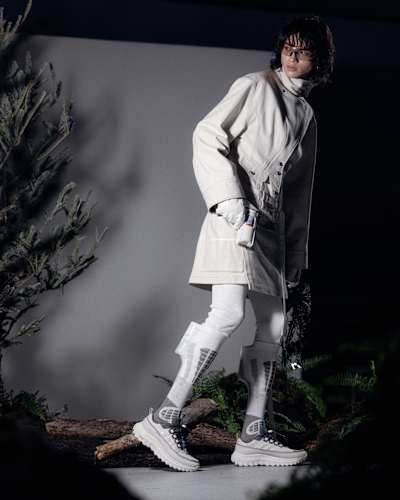
Model wearing Jane Wade
© Anna Mirdita
Modular design, functionality, and technology have always been at the forefront of your collections. Can you share how these design elements support someone when they’re at work – or at play – and give us one of your favorite examples?
Beverages and their role in the workplace have been woven into the narrative of several of your collections, including The Summit, where multiple garments included what I would call beverage holsters. Can you tell me more about the inspiration and the decision to incorporate Red Bull Zero into this collection?
Working in corporate structure, coffee is always free at big companies, and it’s this structural thing that they set up, right? For an energy drink, I think Red Bull has such a different narrative because it’s self-serving. When it comes to being outdoors, you’re having an energy drink because you’re going up to the mountain today. It’s 7:00 in the morning. I want to be locked and loaded when I hit the slopes. How one uses energy drinks is almost always in a placement that’s for the self, and I think that’s a really good story to tell.
We also have this really fun macrame one, which we built out of paracord. I like looking at different types of materials and the ways that we can create these carriers. Maybe you’ve seen those cute water bottle slings that hikers make? That was sort of the inspiration, like how can I easily bring this with me but have it be a handmade thing that I created for my water bottle or my beverage? So we’re tapping into two different styles of hydration carriers.
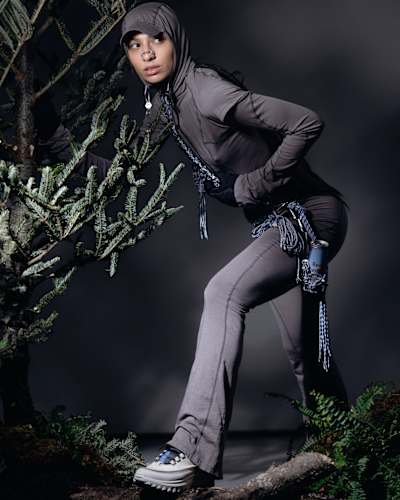
Model wearing Jane Wade for New York Fashion Week
© Aana Mirdita
You began your career in New York working for major fashion houses, where you’ve said you were a “frequent offender” of “inappropriate office dressing.” How would you describe your experience navigating the differences between a West Coast/East Coast dress code?
With West Coast dressing, I think it can be very simplified and performance based. Whereas in New York, it’s the complete opposite and very identity based, but [at work] they also expect you to conform into their format of how you’re supposed to be dressing.
I think that’s why it was such a big challenge for me working in corporate structures, because it’s about removing the unique identity and conforming to what the larger company is and dressing in their language to fit in. And I really struggled with that, honestly. I mean, here we are. I’m talking to you from my own brand. The birth of this has been launched off the back of that idea.
I also have this thing about showing skin and feeling powerful and not feeling like I need to cover every inch of myself, but then also needing to be respected and regarded as a smart, intelligent young woman that can run a successful business. How all that sits together gets very complicated and complex. As a woman, what does it mean to show skin if I’m working in a law firm? Do I have to cover every single inch, from my shoulders to my ankles to be respected, to think that my opinions are valuable?
What advice would you give to a young person entering the workforce, especially if there is a clear dress code?
You’re known for casting some of your employees as models, and this season you also cast your mom. How would you describe the workplace environment that you’ve created?
This is a practice of the heart. The business itself is a living, breathing practice of friendship, of community, and somewhere in the universe, I have to believe that’s what’s lifting it up to be as successful as it is. For me, it’s very much a family. Here in the studio, anybody that wants to come and learn is welcome. And if you want to stay on and continue your internship and grow into a position as the business grows, then that really feels like the success of the story. If I can create a plate that’s bountiful, where there’s enough for everyone to eat off that plate, then that is success. It doesn’t mean that I need to be a multi-billion-dollar brand, but if I can create a solid foundation and a solid community that can serve people other than myself, then that feels like a win.