
It only takes one close encounter with a lightning strike to get the full sense of its power. At around 1 gigaJoule of energy, a single electrical discharge during a thunderstorm is more than enough to rip apart a tree, knock out an entire city’s energy grid, or kill an unfortunate bystander. But based on recent observations of the planet Jupiter, our biggest neighbor in the solar system features lightning so intense that it makes Earth’s bolts seem like tiny static shocks.
According to a study recently published in the journal AGU Advances, the gas giant regularly sees lightning flashes as much as 100 times more powerful than those seen here on planet Earth. Although Jupiter’s composition and atmosphere share very little in common with our home planet, astronomers say analyzing those distant electrical discharges may help us better understand the lightning experienced on Earth.
Hundreds of millions of lightning strikes occur around Earth every year, but apart from their underlying mechanics, meteorologists still know very little about the natural phenomena. Only in the last few years have scientists even learned about lightning’s peculiar, millisecond-long variations known as transient luminous events taking place high in the atmosphere. Similarly, we still have a lot to learn about Jupiter’s storms, but at least one thing is abundantly clear: they are very, very large. Some Jovian weather events are bigger than Earth itself and can last for centuries. For instance, the planet’s famous Great Red Spot measures over 10,000 miles wide, sustains 200 mph winds, and has churned for over 200 Earth years. In all that time, it and its sibling storms have produced countless lightning bolts.
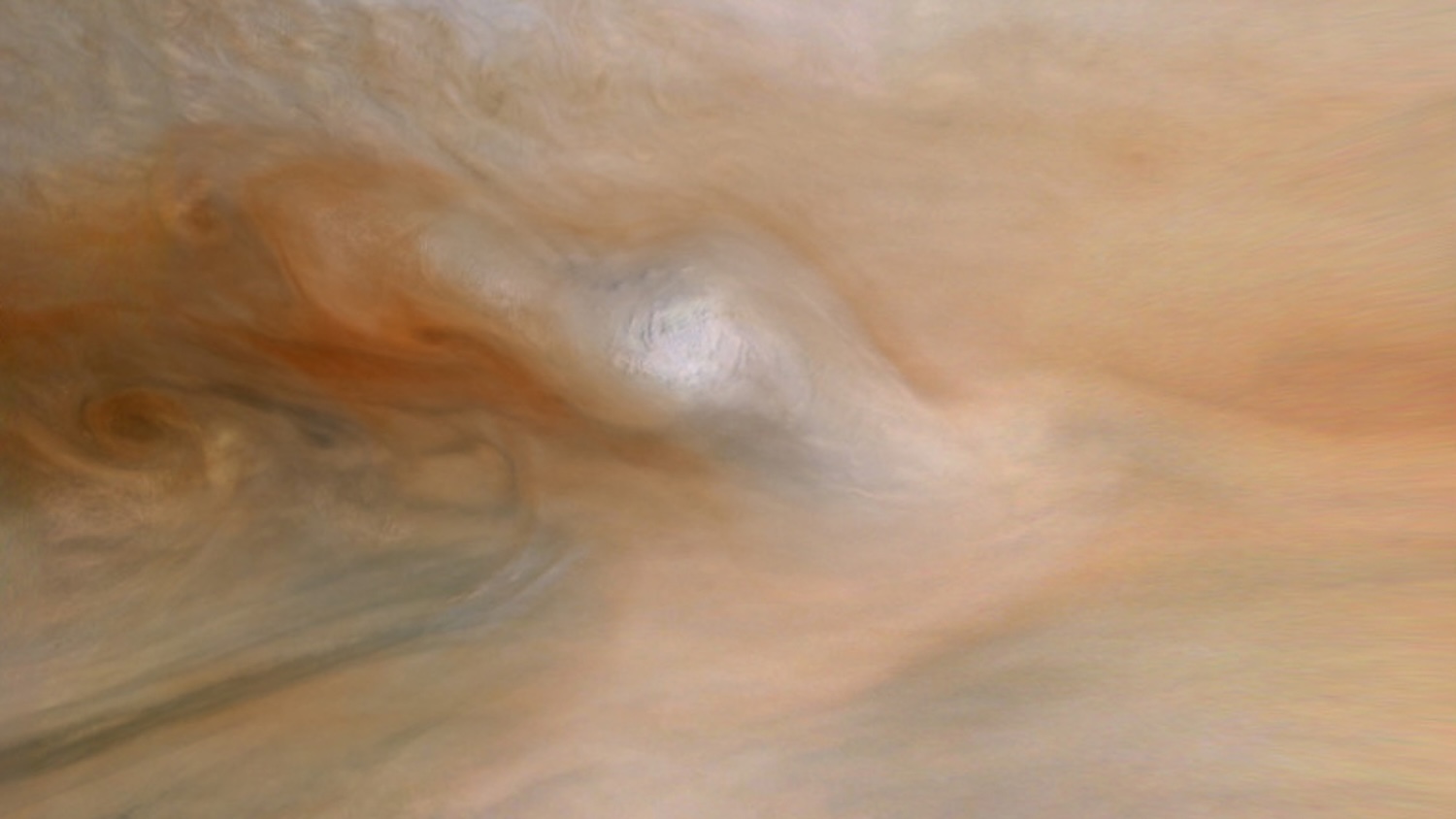
Although nearly every other spacecraft to pass Jupiter has spotted the electrical outbursts, they were mostly captured on the planet’s night side and were particularly powerful. This meant that researchers weren’t sure if Jupiter was constantly producing huge lightning bolts, or if it also saw comparatively weaker ones, as well. However, astronomers using NASA’s Juno spacecraft are getting their best looks at Jupiter to date. Juno began orbiting the gas giant in 2016, and the probe is routinely scanning the atmosphere using equipment like its microwave radiometer. This instrument can flag radio emissions from lightning.
Jupiter’s storms regularly form in belts that circle the planet, which can make it hard to match lightning to specific atmospheric events. But in 2021 and 2022, a calm period along the North Equatorial Belt let researchers hone in on individual storms with help from Juno, the Hubble Space Telescope, and citizen scientist volunteers.
“Because we had a precise location, we were able to just say, ‘OK, we know where it is. We’re directly measuring the power,’” explained Michael Wong, a study co-author and planetary scientist at UC Berkeley’s Space Sciences Laboratory.
The results showcased a much more varied and dynamic spectrum of weather. On four separate passes over the storms, Juno recorded lightning’s microwave static around three times per second. In one instance, the spacecraft flagged 206 pulses. Wong’s team analyzed 613 microwave bursts, and found that their power ranged anywhere from a typical Earth lightning bolt to strikes at least 100 times more powerful than a standard emission. Other calculations suggested lightning above Jupiter contains between 500 and 10,000 times the energy as Earth lightning.
More study is required to fully understand Jupiter’s storms, but there are already some clues that may help explain how they become so powerful. One theory rests on the planet’s atmospheric composition. Unlike Earth’s nitrogen-heavy atmosphere, Jupiter’s clouds are mostly hydrogen. Because hydrogen is much heavier than nitrogen, a gas giant storm’s moist air requires much more energy to rise upward. But once it does get to the top of the atmosphere, its discharges are immense.
“This is where the details start to get exciting, where you can ask, ‘Could the key difference be hydrogen versus nitrogen atmospheres, or could it be that the storms are taller on Jupiter and so there’s greater distances involved?’” explained Wong.

2025 PopSci Best of What’s New