

photo by: NASA/Johns Hopkins University Applied Physics Laboratory/Southwest Research Institute Image
An image of Pluto taken by NASA’s New Horizons spacecraft on July 13, 2015. The planet was first discovered by Clyde Tombaugh, who graduated from high school in rural Kansas and went on to earn his bachelor’s and master’s degrees at the University of Kansas.
It would be understandable if you stopped thinking as much about Pluto after it was “demoted” from being considered one of the nine planets sharing the Earth’s solar system to being classified as a dwarf planet in 2006. Or you could be one of those people who is adamant there are still nine planets.
Either way, the connection between Pluto and Lawrence — though it is billions of miles away — is pretty close, as the man who discovered the it was a Jayhawk.
The University of Kansas’s Physics and Astronomy department is celebrating the discovery of the planet by Clyde Tombaugh, who got his bachelor’s and master’s degrees at KU, with a “Pluto Day” celebration at the Lawrence Public Library, 707 Vermont St., on Saturday, Feb. 21. The event will have arts, crafts and activities for all ages about the icy dwarf planet.
Katie Sheriff, a KU grad student in the Astronomy division, told the Journal-World that Tombaugh officially discovered Pluto on Feb. 18, 1930 — meaning Wednesday was officially the anniversary of the discovery.
Sheriff said Tombaugh graduated from high school in rural Kansas, and he built his own nine-inch telescope out of “spare tractor and car parts.” On his family’s farm, Tombaugh started looking into the sky in the late 1920s.
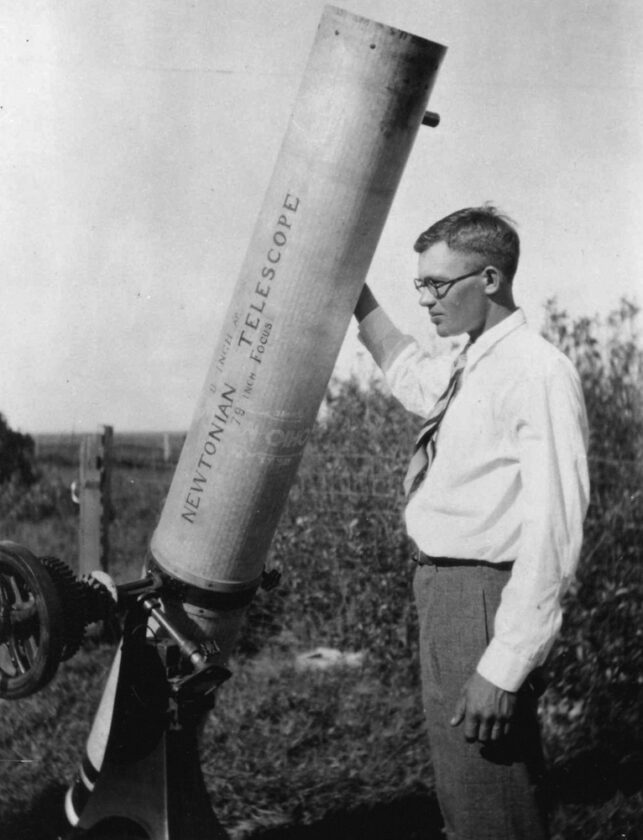
photo by: Wikimedia Commons
A photo of astronomer Clyde Tombaugh and a homemade, nine-inch telescope taken sometime in 1930. Tombaugh, a University of Kansas graduate, was credited with discovering Pluto on Feb. 18, 1930, and the KU Department of Physics and Astronomy is celebrating “Pluto Day” with a Saturday event at the Lawrence Public Library.
While scientists knew from calculations that the planet — at the time called “Planet X” — existed, no one had been able to fully “prove it was there,” Sheriff said. Tombaugh, with his amateur telescope, was one of the people looking for planets, drawing sketches of the night sky of his findings. Tombaugh at one point sent the sketches off the the Lowell Observatoryin Flagstaff, Ariz., and the team of astronomers there were so impressed they offered him a job, Sheriff said.
That observatory was founded by Percival Lowell, a noted astronomer who theorized the existence of another planet beyond Neptune, and it had the specific goal of searching for those distant planets. Tombaugh was working at the observatory when he first discovered the planet on Feb. 18, 1930, Sheriff said, and not long after, the University of Kansas offered him a scholarship.
“He (was) just a little Kansas farm boy that loved astronomy, found a planet and came to KU,” Sheriff said.

photo by: Lowell Observatory | Wichita Eagle
Clyde Tombaugh uses the Zeiss Blink Comparator at Lowell Observatory near Flagstaff, Ariz., to search for Pluto in 1930.
Tombaugh received his Bachelors from KU in 1936 and his Masters in 1938 — though Sheriff said his thesis was not actually about Pluto despite his discovery of the planet. Because of that Jayhawk connection, the department uses the anniversary to help foster an appreciation for astronomy with the wider community.
Sheriff said that during the Pluto Day event Saturday, a mix of professors and students in the Astronomy and Physics department will be on hand to lead arts and crafts stations and demonstrations related to the science of Pluto.
Sheriff said that some of the scientific demonstrations led by the professors include deep freezing items to showcase what the conditions on Pluto would be like and use dry ice and dirt to illustrate to make their “own little Pluto.” Sheriff said these activities are a great way to get the community involved in learning about the science of space.
“Space is cool,” Sheriff said. “We can do a lot and spread the science, knowledge and love for it (with this event).”
The Pluto Day celebrations will begin on Saturday, Feb. 21 at 10:30 a.m. to 12:30 p.m. at the Lawrence Public Library. More information can be found at KU’s website.

In this 1980 photo provided by Dale Wittner, Clyde Tombaugh is shown in Las Cruces, N.M., with a telescope similar to one he used to find Pluto decades earlier.
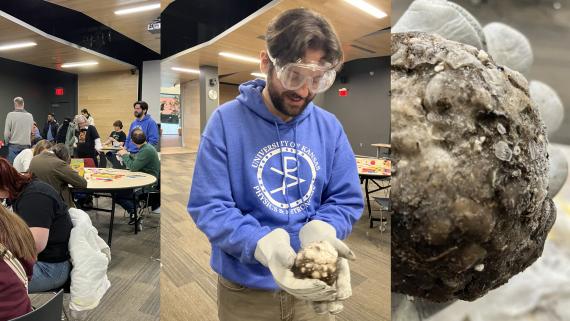
photo by: Contributed
A collage of photos from a demonstration during a Pluto Day event in 2025 hosted by the University of Kansas’s Department of Physics and Astronomy. This demonstration built a “little Pluto” with dry ice and dirt.