
Overview
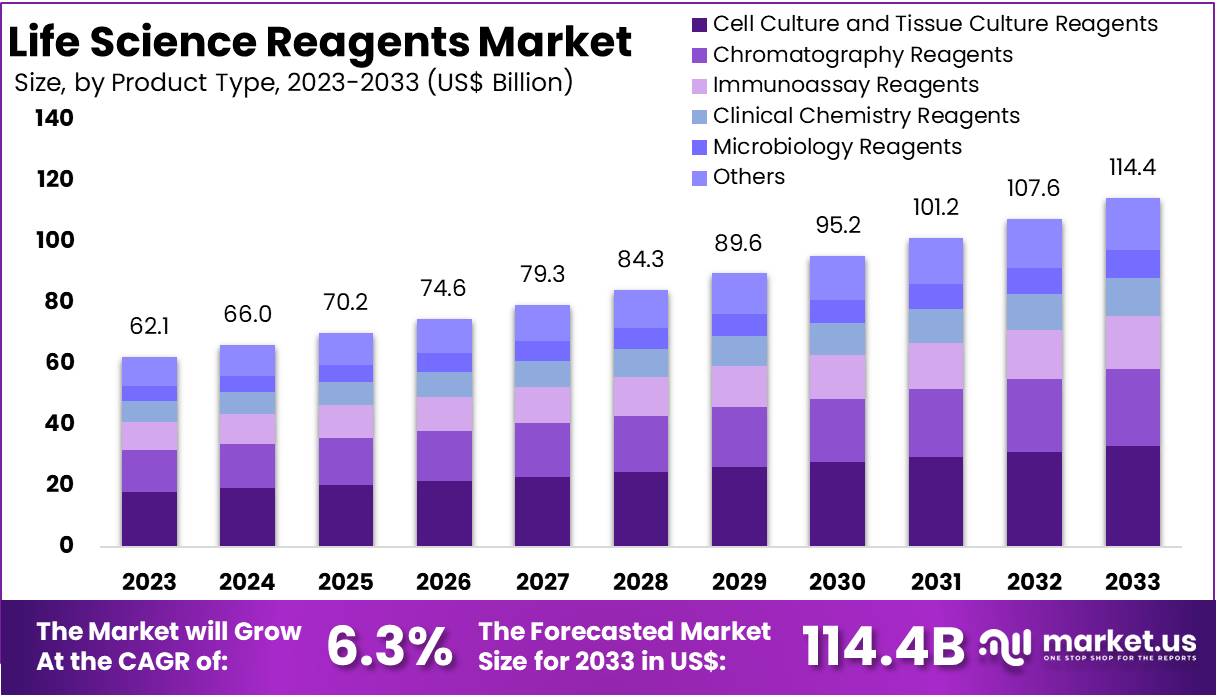
New York, NY – Feb 18, 2026 – The Global Life Science Reagents Market size is expected to be worth around US$ 114.4 Billion by 2033, from US$ 62.1 Billion in 2023, growing at a CAGR of 6.3% during the forecast period from 2024 to 2033.
The global life science reagents market continues to demonstrate steady expansion, supported by sustained investments in biotechnology, pharmaceutical research, and diagnostic innovation. Life science reagents, including molecular biology reagents, cell culture reagents, immunoassay reagents, and chromatography reagents, represent essential components in research laboratories, clinical diagnostics, and drug development activities.
Market growth is being driven by the rising prevalence of chronic and infectious diseases, increasing demand for personalized medicine, and expanding genomics and proteomics research. The growth of biopharmaceutical production and vaccine development has further accelerated the consumption of high-quality reagents across academic institutes, contract research organizations, and pharmaceutical companies. In addition, technological advancements in polymerase chain reaction (PCR), next-generation sequencing (NGS), and cell-based assays have strengthened product adoption rates globally.
North America accounts for a significant share of the market, supported by advanced research infrastructure, strong funding mechanisms, and the presence of leading biotechnology firms. Europe maintains stable growth, while the Asia-Pacific region is projected to register the fastest expansion due to increasing research expenditure, expanding clinical trial activity, and improving laboratory capabilities.
Strategic collaborations, product innovations, and capacity expansions are being implemented by key industry participants to strengthen competitive positioning. Regulatory compliance and quality assurance remain critical success factors in this market.
With continuous innovation in life sciences and diagnostics, the demand for reliable, high-performance reagents is expected to remain strong over the forecast period.
Key Takeaways
- The global life science reagents market is anticipated to reach approximately US$ 114.4 billion by 2033, rising from US$ 62.1 billion in 2023, reflecting a compound annual growth rate (CAGR) of 6.3% during the forecast period.
- In 2023, the cell and tissue culture reagents segment accounted for the largest share within the product type category of the animal material genetics market, representing more than 29% of total revenue.
- Hospitals and diagnostic laboratories emerged as the leading application segment in 2023, contributing over 56% of the overall life science reagents market share.
- North America held the dominant regional position in 2023, capturing approximately 36% of the global market, with a valuation of US$ 22.3 billion.
Regional Analysis
In 2023, North America secured a leading position in the global life science reagents market, accounting for over 36% of total revenue and reaching a valuation of US$ 22.3 billion. This dominance has been supported by a well-established healthcare infrastructure, substantial investments in biotechnology and pharmaceutical research, and the strong presence of major reagent manufacturers across the region. The United States represented the primary growth engine, driven by significant research and development funding from both public institutions and private enterprises.
Canada contributed meaningfully to regional performance, supported by the steady expansion of its life sciences industry and increased collaboration between academic institutions and biotechnology companies. Favorable regulatory frameworks have further strengthened innovation and commercialization activities.
Mexico, although comparatively smaller in market size, demonstrated steady progress. Government-led initiatives aimed at improving healthcare facilities and promoting scientific research have supported market development. Continuous adoption of advanced diagnostic and laboratory technologies has reinforced North America’s overall market leadership.
Emerging Trends
- Rise of Genome Editing Tools: Genome editing platforms such as CRISPR are increasingly adopted across academic and pharmaceutical laboratories. Specialized reagents enable precise DNA modification, supporting mutation correction, functional genomics research, and development of targeted therapies.
- Growing Demand for Customized Reagents: Research institutions are increasingly seeking tailored reagents designed for specific cell types and experimental conditions. Customized solutions enhance accuracy, minimize cross-reactivity, and support complex studies in immunology, neurology, and rare disease research.
- Automation and Smart Laboratory Integration: Laboratories are adopting automated and AI-enabled systems to enhance efficiency and reduce manual errors. This transition requires standardized, automation-compatible reagents that ensure reproducibility, high-throughput processing, and reliable performance across robotic platforms.
- Expansion of Multi-Omics Research: Multi-omics approaches integrating genomics, proteomics, and metabolomics are expanding rapidly. These studies require highly sensitive and compatible reagents for accurate sample preparation and analysis, supporting comprehensive biological insights and personalized medicine advancements.
Use Cases
- Medical Diagnostics: Life science reagents are widely utilized in disease detection across hospitals, diagnostic laboratories, and home-testing environments. They enable rapid identification of pathogens and genetic markers, facilitating early diagnosis and improved patient management outcomes.
- Drug Development and Testing: Pharmaceutical research depends extensively on reagents for drug screening, mechanism analysis, and clinical evaluation. These materials support safety testing, efficacy validation, and quality control processes throughout the therapeutic development lifecycle.
- Genomics and DNA Analysis: Reagents are fundamental in DNA and RNA extraction, amplification, sequencing, and gene editing applications. They enable mutation detection, genetic disorder identification, and advancements in personalized medicine, agriculture, and biomedical research initiatives.
- Vaccine Research and Production: Vaccine development relies on reagents for pathogen identification, immune response evaluation, and manufacturing quality assurance. Their application accelerates vaccine discovery, ensures batch safety compliance, and supports large-scale immunization programs globally.
Frequently Asked Questions on Life Science Reagents
- What are life science reagents?
Life science reagents are specialized chemical and biological substances used in laboratory research, diagnostics, and pharmaceutical development. These reagents include antibodies, enzymes, buffers, stains, and assay kits that enable accurate experimentation, detection, and analysis in life science applications. - What are the major types of life science reagents?
Major categories include molecular biology reagents, cell culture reagents, immunoassay reagents, chromatography reagents, and proteomics reagents. Each category supports specific research functions such as DNA amplification, protein analysis, cell growth, and biomarker detection across academic and industrial laboratories. - Where are life science reagents primarily used?
Life science reagents are extensively used in pharmaceutical and biotechnology research, clinical diagnostics, academic research institutions, and contract research organizations. Applications include drug discovery, disease diagnostics, genetic analysis, forensic testing, and vaccine development programs worldwide. - What factors influence the quality of life science reagents?
Reagent quality is influenced by purity levels, stability, manufacturing standards, storage conditions, and regulatory compliance. High-grade reagents ensure reproducibility, sensitivity, and accuracy in experiments, which is essential for reliable research outcomes and regulatory approval processes. - How are life science reagents stored and handled?
Proper storage conditions vary depending on reagent composition and stability requirements. Many reagents require refrigeration or freezing to maintain activity, while others must be protected from light and contamination to preserve effectiveness and extend shelf life. - What are the key growth drivers of the life science reagents market?
Market growth can be attributed to increasing R&D expenditure, growing prevalence of chronic diseases, expanding biopharmaceutical production, and technological advancements in molecular diagnostics. Government funding for research and innovation also contributes significantly to market expansion. - Which regions dominate the life science reagents market?
North America holds a leading position due to strong research infrastructure, high healthcare expenditure, and the presence of major biotechnology companies. Europe follows closely, while Asia-Pacific is emerging rapidly owing to expanding research capabilities and healthcare investments.
Conclusion
The global life science reagents market is positioned for sustained growth, supported by rising investments in biotechnology, pharmaceutical research, and advanced diagnostics. Expanding applications in genomics, proteomics, vaccine development, and personalized medicine continue to strengthen product demand. Strong adoption across hospitals, diagnostic laboratories, academic institutions, and pharmaceutical companies reinforces market stability.
North America maintains regional leadership, while Asia-Pacific demonstrates accelerated expansion potential. Technological advancements in PCR, next-generation sequencing, and automation further enhance adoption rates. With the market projected to reach US$ 114.4 billion by 2033 at a CAGR of 6.3%, long-term growth prospects remain firmly established.
Discuss your needs with our analyst
Please share your requirements with more details so our analyst can check if they can solve your problem(s)
