
A lone rover working through the Martian sands has now provided the answer to an ancient question – if lightning strikes on the red planet and no one hears it, does it make a sound?
In recordings taken by NASA’s Perseverance rover, scientists have identified, for the first time, electrical discharges captured during fierce dust storms and rotating dust vortices on Mars – not once, but 55 times during two Martian years of observation.
Importantly, the dusty weather in which these events occurred demonstrates the specific conditions needed to generate electricity in Mars’ thin, dry atmosphere – long suspected but never directly demonstrated until now, the report says. sciencealert.
Lightning is thought to occur when turbulent conditions in an atmosphere move particles, causing them to rub against each other to generate charge. Eventually, the charge becomes so great that it must be discharged somewhere, producing an electrical discharge.
Lightning is widespread here on Earth, creating some of the most beautiful and extraordinary weather phenomena on the planet, the Telegraph reports.
– YouTube www.youtube.com
It is most commonly associated with clouds of water vapor, but moisture is not necessary. Electrical discharges also erupt in large quantities of ash thrown up by volcanoes, for example.
Even sandstorms – where dry silicate particles are insulators and not conductors – can accumulate enough charge to cause electrical discharges.
Scientists had proposed that similar mechanisms could operate on Mars, although its mostly carbon dioxide atmosphere is much thinner and drier than Earth’s.
After all, lightning has been recorded on Jupiter and Saturn, and has been tentatively detected on Neptune and Uranus, all of which also differ significantly from Earth (lightning on Venus remains an open question).
Models suggest that if electrical discharges occur on Mars, they are probably located near the surface, where atmospheric pressure is highest.
Fortunately, we have active rovers on the surface of Mars – and one of them, Perseverance, has an instrument capable of detecting signs of lightning.
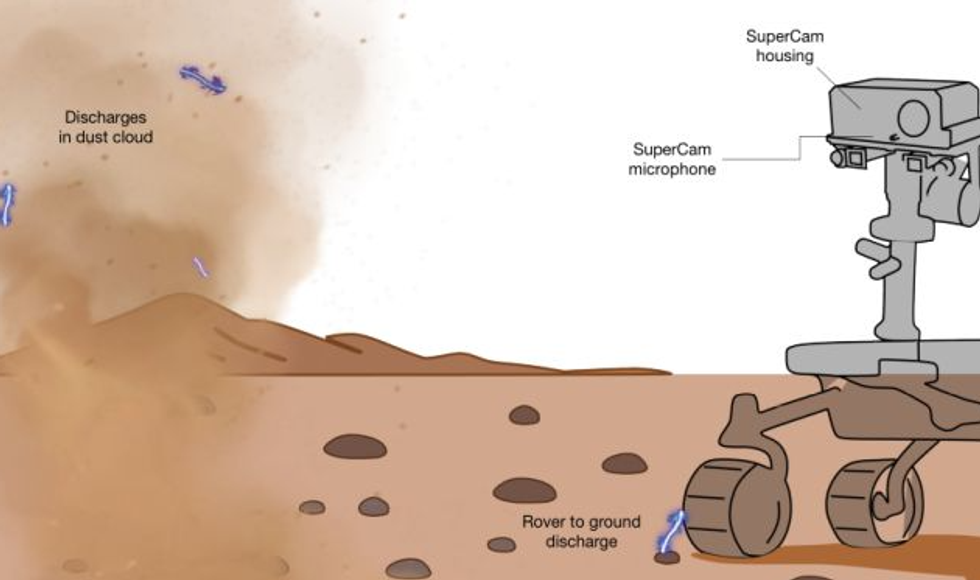
Led by planetary scientist Baptiste Chide from the University of Toulouse in France, a team of scientists analyzed data collected by Perseverance’s SuperCam microphone, a device capable of recording sound data and electromagnetic interference.
They analyzed 28 hours of microphone recordings, looking for signs of electrical discharges among the dust swirling around the planet.
They found 55 events, of which 7 fully captured a characteristic signature of an electrical discharge. Initially, the device records a sudden electronic “blip” caused by electromagnetic interference as the electrical discharge connects to the microphone wiring. This blip is followed by a relaxation, or “ringdown,” lasting about 8 milliseconds.
The seven events that Perseverance captured in full ended with the acoustic signature of a small sonic boom created by the electrical discharge heating and expanding the air around it – a very small flash of lightning.
To make sure the recordings were really coming from miniature electrical discharges, the researchers used a copy of SuperCam here on Earth. They recorded electrical discharges, reproducing the profile of the Martian recordings. Interestingly, a high concentration of dust in the atmosphere was not enough on its own to produce electricity.

The vast majority of the events – 54 out of 55 – occurred during the top 30 percent of the strongest winds that Perseverance recorded on Mars during the study period, with most associated with dust storm fronts.
Meanwhile, 16 electrical discharges were recorded during Perseverance’s two encounters with the dust.
Based on six of the seven recorded lightning flashes, most of the discharges were very small, only 0.1 to 150 nanojoules. The seventh acoustic event was the largest, reaching 40 millijoules – consistent with a discharge from the Rover to the ground, possibly related to charge buildup from particles rubbing against Perseverance itself.
By comparison, a cloud-to-ground lightning strike on Earth discharges about a billion joules. So lightning, as it appears on Mars, is quite different from lightning on Earth – but it exists, and that has some interesting implications.
One of the most obvious is that it could help inform the design of future technologies for Mars exploration, to protect them from the electrical discharges that we now know occur. Just as they did for early Earth, planetary scientists can now more accurately model the chemical reactions in the Martian atmosphere that would be mediated by electrical discharges.
On a more speculative level, some current theories about the emergence of life on Earth cite lightning as a system for delivering the ingredients needed to propel a collection of molecules toward biology. If lightning exists on Mars, astrobiologists could factor this into their estimates of the probability of life there.
“This study opens an important field of investigation into the Martian atmosphere… and encourages the development of new atmospheric models to calculate electrical phenomena and their consequences in the Martian atmosphere,” Chide and his colleagues conclude. /Telegraph/