
The days between Christmas and New Years are blissfully blurry. After yuletide stress dissipates, and before resolution anxiety seizes us, we find ourselves in a prolonged pajama-clad fugue. The Brits call it “Boxing Week,” while Americans call it “Dead Week.” In Norway, the land of my ancestors, it’s known as Romjul, a quiet, unstructured interlude for staying home with friends and family, free from outside demands.
Article continues after advertisement
In our house, that means movies – primarily, crime movies of a certain vintage. My Dad is partial to film noir, while I enjoy hard-boiled gangster pictures. I have a special fondness for those made by Warner Bros. – Little Caesar, The Public Enemy, Larceny, Inc. This year, with Netflix circling Warner Bros. like it’s casing the joint, I’m scheming to revisit some of the studio’s lesser-seen crime pictures. So, you in? Lace up your spats and grab a crowbar, let’s crack open the vault.
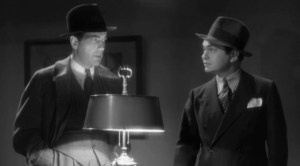
Bullets or Ballots (1936, William Keighley)
In 1931, Warner Bros. proved that crime does, in fact, pay: Both Little Caesar, starring Edward G. Robinson, and The Public Enemy, starring James Cagney, were buzzy box office hits. But soon after, the Production Code Administration clamped down, imposing rigid guidelines for what could – and could not – be shown on screen, while condemning Warner Bros. for glorifying criminality.
To counteract these claims, Warner Bros. had Cagney and Robinson play heroic law enforcement figures. Cagney starred as James “Brick” Davis in “G” Men (1935), while Robinson playing an undercover cop in Bullets or Ballots.
When an honest new police commissioner sets out to dismantle the city’s rackets, he taps tough NYPD detective Johnny Blake (Robinson) to go undercover and infiltrate the mob. But as he burrows deeper, the line between lawman and outlaw grows increasingly thin.
Robinson’s Johnny Blake was reportedly based on real-life New York City policeman Johnny “The Duke” Broderick, and crime boss Al Kruger (Barton MacLane) was inspired by Dutch Schultz, notorious bootlegger and racketeer. Though not as fondly remembered as other films of the era, it’s a solid crime tale with a crackerjack supporting cast, including Joan Blondell and a young up-and-comer named Humphrey Bogart. Buy or rent it here.
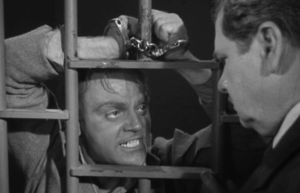
Each Dawn I Die (1939, William Keighley)
Based on the novel by Jerome Odlum, Each Dawn I Die stars James Cagney as Frank Ross, a straight-arrow newspaperman framed by a crooked District Attorney and thrown into Rocky Point, a brutal penitentiary. There, he is assigned to a jute mill and chained to “Hood” Stacey (George Raft), an infamous gangster. They strike a deal: Stacey will help Ross clear his name – if Ross helps Stacey escape
Though very much a two-hander, it is Ross’s moral degradation that captures Keighley’s unblinking eye. In one pivotal scene, Ross catches Stacey practicing with a sharp, forbidden weapon. “I don’t see any shiv,” Ross says with a smirk. Despite the Code’s heavy hand, Keighley and company managed to paint an irredeemably grim portrait of the American penal system. Each Dawn I Die went on to become one of 1939’s most successful films, and – it is rumored – one of Joseph Stalin‘s favorite American movies.
As with Bullets or Ballots, elements of the story were ripped from real events. The failed gun smuggling sequence was inspired by an Indiana prison escape carried out by John Dillinger in 1933. Early in development, Cagney was meant to play Stacey, with John Garfield as Frank Ross, and Michael Curtiz directing. In the end, Cagney and Raft are both superb. The picture’s been laying low with the other fading classics in the Warner crime vault, but you can still take a gander on HBO Max.
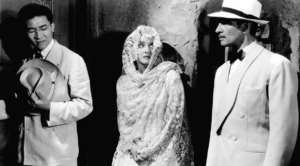
The Letter (1940, William Wyler)
Set in colonial Malaya, the wife of a British plantation manager kills a socially prominent man in her home, claiming self-defense. When the circumstances of the killing are investigated, a letter surfaces that casts doubt on her story, revealing deceit and infidelity. The Letter is a taut tropical melodrama that “extenuates tension like a grim inquisitor’s rack,” as one critic put it in 1940. It’s also one of Better Davis and William Wyler’s finest collaborations.
“I should have married Willy,” Bette Davis once told her friends of director Wyler. Though they had been lovers years earlier, their romance had been sublimated fully to the screen by the time they made The Letter. It was a commercial smash in its day, nominated for seven Academy Awards – though it won none. Davis’s morally ambiguous performance is revelatory. You can see it for yourself here.

Key Largo (1948, John Huston)
Twelve years after Bullets or Ballots, Edward G. Robinson and Humphrey Bogart reunited in a muggy Florida hotel. Major Frank McCloud (Bogart) arrives intending to pay his respects to the family of a fallen comrade, only to find himself taken hostage by Johnny Rocco (Robinson), a ruthless crime boss who has emerged from hiding to broker one last deal. As a hurricane swells off the coast, the hotel becomes a pressure cooker, and McCloud and Rocco develop a grudging respect. Key Largo is a chamber thriller about power: the ruthlessness required to seize it, and the courage required to stand up to it. “You don’t like it, do you Rocco, the storm?” McCloud teases as the wind whips. “Show it your gun, why don’t you? If it doesn’t stop, shoot it.”
The script, adapted from a popular 1939 play by Maxwell Anderson, would be Bogey and Bacall’s fourth and final collaboration. It was rehearsed and shot in three weeks on the Warner Bros. lot, and released to momentous acclaim in 1948. Fans of film noir still hold it in high regard, but few others have checked in. You can do so on HBO Max.
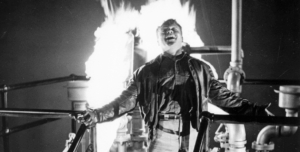
White Heat (1949, Raoul Walsh)
We’ll end this list with a film that fuses the gangster picture with film noir: the electrifying White Heat. After swearing off gangster roles (and Warner Bros.), winning an Oscar for Yankee Doodle Dandy, and launching an ill-fated independent production company, James Cagney returned to Warner in 1949 to play Cody Jarrett – a volatile, sadistic gang leader whose criminal ferocity is matched only by his pathological devotion to his mother, Ma Jarrett (Margaret Wycherly). Hounded by the law and cracking from within – Cody is prone to sudden violent headaches – White Heat chronicles Cody’s downward spiral, culminating in one of the most indelible final moments in American cinema.
Cagney used his own father’s drunken outbursts as inspiration for Jarrett, and made sly references to some of the gangsters he’d played in the past. White Heat plays like a reappraisal of the gangster genre – and specifically, Cagney’s contributions to it – seen through a post-war Freudian lens. Jarrett’s Oedipal fixation was based on real-life murderer Francis Crowley, whose last words from the electric chair were, “Send my love to my mother.” Though the film’s most famous line (“Made it ma! Top of the world”) is still well-known, the movie itself is woefully underseen. You can help correct this injustice by watching it here.