
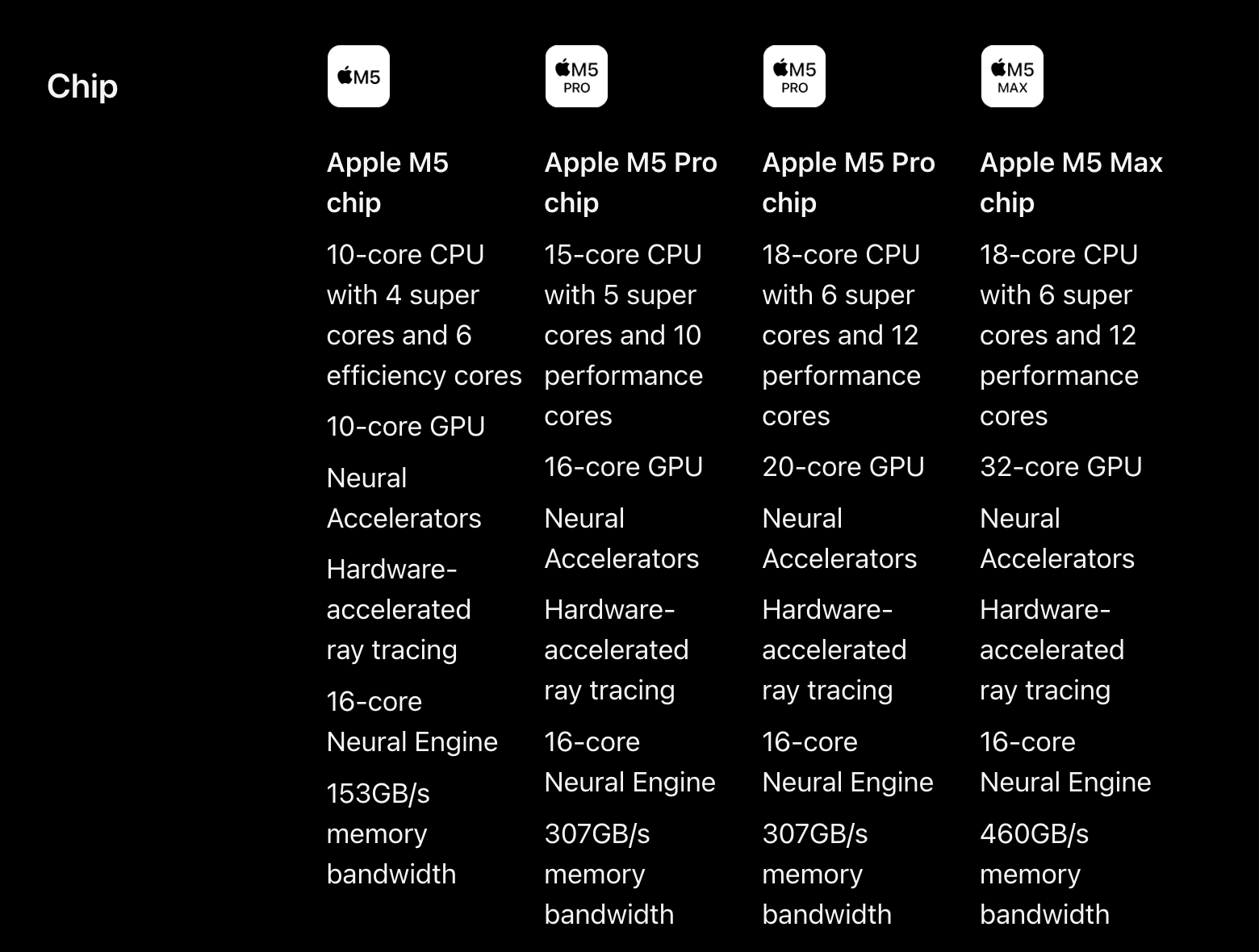
The second die is where the two chips differ; the M5 Pro gets up to 20 GPU cores, a single media encoding/decoding engine, and a memory controller with up to 307 GB/s of bandwidth. The M5 Max gets up to 40 GPU cores, a pair of media encoding/decoding engines, and a memory controller that provides up to 614 GB/s of memory bandwidth (note that everything in the GPU die seems to be doubled, implying that Apple is, in fact, sticking two M5 Pro GPUs together to make one M5 Max GPU).
Credit:
Apple
Apple’s spec sheets now list three distinct types of CPU cores: “super” cores, performance cores, and efficiency cores.
Credit:
Apple
Apple is also introducing a third distinct type of CPU core beyond the typical “performance cores” and “efficiency cores” that were included in older M-series processors.
At the top, you have “super cores,” which is Apple’s new M5-era branding for what it used to call “performance cores.” This change is retroactive and also applies to the regular M5; Apple’s spec sheet for the M5 MacBook Pro used to refer to the big cores as “performance cores” but now calls them “super cores.”
At the bottom of the hierarchy, you still have “efficiency cores” that are tuned for low power usage. The M5 still uses six efficiency cores, and unlike the super cores, they haven’t been rebranded since yesterday. These cores do help with multi-core performance, but they prioritize lower power usage and lower temperatures first, since they need to fit in fanless devices like the iPad Pro and MacBook Air.
And now, in the middle, we have a new type of “performance core” used exclusively in the M5 Pro and M5 Max.
These are, in fact, a new, third type of CPU core design, distinct from both the super cores and the M5’s efficiency cores. They apparently use designs similar to the super cores but prioritize multi-threaded performance rather than fast single-core performance. Apple’s approach with the new performance cores sounds similar to the one AMD uses in its laptop silicon: it has larger Zen 4 and Zen 5 CPU cores, optimized for peak clock speeds and higher power usage, and smaller Zen 4c and Zen 5c cores that support the same capabilities but run slower and are optimized to use less die space.