
Actress-director Maggie Gyllenhaal may be the first person to go from playing a woman blown up in an IMAX movie (The Dark Knight, 2008) to being the woman actually directing an IMAX movie (The Bride, 2026). Watching the result on the big screen feels like riding shotgun in a stolen car—like someone cramming a lifetime of big-movie big-Hollywood big-monster big-gore fandom into 126 minutes.
The plot goes something like this: Frankenstein’s monster (Christian Bale) pays a visit to Dr. Corneilus Euphronia (Annette Bening) in 1930s Chicago. He’s heard she’s been doing a lot of experiments with dead animals, and so he’s fairly sure that she could revive a dead lady for him to hang out with. He is, he explains, very, very lonely. Specifically, he says: “There is a whole garden of pleasure to which I have not had access.”
Euphronia laughs in his face. “Give me a break, Frank,” she says. “Everyone’s lonely.”
This “you can’t just make a dead girl be your girlfriend” attitude is remarkably faithful to the spirit, if not the letter of the film The Bride is based on: James Whale’s Bride of Frankenstein (1935). In both that film and Frankenstein (1931), the very gay Whale presents the monster as something of a sad sack. The Bride, meanwhile, is feral, glorious, and thriving outside all concepts of conventional love interest. She is a classical statue—Whale modeled her look and famous hairdo after the Egyptian bust of Nefertiti—with the moves of a velociraptor. She towers over Victor Frankenstein and Dr. Pretorius, her queer-coded science daddies (outside, Victor Frankenstein’s fiancee pounds on the laboratory door and sobs).
Never commented on (or acknowledged in the credits) is the fact that 1935 Bride is played by Elsa Lanchester, the same actress who plays Mary Shelley, the author of Frankenstein, in Bride of Frankenstein’s spritely intro. In that intro, Shelley (doing needlepoint, squeezed into a diaphanous gown) jauntily tells Lord Byron and Percy Bysshe Shelley that there was much more to the tale of Frankenstein than she ever wrote down, and she’s about to lay it on them.
Gyllenhaal does something similar, but more ominous, casting actor Jessie Buckley not only as the Bride, but as an older, weirder Mary Shelley, whose face hovers in the darkness like a midnight horror show emcee. The two characters seem to be haunting each other. Shelley describes the story of The Bride as “this tumor.” (When the real Mary Shelley died in 1853, after living through years of seizures and migraines, doctors attributed her death to a brain tumor).
Is this some kind of Mulholland Drive scenario, where The Bride is a story told by Mary Shelley’s dying synapses, despite the real Mary Shelley never having seen either the 20th century or Chicago?
The script for The Bride does at times have a sort of, “did a tumor write this?” quality. Sometimes it’s a monster movie. Sometimes it’s a mobster movie. Sometimes it’s an old-fashioned movie musical. Sometimes it’s a cinematic in-joke, riffing on other films like Young Frankenstein (1974). Sometimes—1930s setting be damned—there’s a rave under the overpass and Fever Ray is playing.
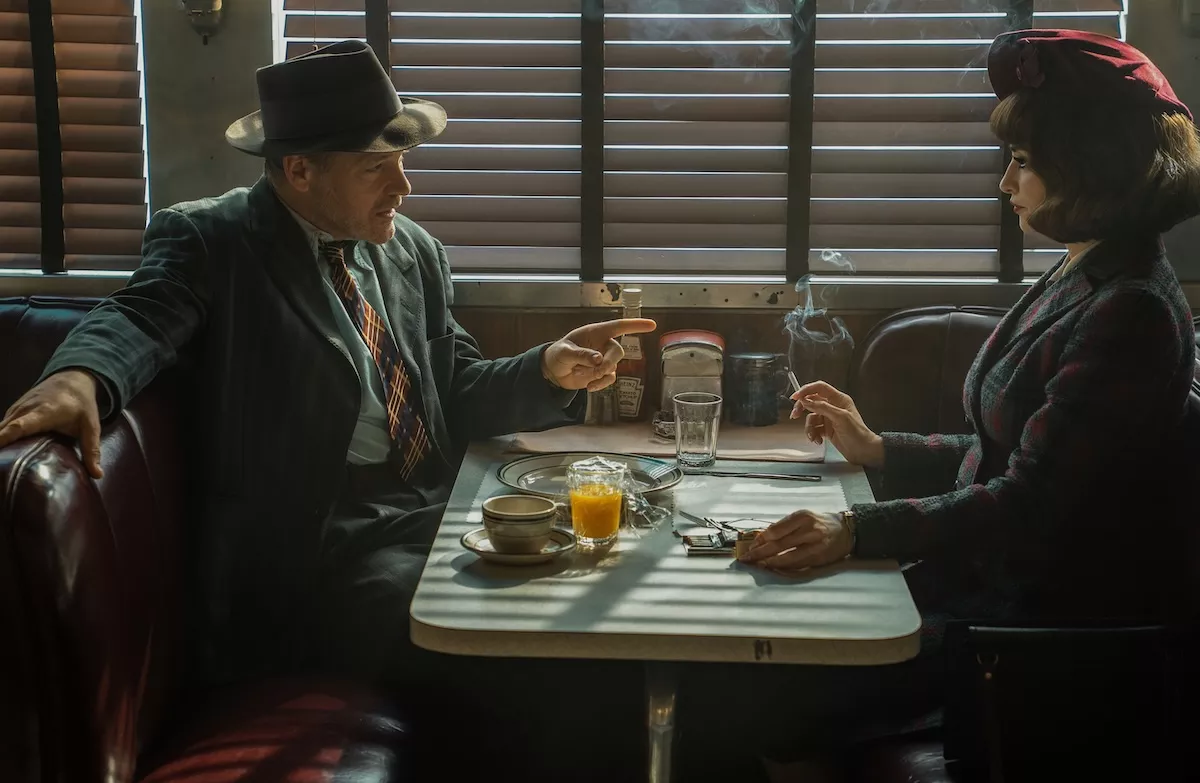
There are two investigators, Detective Jake Wiles (Peter Sarsgaard) and his assistant, Myrna Mallow (Penélope Cruz) who seem to be investigating gender roles as much as anything else. (“You do your detective work; I seduce the sheriffs,” Wiles tells Mallow at one point. “I’m your Gal Friday.”)
Maggie Gyllenhaal has given a range of answers as to why she became a director. Sometimes, she’s described how, as an actor, she wanted a certain kind of collaboration between actor and director that she rarely got. As a director, she could create the kind of world she wanted to live in. Sometimes she talks about how, when she was playing a sex worker turned pornographic film director in HBO’s The Deuce, becoming a director herself began to feel more and more real. And sometimes she talks about Donald Trump.
“I actually think that when I really became a director was the morning that Trump was first elected,” she said, in a recent interview.” I was like, ‘I have a lot more to say than I’ve been saying.’”
In the 1935 Bride of Frankenstein, the Bride doesn’t have a single line of dialogue. In The Bride, she does most of the talking, and the monster rides sidecar.
To the generation raised under the shadow of Christian Bale as BatDaddy, Bale’s IMAX-scale pivot from big galoot so tough to big galoot so tender may induce whiplash. But Jessie Buckley, and this film, are a hell of a thing to ride sidecar in, even in the moments when you can feel its sheer weirdness being pulled back onto the tracks of a more conventional love story. “The whole world is on fire for a lady criminal,” as one character puts it “and it’s turning them on.”
The Bride opens in wide release on Fri March 6, 126 minutes, rated R.