
When Sheraz Pompey was growing up, he seldom saw the outfits he visualized on store racks. He came of age in a period when “urban fashion” locally was often reduced to a predictable uniform of athletic staples, leaving little space for personal flair. So he started building his own looks, pieces he could wear not simply as clothing, but as proof of identity.
“I always make sure the outfit I designed is better than the last,” said Pompey, co-owner and in-house designer at Blueprint in Grandview. ”I try to make pieces that no one else has, and I think that puts me in the category of a trendsetter.”
Across the Kansas City metro, that impulse to create a lane where one does not exist shows up again and again.
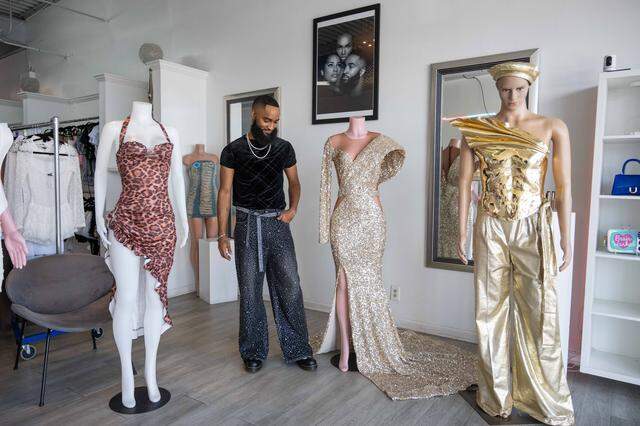
Pompey, now the co-owner and in-house designer at Blueprint in Grandview, is part of a network of designers and fashion entrepreneurs whose paths began with the same friction: a feeling that what they wanted to wear, what they wanted to represent, could not be found easily.
For Ciara Barton, it was the disconnect between glossy fashion editorials and what she saw in mainstream stores. For Kenya Martin, it was the absence of Afrocentric design in local shopping options and the limited opportunities she experienced as a model.
Getting started in fashion
Pompey traces his entry point to a classroom.
“We started with the basics like taking measurements and making patterns,” he said. “Then we moved on to adult clothing, and eventually we started designing for ourselves.”
Before that, he did what many young people do when money is tight and style still matters: He improvised. Not always able to afford new clothes or shoes, he pieced outfits together from what was available. Sometimes that meant borrowing from siblings and restyling items into something that looked like his own. In a fashion design class, that resourcefulness became a skill set. Students started with measurements and patterns, then moved toward making garments for themselves. Pompey said even the short time he spent in the class changed how he saw his future.
“Just from that half-semester in her class, I got the inspiration to become a fashion designer,” he said.
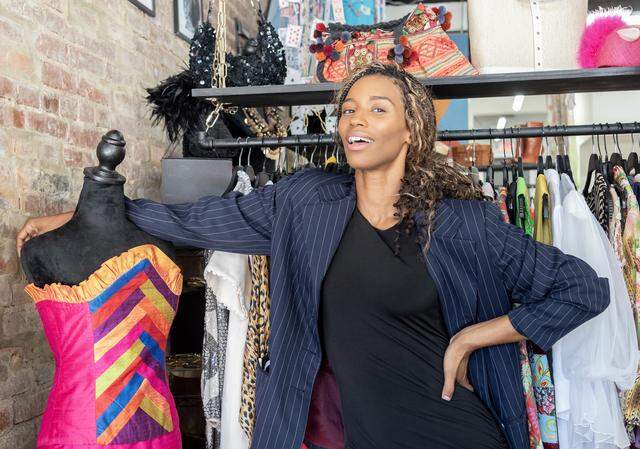
Barton’s origin story starts in the same age range, but her doorway into fashion opened in a thrift store rather than a sewing classroom. She said she loved fashion magazines from childhood and imagined herself as a supermodel. But as a teenager, she was often unimpressed by traditional retail stores, unable to find the kinds of pieces she saw in editorials. At 14, during a family Christmas shopping trip, she asked to browse a thrift store next door so she would not see what her mother was buying. The experience, she said, changed how she understood what style could be.
“When I stepped into this thrift store, it was like stepping into the pages of those fashion magazines,” Barton said.
She found textures and details that matched the fashion language she had been drawn to but could not locate on mall racks: denim, rhinestones, leather, suede. Her mother gave her $50 and Barton left with an armful of finds. The real test came when she wore those pieces to school.
“As a freshman, everything I had was vintage, except for my shoes,” Barton said. “When I would walk the hallways, it would be like I’m walking the runway.”
Her peers reacted with disbelief when she told them where the clothing came from. For Barton, that moment became both a style foundation and a lesson in how secondhand clothing could create individuality in a way mass retail often could not.
Martin’s earliest fashion education, like Barton’s, began with a dream of walking the runway. She, however, did not always feel welcomed by the scene’s traditional beauty standards. Born and raised in Mississippi, Martin relocated to Kansas City in 2003. Her experience on runways shaped how she would build her brand.
“Because I am bowlegged, I didn’t always get selected to model on the runway,” Martin said. “So I came up with a plan. If I decided to transition from a model to a fashion designer, then I could help the up-and-coming models who don’t always get chosen.”
If Pompey’s early years were defined by making what he could not buy and Barton’s by finding what others overlooked, Martin’s path formed by recognizing what was missing. She said she did not see enough Kansas City businesses that represented Africa or offered Afrocentric designs, a gap she decided to address through her work.
“There are not a lot of businesses out here that represent Africa,” Martin said. “There are not many places where we can purchase Afrocentric designs.”
Turning points that became businesses
For all three, passion hardened into commitment in stages, each step built out of earlier constraints.
Pompey kept designing after high school while working a full-time job. He said he was still designing during his senior year, and his early business foundation formed while he balanced employment with garment work. His first public breakthrough came when a friend asked him to create a collection for a local fashion show, “Coldest Winter Ever,” held at the Jackson Museum. It was Pompey’s first chance to showcase his work publicly and be recognized for it.
“That was my first show, my first time designing publicly and the first time I got noticed for my fashion,” he said.
Demand followed. He began receiving requests for garments and the math eventually forced a decision about where his future was headed.
“I was making my weekly paycheck from UPS off of one dress, so I decided to take the risk and quit my full-time job to run my business full time,” Pompey said.

Barton’s professional arc included a pivot shaped by timing and opportunity. She moved from modeling aspirations into a mix of modeling, runway coaching and early entrepreneurship. In 2014, she launched what she called Trash to Treasure Party, an eco-friendly fashion event that began booking across the city. In 2017, she launched a runway coaching and modeling services business. But when the pandemic hit and those services slowed, Barton found a different kind of runway: the internet.
Through online fashion and thrift communities, she began showcasing pieces from her own closet. People asked to buy them. She started going live online multiple times a week, building an audience and a revenue stream that made the business feel viable beyond hobby.
“I began to make like $1,000 a week during the pandemic,” Barton said.
Martin’s foundation was built through reinvention, and it came later than people might expect. She said she did not begin sewing until 2021. After an apprenticeship at the Sewing Lab and classes, she launched K-Made It in 2023 amid government layoffs that pushed her toward focusing on her business full time. Her brand name carries the message she wants people to hear about starting over, starting late and starting anyway.
“My name is Kenya Martin, and if K-Made It, so can you,” she said. “It doesn’t matter what age you are, you can always start.”
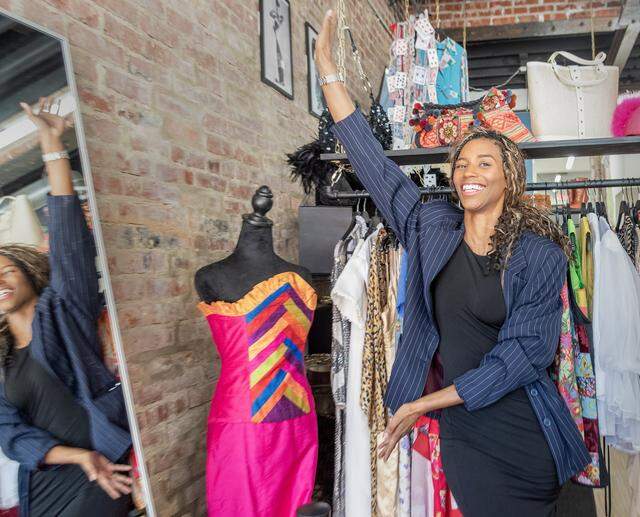
As the online audience grew, Barton said inventory spilled out of her home. She moved into a studio, then into a small space at 36th and Main, where she tested retail while still holding workshops and fashion-related events. Today, her business, Thrift The Runway, operates from a physical storefront at 811 E. 31st St. She has also built KC Thrift Tours, now in its second season, which runs from March through October and takes groups by bus to multiple thrift and vintage shops across the metro.
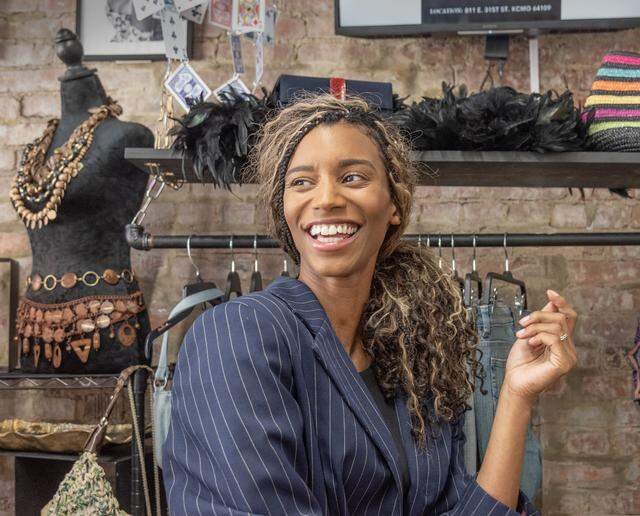
Barton describes herself as a “first-generation thrifter,” a phrase meant to explain how new the practice was within her family and how much stigma used to surround it.
“My mom grew up in a less fortunate upbringing and she had that stigma of thrifting being something for needy people,” Barton said. “It was a mentality of the past.”
That stigma has shifted, she said, in part because people now wear secondhand clothing openly and confidently online.
“People are able to use social media to showcase their collections and personal style,” Barton said. “They started to see people wear secondhand clothing proudly and with confidence.”
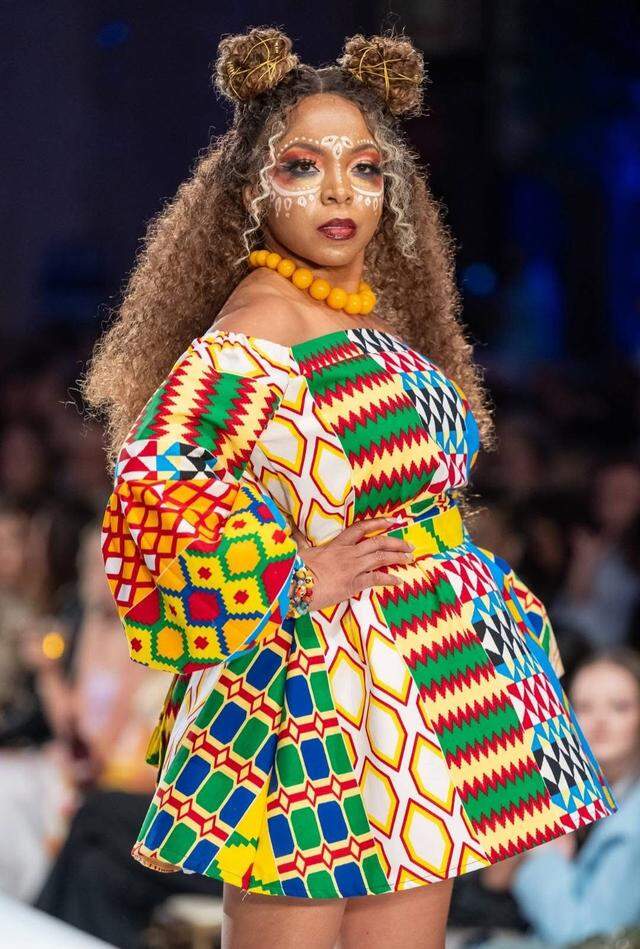
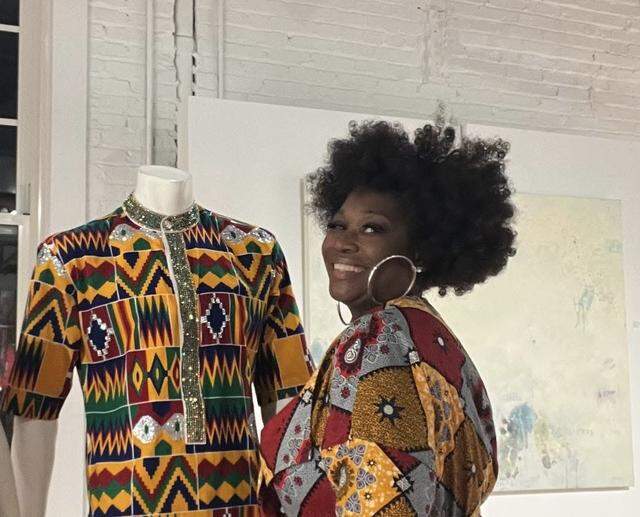
Martin works out of the Zhou B Art Center in the historic 18th and Vine District, developing a style built around bold color and Afrocentric design, often using Ghanaian and Nigerian textiles, kente-inspired fabrics and mixed prints. She said she is actively educating herself on symbols and meanings behind the materials she uses.
“I am continuing to educate myself,” she said. “I also know that kente fabric is one of my favorites, and I’m learning more about it.”
Martin said she is the only resident artist in the building who is a fashion designer, and that distinction has mattered, especially during First Fridays.
“As of right now, I am the only artist there that is a fashion designer,” Martin said. “That makes me feel amazing.”
.jpeg "att.tfBqnjw2xbQ3_sEWmwS7nHaiFdXzaE-e8DEXq6hLHm4 (1).jpeg")
Pompey, now co-owner and in-house designer at Blueprint in Grandview, describes his work as custom, one-of-one and ready-to-wear, built to stand apart from trend cycles and fast fashion. His runway approach has long been about impact, including an early moment that helped put him on the map.
“I wanted to show variety,” Pompey said. “I had three models walk out at the same time wearing the same dress in different colors. That was the wow moment of the show.”
That pursuit of originality remains his brand positioning.
“I try to make something you’ve never seen before,” he said. “I don’t follow trends, I create them.”
What it costs to make it custom
Recognition has not erased the financial realities. Martin says fashion, especially custom fashion, is still often undervalued compared with other art forms and compared with more affordable retail goods.
“People will pay money for a painting, but they won’t pay the money for a custom fashion piece,” she said.
To explain the gap, Martin breaks down labor and materials. If a bomber jacket takes five hours and she pays herself $25 an hour, she said, that is $125 before fabric, zippers, interfacing and thread.
“People don’t always understand the cost behind custom work,” Martin said.
Pompey runs into a parallel problem from a different angle. Kansas City is not built like a fashion city, he said. There is no garment district and fewer places to source materials quickly. As his business has grown, the lack of infrastructure has remained a constant friction point.
“Kansas City doesn’t have a large fashion industry. We don’t have many fabric vendors,” Pompey said. “We just lost Joann’s recently, which was one of the largest fabric retailers for the fashion community here.”
He said he now orders most supplies online and beyond materials, scaling the business brings its own issues: building a team, maintaining growth and drawing foot traffic to a store outside the city’s center.
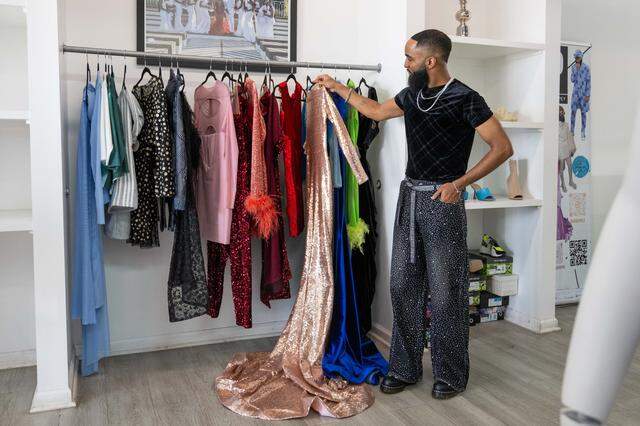
Barton says the growth of thrifting has brought its own complications. The mainstreaming of the market has changed the hunt, she said, as more fast fashion enters thrift stores and pricing sometimes rises close to retail levels.
“There is a lot of fast fashion dumped in, and it has become very difficult to find those gems,” Barton said. “Sometimes you will go in and the pricing will be just as much as in the retail store.”
The work of building a KC fashion ecosystem
In different ways, all three are facing the same question: how to build a fashion business in a city where infrastructure is thin, the market requires education and visibility is not guaranteed.
For Pompey, it means grinding for recognition and building a client base one garment at a time.
“We’re not in LA, where you can wear an outfit, walk down the street and be discovered by a top designer or celebrity,” he said. “So for Black creatives here, you really have to grind.”
Barton built her visibility through early personal style, then through events and digital community. Martin built hers through fashion shows, studio traffic and the credibility that comes from carving out space in an art institution. Each has constructed a platform in a different way, but all are contributing to a larger shift in how Black fashion is seen and practiced across the metro.
Pompey sees the broader impact when he watches younger designers take risks in a city that is still learning how to support them.
“It’s amazing to see young Black designers take risks,” he said. “It makes Kansas City known for more than just sports. It shows we have creativity and style too.”

J.M. Banks is The Star’s culture and identity reporter. He grew up in the Kansas City area and has worked in various community-based media outlets such as The Pitch KC and Urban Alchemy Podcast.