
The scientific world may slowly be realizing just how much it has overlooked women’s health. Even so, not all topics within that broad umbrella are getting equal attention — and menopause is among the most neglected.
Education about menopause is lacking in the U.S., with more than 60% of women reporting they did not feel informed about menopause at all in a 2022 survey published in Women’s Health. Meanwhile, fewer than 2% of physicians are trained around menopause, according to the Menopause Society, leaving women with few options if they do seek care.
It might come as no surprise, then, that “menopause is not even reported in the health records,” said Rupal Patel, a professor of communication sciences and disorders at Northeastern University. “That’s what we’re trying to shine a light on.”
Patel and two other researchers at Northeastern are behind a new effort to bring attention to menopause. Called the Center for Women’s Health and Economic Wellbeing, or WHEALTH, the new initiative aims to study and raise awareness not only around the health impacts of menopause but how they affect women’s day-to-day lives, and particularly their economic reality.
Broadly speaking, menopause is when a woman stops menstruating. But that major marker, which is brought on by fluctuations in hormone levels, is often accompanied by a host of other symptoms, ranging from hot flashes and brain fog to high blood pressure and sleep disruptions. Changes in hormones can also cause decreases in calcium levels, which in turn can cause muscle and joint issues. Blood pressure and cholesterol increases can make women more susceptible to heart conditions.
What complicates matters is that those symptoms vary widely from person to person. There’s no set age for when menopause begins, and women can experience symptoms seven to 14 years before they’re even formally in menopause.
“This cascade of events is almost like this domino effect,” said Patel, who is also director of the Voice of Women Lab, which has pioneered using the human voice as a biomarker.
“The hormones spike and then it has a result on your heart and then that has a result on your sleep and because you’re not sleeping well you can’t really think well and if you’re not thinking well, you can’t be productive at work. It’s just this cycle.”

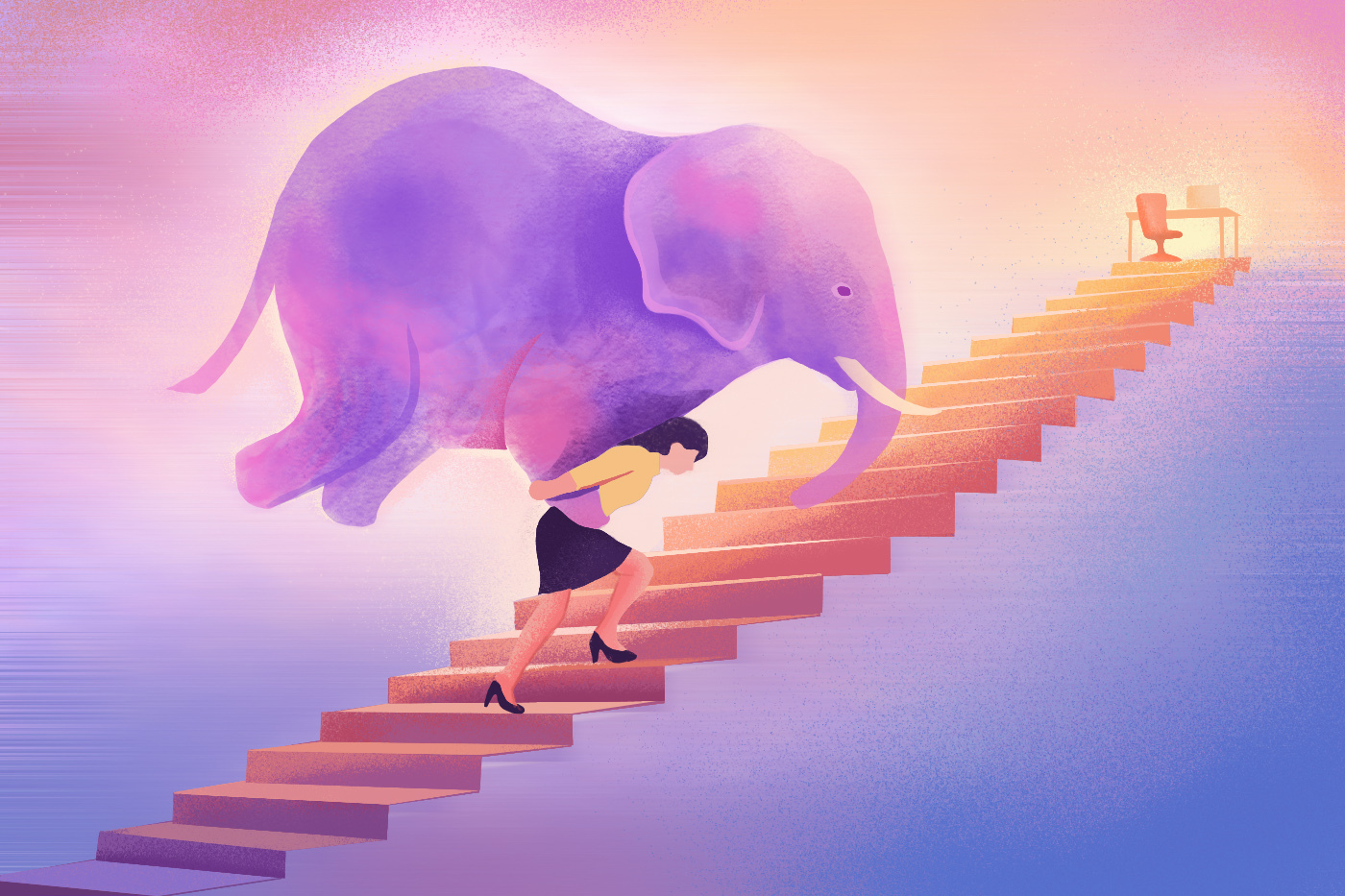
But given how poorly studied menopause is, there is also a significant lack of awareness, education and support around it. Employers also rarely offer workplace accommodations to those experiencing symptoms that interfere with their jobs.
“A lot of times when you say ‘menopause,’ clinicians think ‘end of fertility,’” said David Franklin, the founder and CEO of digital women’s health company Naviday Health and an industry partner of the Center for WHEALTH. “Yes, that is part of it, but it’s so much broader than that because a woman’s health journey not only impacts physically, biologically, mentally. It impacts the home, it impacts the community, it impacts the workforce.
One of the better known impacts is a neurological effect called brain fog.
“Forgetfulness is an annoyance, but when that gets in the middle of you doing your job, it becomes more than an annoyance,” Patel said. “It becomes a big challenge.”
Researchers are also just starting to understand how estrogen decreases impact bone health and potentially cause bone diseases like osteoporosis, which can also make women more prone to fractures, Patel explained
Patel and her colleagues, Aarti Sathyanarayana, assistant professor of public health and health sciences, and Leanne Chukoskie, associate professor of physical therapy, human movement and rehabilitation services, hope their research at the Center for WHEALTH can continue to build on the current understanding of this biological period of a women’s life.
Each researcher brings a different expertise to the center. Patel’s work focuses on using the human voice as an early indicator of developing health conditions, including menopause. As estrogen decreases significantly during this time, tissue in the vocal folds can change, making women’s voices deeper and more strained.
Sathyanarayana has experience tracking and translating digital health data for doctors. She has also worked to improve diagnosis for sleep apnea, which menopause can cause.
Chukoskie comes to the center with experience researching how women engage in strength resistance training, which has proven highly beneficial during midlife. Her work uses wearable electronics and sensors to involve women more effectively in this kind of exercise.
Together, they bring an array of approaches to an issue that can be all-consuming during this phase of a woman’s life. They hope to bring together even more academic and industry collaborators onboard in the future. The WHEALTH Summit 2026, held at Northeastern on April 9 and which will bring together Northeastern faculty with industry partners, like Naviday Health and mattress company Eight Sleep.
In addition to the medical effects of menopause, the research conducted at the Center of WHEALTH also aims to identify how the myriad symptoms experienced by women impact them on a professional and economic level.
Without an employer willing or aware enough to offer workplace accommodations, women have few options but to take time off work or quit altogether. A survey by the Society of Human Resource Management found that 13% of women in the U.S. quit their jobs because of menopausal symptoms. The Mayo Clinic also estimates that employers lose $1.8 billion annually from women missing workdays due to menopause symptoms.
Without the appropriate support, “[women are] going to look for a place that’s more open,” Chukoskie said. “That is what’s happening: People just say, ‘I’m done’ and they leave, and we’re poorer for [losing out on institutional wisdom].”
Even though only about 5% of U.S. employers offer menopause-specific benefits, according to a survey from NFP, a benefits consultant and insurance broker, Franklin has started to see a “momentum shift.” Large employers like Bank of America are starting to identify, if not yet act on, the health needs of their female workers. Legislation is also starting to play a role: In 2025, Rhode Island became the first state to require that companies offer menopause accommodations to their employees.
“At a point where people should be at their leadership peak, moving into these roles, they are being sidelined,” Chukoskie said. “How can we make sure that’s not the case, and how can we develop policies, encouragement [and] awareness …that [menopause] is a thing?”