Kalshi and Polymarket are crashing the NBA’s All-Star Weekend.
Well, technically, they were invited. I broke a small bit of news over at The Closing Line:
If you don’t like clicking on links, here’s some of it:
The founders of the two biggest prediction markets will appear at the NBA All-Star Technology Summit on Friday in Los Angeles.
Kalshi founders Tarek Mansour and Luana Lopes Lara, as well as Polymarket founder Shayne Coplan, will be among the participants on a panel about the prediction market industry during All-Star Weekend.
Here’s the description of the panel:
Prediction Markets: The Impact on Sports and Beyond
The surge of interest in prediction markets has disrupted the sports betting landscape, offering new ways to engage with the games we love. While these platforms have the potential to enhance the fan experience, they also present new risks to the integrity of competition. Hear industry leaders talk about the opportunities, the pitfalls, and the yet-unknowns of this quickly evolving space and the impact it could have both within sports and beyond.
FanDuel, DraftKings, and MGM are also involved in the panel. The event is invite-only, so it’s not clear what we’ll hear about how the event went.
This isn’t the same as a deal between the NBA and a prediction market, but it’s clearly a step along that path. The NBA isn’t keeping prediction markets at arm’s length; they are getting invited to speak alongside some very big names. (Former President Barack Obama is a part of the event, as well.)
Much of the metagame for prediction markets right now is about gaining legitimacy. Getting the seat at the table. Being seen as something more than gambling.
On that last one, I actually believe it is and can be (at least for stuff outside of sports) but it needs validation from outside sources… like the NBA.
As I’ve written in this space before, the leagues are in both an enviable and unenviable spot. Sports event contracts are here for the next few years, at minimum. And they very well may survive beyond that.
Leagues could choose to fight prediction markets, or sit it out entirely. But the most likely path is somewhere in the middle… to find ways to work with prediction markets while also getting 1. some measure of control, 2. assurances on integrity monitoring, and 3. some money.
I could be overblowing an invitation to NBA All-Star Weekend. But it feels like another pretty pivotal moment as prediction markets try to become mainstream.
One footnote before it gets lost to the sands of time: Remember when an account with a Kalshi badge portrayed NBA Commissioner Adam Silver as a Nazi? Fun times, fun times.
Finally, against the backdrop of that NBA news, lots of people have opinions on an NBA player getting involved with a prediction market:
-
Wetzel: Giannis/Kalshi deal does NBA no favors (ESPN): “Against this backdrop, one of the league’s biggest stars, Milwaukee‘s Giannis Antetokounmpo, might not have done anything wrong, but he also didn’t do the NBA any favors last week when he announced he had taken a small ownership in the prediction market Kalshi. … These predictive markets are the last thing professional sports leagues need seeping into the public consciousness. Even worse when star athletes become involved as owners (a nonwagered prediction: Antetokounmpo won’t be the last). …”
-
“The more intertwined the leagues, teams and players get with sports betting, however, the more fans are being asked to extend their blind faith. At some point, perception defines reality and optics are going to overwhelm everything.”
-
-
On The Breathtakingly Cynical Giannis Antetokounmpo Kalshi Investment (Defector, podcast): “This week on Nothing But Respect, we are covering the trade deadline in a very characteristic way, by which I of course mean we spent most of the episode talking about Giannis Antetokounmpo’s Kalshi investment, prediction markets, and the increasingly fractured and incoherent ways the sport is consumed and talked about.”
-
ICE Launches Polymarket Signals and Sentiment Tool Turning Crowd-Sourced Dynamic Views into Market Opportunities (press release): Intercontinental Exchange, Inc. (NYSE: ICE), a leading global provider of technology and data, today announced the launch of the Polymarket Signals and Sentiment tool, delivering prediction market data and analytics. ICE will become the exclusive provider of this data for institutional capital markets.
-
Polymarket is the world’s largest prediction market, which includes prediction markets that are related or adjacent to financial and commodity markets. ICE now offers normalized data feeds representing Polymarket’s prediction markets, enabling professional and institutional traders to consume crowd-sourced probability assessments as market signals. These signals indicate implied probabilities on real-world outcomes that are not typically captured by financial instruments and are designed to complement traditional market, pricing, and sentiment inputs within institutional workflows.
-
“Polymarket’s prediction markets have ushered in an entirely new way to look at the world around us, and with billions in trading volumes, they are allowing us to structure dynamic views of key market-moving economic, political, and market events from unstructured datasets in a way previously difficult for institutional capital market participants to use,” said Chris Edmonds, President of ICE’s Fixed Income and Data Services. “It’s so rare for new datasets like this to become available at such a quick pace, but with our sophisticated AI and data science experience, we’re able to normalize the data to help our customers convert the wisdom of those markets into signals that they can use to develop alpha generation strategies and manage risk.”
-
“As prediction markets mature, their value to institutional investors becomes clearer,” said Shayne Coplan, Founder and CEO of Polymarket. “These markets reflect collective expectations on market-moving events in near real time and have quickly emerged as a credible input alongside traditional data sources. Working with ICE helps ensure that those signals can be accessed, interpreted, and applied in a way that can be used as a resource for institutional market participants.”
-
ICE’s Polymarket Signals and Sentiment service aggregates and normalizes data, bringing it to customers in a structured environment that matches the way they access markets and trade. The service is delivered through ICE’s existing data infrastructure, with near real-time access via the ICE Consolidated Feed and historical time-series data available through ICE Consolidated History to support backtesting and quantitative analysis.
The tool leverages ICE’s extensive entity identification and reference databases to map Polymarket signals to specific securities or companies, allowing customers to integrate it with existing ICE data offerings, including securities pricing, fundamental data and corporate actions.
-
This data is part of ICE’s recently launched Signals & Sentiment service, which includes data and analytics from Reddit, Dow Jones and now Polymarket.
-
For more information on Polymarket Signals and Sentiment, please visit: https://ice.com/fixed-income-data-services/data-and-analytics/market-signals-and-sentiment.
-
-
Who needs lawyers at the CFTC?

Nick Devor@nickdevor_
UPDATE: The last attorney resigned on Monday, according to people familiar with the matter.
That attorney has not responded to my requests for comment.

Nick Devor @nickdevor_
SCOOP: There’s only one enforcement attorney left at the CFTC’s Chicago office.
Known as a group of heavy-hitters, attorneys and investigators in the Chicago office have had a role in most major CFTC enforcement actions since the birth of the agency in 1975. In recent months,
3:08 PM · Feb 10, 2026 · 434K Views
17 Replies · 291 Reposts · 1.71K Likes
-
The CEOs of Kalshi and Polymarket Are Betting On the Most Hated Experiment in Business (Vanity Fair): Yet only one person there mentioned the dirty word that everyone else had so carefully avoided. A little guy in the corner with especially large teeth, a thick Eastern European accent, and a few sparse hairs attempting to cloak his balding forehead. He was swirling a glass of ice and cryptically dodging my basic questions—for instance, what his name was. I’d been riffing about prediction markets with him when he leaned in close, his mouth full of cheeseburger.
-
“You’re writing about this, but you have no idea what this meeting is, do you?”
-
“What is it?” I asked, leaning back to avoid his spittle.
-
“This,” he said, taking in the barroom of traders, “is just the latest Gamblers Anonymous meeting.”
-
-
Thousands of Amateur Gamblers Are Beating Wall Street Ph.D.s (New York Times): “Over the five years that Kalshi has existed, its thousands of gamblers have proved as accurate on average at predicting certain economic indicators as the highly trained forecasters, a working paper published last month by the National Bureau of Economic Research found. The crowd is also pretty good at predicting interest rate decisions from the Federal Reserve, and even better than the professionals at predicting the rate of inflation.”
-
“Getting information from a large pool of people can be a remarkably good form of forecasting,” said Jonathan Wright, an economics professor at Johns Hopkins University who co-wrote the paper.
-
-
Examining The US Prediction Market Landscape From The United Kingdom (InGame): “InGame interviewed Sabin Brooks, chief revenue officer of Bettormetrics, a UK-based, sports-focused, data-analytics platform and data provider, and company analyst Alfie Arrand about what they have so far observed, using the history of prediction markets globally as context.”
-
“Arrand said that the true delineation between prediction market gamblers and sportsbook customers has yet to be determined in the U.S. While Arrand believes sportsbook bettors are generally recreational sports fans, he said that prediction markets haven’t “nailed exactly what their customer will look like.” The overlap between the experienced day trader and sports bettor, he said, remains undefined.”
-
“The typical argument that seems to be happening every day is whether or not it’s gambling, because they’re suddenly interacting with sports in a way that they wouldn’t normally have done before,” he said of typical financial speculators. “And everything is currently happening on a much shorter horizon than those individuals – the day-trader types – might be used to.”
Ultimately, he said, “I think it’s going to be a bit of both.”
-
-
VCs Are Throwing Money At Recent College Grads To Build Prediction Markets (Forbes): “When venture capitalist Mark Goldberg looks at the year ahead, he’s certain of one thing: prediction markets will be one of his main areas of investment.”
-
“Prediction markets are moving so quickly into the mainstream in a way where I think the amount of money being traded is going to go 100x in the next 5 years,” says Goldberg, cofounder and managing partner of San Francisco’s Chemistry.
-
Goldberg is not alone. “Over the last year, it’s probably been one of the most popular areas for the places that we see new founders gravitate towards,” says Caitlin Pintavorn, partner at crypto-focused venture firm Paradigm.
-
-
Are prediction markets democratizing information or gamifying war? | The Excerpt (USA Today, podcast): “Are prediction markets democratizing information as some argue or are we monetizing reality in a way that incentivizes perverse motives? Alex Goldenberg, Fellow at Rutgers University, joins The Excerpt to explain how these markets work and the risks they pose financially and politically.”
-
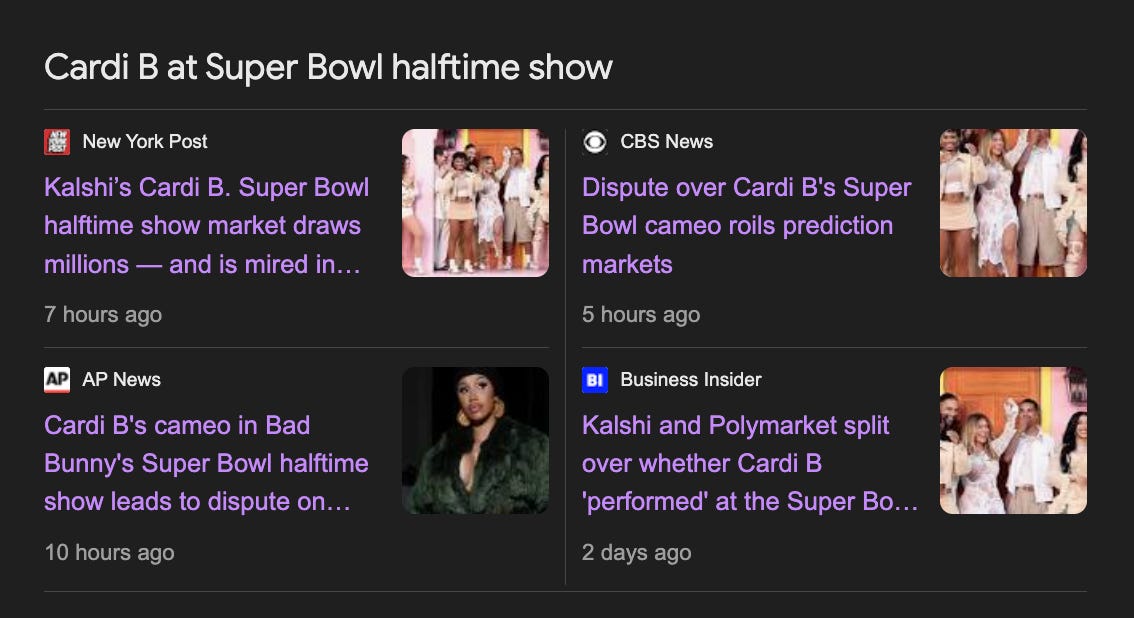
Cardi B won’t go away: There is a lot of virtual ink being used to write about prediction market betting on Cardi B “performing” at the Super Bowl halftime show:
-
Lubit Announces a Prediction Market for Energy (press release): Lubit, the pioneer in energy price prediction markets, today announced the world’s first dedicated marketplace for predictive energy markets. Announced at E-world, Europe’s premier energy trade fair, Lubit launches prediction markets for global energy.
-
Prediction markets have historically been focused on one-time events, like election outcomes or questions like “will it rain tomorrow”, but Lubit reframes this theory for repeating predictions – seeing markets as incentivised aggregators of information – across multiple energy traders prediction models, aggregated into a prediction of the future direction of the market – better than individuals are able to, applied to the high-volume, high-complexity, world of energy – starting with price, but later also volume and other types of energy than electricity.
-
By opening with day-ahead electricity predictions, Lubit will provide traders with a venue to compete on their predictions and monetize these – competing with incentives for the best prediction accuracy.
-