
The freshman seasons — and presumably college careers — of AJ Dybantsa and Darryn Peterson came to an end this weekend as BYU and Kansas failed to advance past the first weekend of the NCAA Tournament. That does not mean the race to be the No. 1 pick in the NBA Draft is over. If anything, it may just be getting started.
Dybantsa finishes the season atop the updated CBS Sports Big Board after leading the country in scoring while making notable improvements across his game. He showed his ability to create his own shot translates against high-level competition, improved finishing through contact and made strides as a shooter, passer and decision-maker. Combine that with elite wing size, length and athleticism, and he remains a strong candidate to be the No. 1 pick in any draft class.
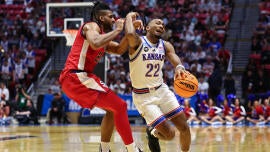
Peterson’s season ends without fully matching the sky-high expectations he set in the fall. The production was solid, and flashes of elite shot-making were undeniable, but he never escaped the cloud of preseason injuries and availability issues. He did not consistently look fully healthy or able to play with the same force and explosiveness he showed in high school. If the pre-draft process allows him to return to full strength, however, the debate at No. 1 could quickly intensify.
Kansas squanders its best player as Darryn Peterson’s college career ends with second-round loss to St. John’s
Cameron Salerno
While Dybantsa and Peterson are done, several top prospects remain alive entering the Sweet 16 — and not coincidentally, many of them are climbing the latest Big Board.
📈 Darius Acuff Jr., Arkansas
There may be only one player in college basketball who can create offense on demand with the same volume and reliability as Dybantsa. It’s Acuff, who is captivating basketball audiences at all levels.
At Arkansas, he has continued doing what defined his high school career: taking over games. He led the Razorbacks to an SEC Tournament title while averaging 30 points, seven assists and four rebounds, then carried that momentum into March Madness. Through two NCAA Tournament games, he has posted comparable production while shooting 46% from the field, 49% from 3-point range and 87% from the free-throw line.
Acuff is the best shot creator left in the field and pairs that with high-level decision-making.
There are still questions about how his game translates to the next level. His size, lack of elite burst and defensive inconsistency could present challenges, particularly given the high bar for undersized, ball-dominant guards in today’s NBA.
So why is he rising? Because the offense is undeniable. The shot-making, passing, scoring at all three levels and ability to create separation are all visible right now. There is nothing theoretical about this. His postseason run has only reinforced that he has been operating on a different level than his freshman guard peers. Acuff is No. 5 in the CBS Sports Big Board and is the No. 2 point guard prospect behind Peterson.
📈 Morez Johnson and Aday Mara, Michigan
Both Michigan bigs are rising, but for very different reasons.
After two uneven seasons at UCLA, Mara has found his footing at Michigan. The 7-foot-3 center is averaging nearly three blocks in under 23 minutes per game, but his impact goes beyond the box score. His presence allows Michigan’s perimeter defenders to aggressively pressure shooters, knowing he is protecting the rim behind them.
Offensively, he offers vertical spacing, passing feel and flashes of skill. He remains a polarizing prospect, but one whose stock has clearly improved. Mara now sits at No. 23 in the CBS Sports Big Board.
Getty Images
Johnson’s development has been just as notable. Once viewed as an undersized big, he has evolved into a versatile, two-way frontcourt piece. His physicality, rebounding and finishing remain strengths, but he is now showing improved perimeter mobility and early signs of shooting touch. He has also proven he can thrive alongside another traditional center.
That combination points to a clear NBA role as an efficient, complementary frontcourt player. Johnson ranks No. 21 in my prospect rankings.
📈 Tarris Reed, UConn
Reed is climbing the center rankings and could push into first-round consideration depending on how the draft field shapes up. Right now he’s No. 38 overall in the CBS Sports Big Board.
The UConn big brings NBA-ready size and strength, highlighted by a 7-foot-5 wingspan. More importantly, his development has been steady and consistent. He has improved each of his four college seasons and continued that progression this year.
He excels scoring inside through seals and physicality while showing growth in footwork and comfort operating in dribble handoff actions. His experience in UConn’s system should help accelerate his transition to the NBA.
📈 Otega Oweh, Kentucky
Oweh made headlines with two game-tying shots in Kentucky‘s first-round win, but his rising NBA outlook is more about role projection.
He took on significant creation responsibility this season, which impacted his efficiency. He shot 33% from 3-point range overall, but an impressive 60% on open catch-and-shoot attempts — a strong indicator he can space the floor at the next level.
Defensively, his tools suggest he can be a more impactful player in a reduced role. His long-term value will likely come as a two-way role player rather than a primary creator. Oweh is up to No. 45 in the CBS Sports Big Board.
📉 Keaton Wagler, Illinois
After a dominant stretch earlier in the season, Wagler’s play has leveled off and his stock is dropping. His shooting and feel remain strengths, but limitations in burst and strength have become more apparent against focused defenses. Wagler is still a lottery talent but trails other freshman guards, including the two players he’d been clustered with around the No. 5 spot in Acuff and Houston‘s Kingston Flemings. Wagler is currently No. 7 for me and the No. 4 point guard.
📉 Braylon Mullins, UConn
When a shooting specialist hits just 33% from 3-point range, it raises questions. Mullins’ long-term shooting outlook remains positive, but he may need more time in college — both to regain confidence and add strength. I have him as a faller. He is No. 28 on my big board.
📉 Joshua Jefferson
Offensive struggles in Big 12 play — 39% from the field and 31% from the free-throw line — have amplified concerns about his scoring translation. He still projects as an NBA player, but is no longer a lock for the first round as his stock slips. It is uncertain whether we see Jefferson against Tennessee in the Sweet 16. I have Jefferson at No. 34 in the big board.