
Coverage features 4X-slo-mo Supracam and Steadicam, Nucleus 4K cameras, closer play-by-play angle, 10 player mics
NBC Sports is in the midst of its first NBA All-Star Weekend in nearly a quarter century, and it has rolled out a wealth of new production technology to put its own stamp on the league’s signature event. Whether newly conceived camera angles, a robust arsenal of player/coach mics, or the launch of Peacock’s Courtside Live experience, NBC brings a fresh take to its coverage of the NBA All-Star festivities at Intuit Dome.
“There’s no greater celebration of the NBA stars than All-Star Weekend,” says NBA on NBC Director Pierre Moossa. “It’s our job to make sure it is an extremely fun experience for the viewer at home. We’ve always talked about bringing the audience closer to the action and making sure everyone at home has an even better seat than those front-row seats. With the mics, cameras, and unique angles we have, we’re going to make sure fans at home appreciate how special this weekend is.”
This year’s All-Star Game is the first to feature a U.S. vs. World format, as NBC looks to draft momentum off the 2026 Milano Cortina Winter Games bookending today’s All-Star Game broadcast.
“We also understand that, with the Olympic lead-in and throwing to Olympics afterwards, we’re going to be exposing the NBA to a much broader audience,” says Moossa. “A lot of people may not be familiar with the All-Star game, so we have to make sure people appreciate what makes this event special.”
Cameras Galore: NBC Sports’ Signature Style Comes to NBA All-Star
Essentially all the primary game-coverage cameras in NBC Sports’ 50-plus complement are high-frame-rate systems. This includes a dozen Sony HDC-5500’s running at 6X slo-mo, a 4X Supracam cabled system flying overhead (carrying a Sony HDC-P50), a 4X RF Steadicam (one of two Sony HDC-P50 RF Steadicams on hand), and, on each basket, above-the-rim (2X) and behind-the-glass (6X) Sony HDC-P50 robos from NEP Specialty Capture (formerly Fletcher).
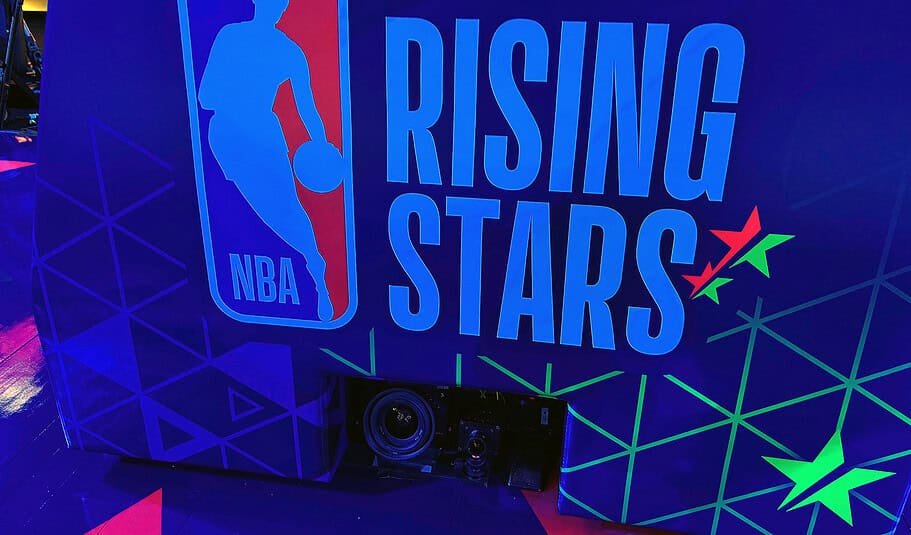
NEP Specialty Capture is also providing an Antelope Nucleus miniature 4K POV system in the stanchion of each basket. A Nucleus camera on each end of the scorer’s table serves the Courtside Live streaming experience: providing an ultra-wide shot of the court, the camera is enclosed in a padded housing and placed on a turntable to enable the operator to move it easily from side to side to cover more of the action.
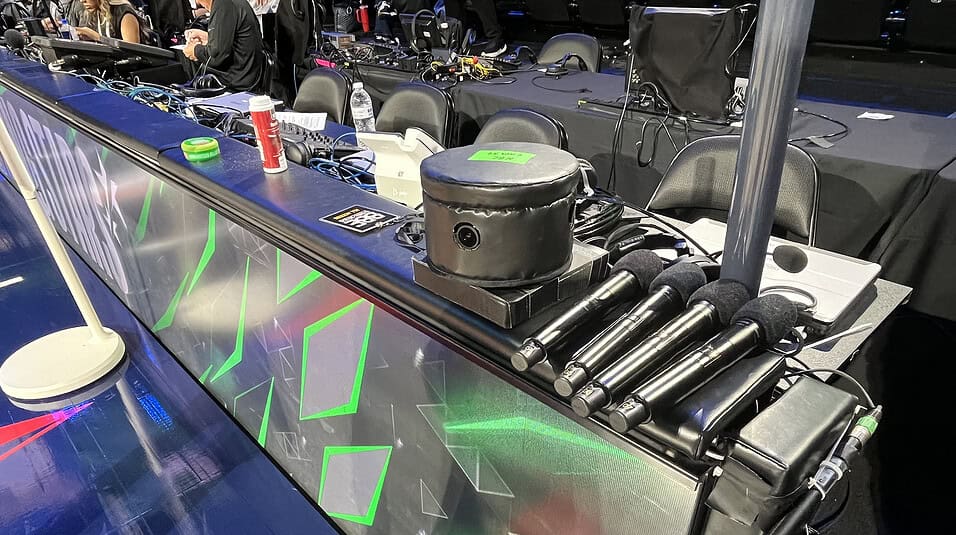
NBC has also deployed a Proton Zoom ultra-compact POV camera from NEP Specialty on the announce table to capture announcer reactions, as well as Panasonic 150 PTZs outside both home and visitor locker rooms.
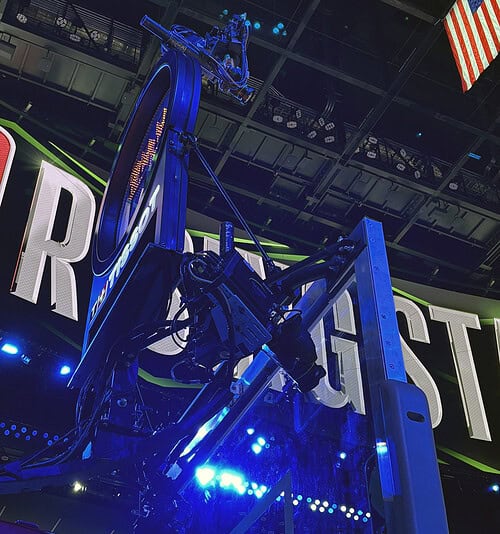
The play-by-play position (as well as the tight action shot) will be lower than usual, providing what Moossa calls a “more intimate look” for the primary game camera.
NBC will also be flying a drone outside the arena for beauty shots and taking a feed from an interior drone, both drones operated by the NBA Live Production & Entertainment (LP&E) team.
NBC is using Canon glass exclusively, including 10 122X and six 111X lenses 4K zoom lenses.
On-Court Audio: NBA PlayerMic Debuts on NBC
For the first time this season, NBC will deploy Q5X PlayerMics to capture player audio on the court. NBC miked eight players for Friday’s Rising Stars game, and a lavalier/IFB combo on all four team coaches (NBC talent Carmelo Anthony, Vince Carter, Tracy McGrady, and Austin Rivers) enabled live two-way conversations with game announcers.
For today’s NBA All-Star Game, 10 players will be miked, as will coaches from all three teams. The 10 Q5X PlayerMics require 20 transmitters to cover both halves of the game because players switch jerseys at halftime. Six iso cameras have been dedicated to covering miked players.
For more on NBC’s audio effort (and the in-arena sound), click here.
‘No Room at the Inn’: With Stamford Booked Up, NBC Goes Fully Onsite in L.A.
With Milano Cortina 2026 in full swing, NBC’s Stamford, CT, broadcast center has been dedicated to Olympics production. As a result, NBC Sports has rolled out its entire NBA All-Star operation onsite in L.A. and, with the exception of the edit team, has zero presence in Stamford. In all, NBC has more than 400 people credentialed onsite, about 125 of them serving the game- and studio-production operations.
“The whole month has been unique,” says Kim Titone, senior director, NBA operations, NBC Sports, “because there’s ‘no room at the inn’ in Stamford. Usually during the regular season, our graphics operators are all in Stamford, many of our productions are REMIs out of Stamford, and, obviously, the studio show is in Stamford. But, during the Olympics, none of that is an option.”
With that in mind, NBC has rolled out seven NEP mobile units to serve its NBA All-Star production needs at Intuit Dome: Supershooter 10 and ST 10; Supershooter 4 A/B/C; and Supershooter 12 and ST 12. With significantly more cameras and nearly three times the EVS replay systems of a standard NBA on NBC A game, NBC relies on NEP’s TFC (Total Facility Control) system to bring it all together.
TFC links Supershooter 4 A/B with Supershooter 10, which serves as primary production engine for the entire show. This setup enables NBC to use the larger production-control room in Supershooter 4, allowing Supershooter 10’s PCR to house additional positions and crew. Supershooter 12 A unit produces the onsite studio show, and ST12 provides overflow seating and engineering resources. Supershooter 4 C unit, parked in an ancillary lot outside the arena, serves primarily as an equipment hauler.
Located in a nearby parking lot, Supershooter 6 and ST6 — typically part of the NBA on NBC fleet — serve the NBA world-feed production. TFC also allowed them to be easily connected to the rest of the fleet.
“Through the wonder of TFC,” says Jenny Powelson, director, remote technical operations, NBC Sports, “we were able to network everything together, and it has definitely made sharing feeds much easier. NEP has made some enormous strides with TFC: now they can just [work] with network engineers, get everything connected, and it’s magic. We no longer have to run copper between trucks or worry about making sure we have SDI outputs on the side of every truck. If we need to add one more feed or change a feed on short notice, no problem.”
Also making things easier, all five of the NBA on NBC mobile units are designed to be fully interchangeable to accommodate NBC’s grueling regular-season schedule (which often features five or even six games in three consecutive days each week).
“All five trucks in our fleet can do every level of show: A, B, or C, which is a REMI show,” says Powelson. “They’re all outfitted with the same packages, and that was definitely challenging. It also meant getting all 25 of our tech managers on the same page, which is no easy task. But now that we have that flexibility, it makes [a show like NBA All-Star] much more straightforward.”
Onsite Studio: Limited Programming Window Changes Strategy
Unlike with All-Star Games past, NBC has rolled out only one host set for its coverage, given its limited programming window wedged into Milan Cortina 2026 coverage.
“In the past at All-Star, we had many hours of studio programming, which led us to create several sets,” says Titone, who oversaw NBA ops for TNT Sports before moving to NBC last year. “But, since the windows are so short here, we decided to go with a single set inside the arena. I’m excited about that because it allows you to put more focus on the event.”
The host set is located just off the court at Intuit Dome, making it easy to bring players as guests right off the floor. Given its small footprint, NBC relies on a Steadicam and a single hard camera to produce the show.
“Our studio-production team loves the vibe in the arena,” says Powelson. “Their goal is to convey the energy inside the bowl to the viewers at home. That has been their primary approach. We have not done any sets on the concourse or outside the building.”
All-Star marks the latest chapter in NBA on NBC’s onsite-studio effort, with the studio shows produced from the venue throughout February while Stamford is in Olympics mode. Typically, the studio show is produced as a REMI out of a control room at 30 Rock, but, this weekend, the show has a full dedicated production team inside Supershooter 12.
NBC Sports is also supporting Telemundo Deportes, which has a commentary booth, a roving reporter, and a small studio presence on the court at Intuit Dome.
Looking Back and Ahead: Operations Hit Stride at Halfway Point
As the NBA on NBC team looks toward a busy second half of the season, it’s an opportunity to reflect on a job well done to get to this point.
“This is the culmination of everything we’ve been building toward during the regular season so far,” says Ryan Soucy, VP, production operations, NBC Sports.“Going back to when we toured [TNT Sports’] All-Star production last year, it has been a long haul. Even though we still have a long way to go, this is a great moment to see for how far we’ve come.”
In addition to Powelson, Soucy, and Titone, key members of the NBA on NBC technical and operations team include Senior Production Manager Megan Moltenbrey, Production Manager AJ Honeycutt, Tech Manager Matt Martin, and Remote Technical Manager Samantha Ruby.Overseeing it all is Ken Goss, EVP, remote and studio operations, NBC Sports.
“I’m a mom,” says Powelson, “and I know it takes a village to raise your children. The same is definitely true for a show of this level. Everybody chips in and does an awesome job. NBC has very high expectations for this [NBA on NBC package], and every person on the team is meeting or exceeding those expectations. I could not be prouder.”