
For credit unions, the Gen Z challenge is no longer about digital access but about relevance in moments that shape financial confidence.
That theme runs through “Digital-First Retention Playbook: Winning Gen Z Loyalty at Credit Unions,” the October 2025 edition of the PYMNTS Intelligence Credit Union Tracker Series, produced in collaboration with Velera. The report examines why Gen Z members are both highly desirable and highly unstable relationships for credit unions. While many Gen Z consumers inherit credit union memberships from their families, the research finds members of this generation feel less control over their financial life and show a greater willingness to switch providers if expectations are not met. Digital fluency is assumed, not rewarded. What differentiates institutions is whether they can deliver personalization, trust and practical guidance across digital and physical channels.
The data points to a generation that blends self-service with human interaction and increasingly turns to artificial intelligence (AI) for planning and reassurance. Gen Z members use digital tools not only to transact but to test scenarios, compare options and make sense of financial uncertainty. Credit unions retain an advantage rooted in trust and familiarity, but that edge narrows when digital experiences lag or messaging feels generic. The report suggests that loyalty is earned through consistency across channels and relevance at key decision points rather than through legacy relationships alone.
Key data points underscore the stakes for credit unions:
- 36% of Gen Z credit union members say they are likely to consider leaving their institution, more than double the share across all age groups at 14%.
- 72% of Gen Z consumers say they face financial challenges unique to their generation, reinforcing demand for tools that simplify planning and decision-making.
- 62% of Gen Z members express interest in using AI for “what if” financial planning, signaling rising expectations for real-time, adaptive guidance.
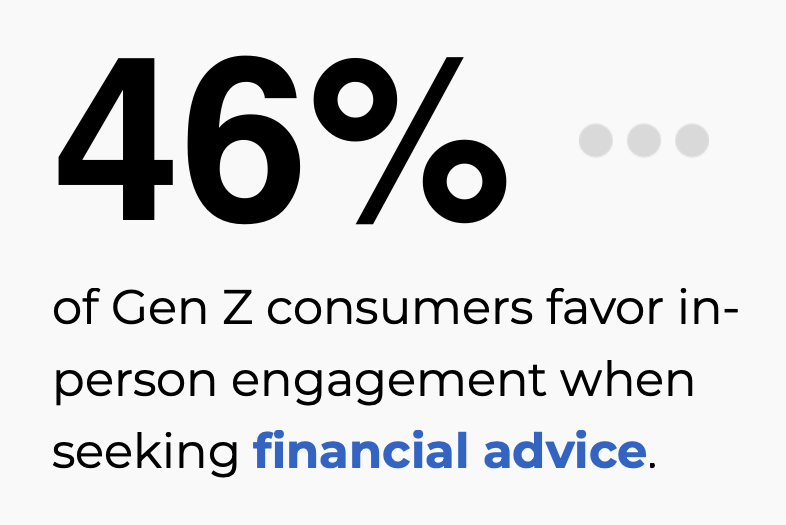
Beyond these headline figures, the report reveals subtler tensions shaping Gen Z engagement. Although digital-first, Gen Z does not equate digital with isolation. Nearly half prefer in-person interaction when seeking financial advice, a higher share than any other age group. What they expect instead is continuity. Experiences should carry context across mobile apps, branches and support channels. Fragmentation erodes trust, while seamless transitions reinforce credibility.
The research also highlights a paradox in how Gen Z views credit unions. Traditional strengths such as community focus and lower fees resonate less strongly with this cohort than with older members. Yet Gen Z rates credit unions relatively well on understanding their needs and being technologically capable. That perception creates an opening. By emphasizing insight-driven engagement and practical digital tools, credit unions can reposition long-standing values in ways that feel modern and useful.
Advertisement: Scroll to Continue
AI emerges as both a risk and an opportunity. As generative tools make it easier to compare financial products, loyalty becomes more fragile. At the same time, AI-powered guidance can anchor relationships if deployed transparently and responsibly. Gen Z views digital relevance as a signal of authenticity. Institutions that speak clearly, personalize interactions and meet members on platforms they already use stand to gain trust.
The report’s broader message is that Gen Z loyalty is not passive or inherited. It must be earned repeatedly through relevance, clarity and follow-through. This generation is watching closely.