
Researchers have developed very light and extremely strong material that can withstand extreme heat. The material could be useful for aerospace and other high-performance industries.
Developed by researchers from University of Toronto Engineering, the material can withstand temperatures up to 932°F (500° C).
The new composite material is made of various metallic alloys and nanoscale precipitates, and has a structure that mimics that of reinforced concrete, but on a microscopic scale.
“Steel rebar is widely used in the construction industry to improve the structural strength of concrete in buildings and other large structures,” says Professor Yu Zou, senior author of a new study.
“New techniques such as additive manufacturing, also known as 3D metal printing, have now enabled us to mimic this structure in the form of a metal matrix composite. This approach gives us new materials with properties we’ve never seen before.”
Researchers revealed that while steel is still the major structural material in trains and automobiles, aluminum has some advantages in airplanes due to its lower weight. Lightweighting — reducing the weight of components while retaining their strength — means that less power is needed to move the vehicle, which in turn improves fuel efficiency. It is particularly important in aerospace, where every gram counts.
But aluminum alloys also have their downsides, explained Chenwei Shao, a research fellow in Zou’s lab and lead author on the new paper.
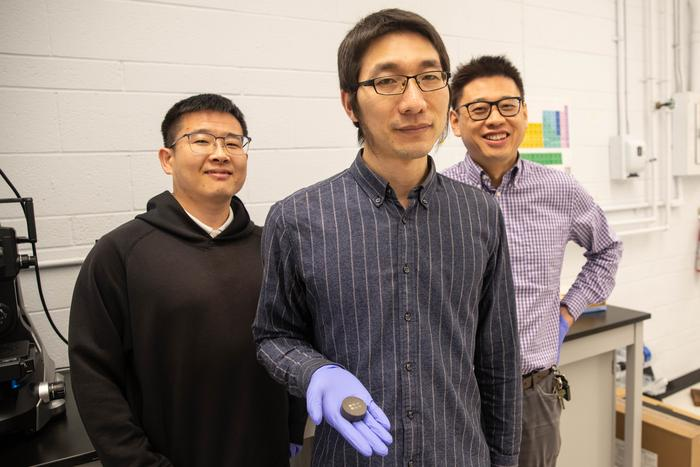
Credit: Tyler Irving
“Until now, aluminum components have suffered from performance degradation at high temperatures,” says Shao. ”Basically, the hotter they get, the softer they get, rendering them unsuitable for many applications.”
To overcome this problem, the team aimed to build a composite of various metals that would have the same structure as reinforced concrete: a cage or mesh composed of steel rebar, surrounded by a matrix of cement, sand and aggregate, according to a press release.
“In our material, the ‘rebar’ is a mesh made of titanium alloy struts. Because we use a form of additive manufacturing in which we fire lasers at metal powders to heat them into solid metal, we can make this mesh any size we want. The struts can be as small as 0.2 millimetres in diameter,” said Shao.