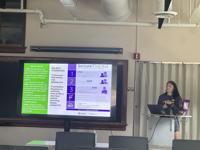
At the opening of Purdue’s Interdisciplinary Conference in Cognitive Science on Thursday, faculty members Daniel Kelly, Sarah Robins, and Danielle Williams outlined the ideas behind Purdue’s new Cognition, Agency, and Intelligence Center, and why they believe the university is positioned to become a stronger home for cognitive science research.
Kelly, a co-director of the center and a philosophy professor, said CAIC is meant to bring together researchers studying cognition, agency, and intelligence across departments and colleges at Purdue. He described cognition as processes such as memory, judgment, and reasoning; agency as minds acting in the world; and intelligence as a way of comparing different kinds of minds, including humans, animals, and artificial systems.
“The center uses cutting-edge cognitive science to help us understand different kinds of intelligent agents and the real-world consequences of their actions,” Kelly said.
Kelly said the center grew out of strengths Purdue already had, especially the recent growth of the philosophy department and the number of faculty members working in areas connected to cognitive science. He said Purdue has built workshops, reading groups, and research connections across campus that helped create momentum for a formal center.
Kelly also said cognitive science is naturally interdisciplinary, making Purdue’s size an advantage.
“The endeavor here is just inherently interdisciplinary,” Kelly said. “The cognitive sciences themselves are just inherently interdisciplinary.”
Robins, the center’s other co-director and cornerstone professor of philosophy, focused on why she sees that kind of interdisciplinary work as important. Robins said academic research can become siloed and overly narrow, which can make it harder for new ideas to emerge.
“How can we be more disruptive?” Robins said. “What can we do to actually shake things up when it comes to how scientific work is done?”
Robins said innovative research often depends on bringing together people with different backgrounds, including junior scholars and researchers whose work does not fit neatly into one field. She argued that those researchers also need shared spaces where they can keep returning to the same questions over time.
“One of the ways that you do more disruptive science is to have large research teams with some weirdos who have a place to come together,” Robins said.
Much of that work, Robins said, is especially relevant now because of the growing role artificial intelligence plays in conversations about minds, reasoning, and behavior. She said CAIC can help create a space where faculty and students ask broader questions about AI in the context of cognitive science rather than as a purely technical subject.
Williams, CAIC’s postdoctoral researcher in philosophy, placed the new center in the context of Purdue’s longer history with computing. In her presentation, she traced how early computing at Purdue grew alongside the university’s demand for more computational power and connected that story to the rise of computer science, AI, and cognitive science on campus.
Williams said Purdue’s computing history stretches back to the late 1940s, when faculty brought in research projects that required major computational resources. Over time, Purdue continued expanding that capacity, eventually establishing its computer science department in 1962. She said that the long push for stronger computing infrastructure helped set the stage for newer programs in artificial intelligence and, eventually, CAIC.
“And it was only a matter of time before they got together and Sarah and Dan … say, hey, we have this kind of critical mass of cognitive scientists,” Williams said. “Why don’t we start this really cool center?”
Williams also connected the center’s development to Purdue’s recent AI degree programs and the philosophy department’s hiring growth between 2022 and 2024. She said those changes helped create an unusually large concentration of faculty working on cognitive science-related questions in one place.
Together, the three speakers presented CAIC as both a research center and a meeting point. Across all three talks, the message was that Purdue’s new center is meant to help turn those strengths into something bigger.