Wednesday, in Stewart Center’s Fowler Hall, National Institutes of Health Director Dr. Jay Bhattacharya, widely known as Dr. Jay, visited Purdue to speak on the topic of ‘Liberty as an Engine for Science’ during an open-to-the-public fireside chat.
The discussion centered on Bhattacharya’s vision for the NIH, the lessons learned from the recent pandemic, and the essential relationship between free speech and scientific progress.

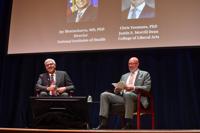
Dr. Jay Bhattacharya, the director of the National Institutes of Health, and Christopher Yeomans, the Justin S. Morrill Dean of the College of Liberal Arts, sit together Wednesday’s NIH Director Fireside Chat. The talk was part of America250, a celebration of 250 years of existence as a country and how that relates to research advancements.
Bhattacharya, a previously tenured professor at Stanford University’s medical school, focused his research on population aging and chronic disease, particularly for vulnerable populations. He published over 170 research papers in peer-reviewed journals in the fields of medicine, public health, and numerous other disciplines, including a leading textbook on health economics.
Bhattacharya was appointed as the 18th director of the NIH and acting director of the Centers for Disease Control and Prevention by the Trump administration.
During the talk, Bhattacharya spoke on his experience as the co-author of the “Great Barrington Declaration,” which advocated for ‘focused protection’ of the elderly, while avoiding broad lockdowns during the pandemic.
Bhattacharya expressed shock at the censorship and ‘excommunication’ he faced for challenging public health issues, arguing that suppressing opinions on either side is harmful to science and democracy. Bhattacharya had been shadow-banned on various social platforms after a July 7, 2024, column titled, “University should promote rigorous discourse, not stifle it”.
“We believe efforts to stifle heterodox thinking are not only wrong from an academic freedom perspective, but harmful to the open and even raucous discourse required for the healthy functioning of a democratic society,” according to Bhattacharya and co-author Wesley J. Smith’s July 7, 2024 column.
Bhattacharya also spoke about his goal to reform the NIH. He proposed ‘decoupling’ research grants from facility support through market competition for facility funding to allow more institutions like Purdue to compete more fairly against higher-ranking and richer schools.
Currently, the system is designed to ensure that places like Purdue do not receive a fair share of funding, according to Bhattacharya.
Senator Jim Banks, a Republican representing Indiana’s 3rd Congressional District, also attended the event and said, “(Dr. Bhattacharya is) thinking about how to reform how we spend research dollars to make it more competitive, (leading to) better results. He understands, like I do, Purdue could do a lot more with resources and (the) NIH can play a big role in that.”


Indiana Senator Jim Banks speaks on his trip to Purdue Wednesday afternoon at the press event after the NIH Director Fireside Chat.
By providing proper funding, Bhattacharya hopes to shift the age range of scientists who receive a first NIH grant to the younger population, compared to scientists in their mid-30s to mid-40s.
“This really matters for innovation because it turns out that it’s early-career researchers (who) are most likely to have the newest ideas that they try out in the research,” Bhattacharya said in the discussion.
Banks said his colleagues know Purdue is doing research that other institutions aren’t doing, which sets the university apart.
Additionally, Bhattacharya hopes to combat the ‘epistemological problem’ of false biomedical research through funding replication studies and adding a ‘replication button’ to research portals to see if an idea has been verified independently.
“I think that the issue is that the American public (is) hungry for science. I think the way that you deal with … getting people good scientific information is by putting out good scientific information and being honest about what’s known and not known,” Bhattacharya said. “If other scientists disagree, we can reason together,… open scientific discussion, and debate, (which are) the best way(s) to address public trust in science.”
Bhattacharya emphasized how the NIH should focus on improving health outcomes for the population, rather than pursuing social or political projects.
“When we get caught up in this sort of desire to achieve social justice through our funding, … you can’t make America healthy again,” Bhattacharya said to the audience.


Attendees of Wednesday’s NIH Director Fireside Chat watch the fireside inside Stewart Center’s Fowler Hall. The presentation was a conversation between Dr. Jay Bhattacharya, the director of the National Institutes of Health, and Christopher Yeomans, the Justin S. Morrill Dean of the College of Liberal Arts.
“But yet so many of those investments we made in DEI had no hope of actually doing that. They were a political project, rather than a scientific project.”
Bhattacharya continued to say that he is most proud of the direction the NIH has taken to solve problems, rather than fighting political fights the NIH should not be involved in.
“The NIH, under my leadership, is once again focused on research that improves the health of every American,” Bhattacharya said.
“We’re not making investments in trying to prevent all pandemics or doing research. The sole focus is research that improves the health and well-being of every American.”
Bhattacharya ended the discussion, urging the younger generation to speak their ideas, instead of suppressing them.
“What I would strongly recommend is to be ready to make a sacrifice for that idea because that’s how you change the world,” Bhattacharya said in his talk. “Have your idea. Try it out… if you don’t invest yourself in that way, you’ll look back in regret rather than in pride.”