
OLED monitors stand out as a rare growth segment still led by Korean makers

A global shift toward premium gaming hardware is turning OLED monitors into one of the display industry’s few clear growth pockets, giving South Korea’s Samsung Display and LG Display a timely lift as broader monitor demand stays subdued.
Omdia said OLED monitor panel shipments jumped 69.3 percent in 2025, far outpacing the overall large-area display market, which grew 2.9 percent. UBI Research separately estimated OLED monitor shipments at about 3.2 million units last year and forecast growth of more than 50 percent in 2026.
The rise reflects more than a routine upgrade cycle. Faster graphics processors and the spread of AI-enhanced gaming content are driving demand for higher refresh rates, deeper contrast and faster response times, all of which play to OLED’s strengths over LCD in the premium segment.
TrendForce said OLED has become the preferred panel type for high-end gaming monitors as 240-hertz-and-above models expand, adding that Nvidia’s RTX 50 series is helping fuel demand for higher-spec displays.
That has created an opening for Korean panel makers as growth in other OLED categories remains relatively modest. Omdia said OLED TV display shipments rose just 1.5 percent in 2025, compared with much faster growth in monitor and notebook OLEDs, and noted that Korean manufacturers shifted strategic focus during the year from TV panels to monitor OLEDs, which offer better returns.
They also still dominate the market. Omdia data cited by industry reports showed Samsung Display holding about 78 percent of global OLED monitor panel shipments in the first half of 2025, with LG Display taking roughly 22 percent.
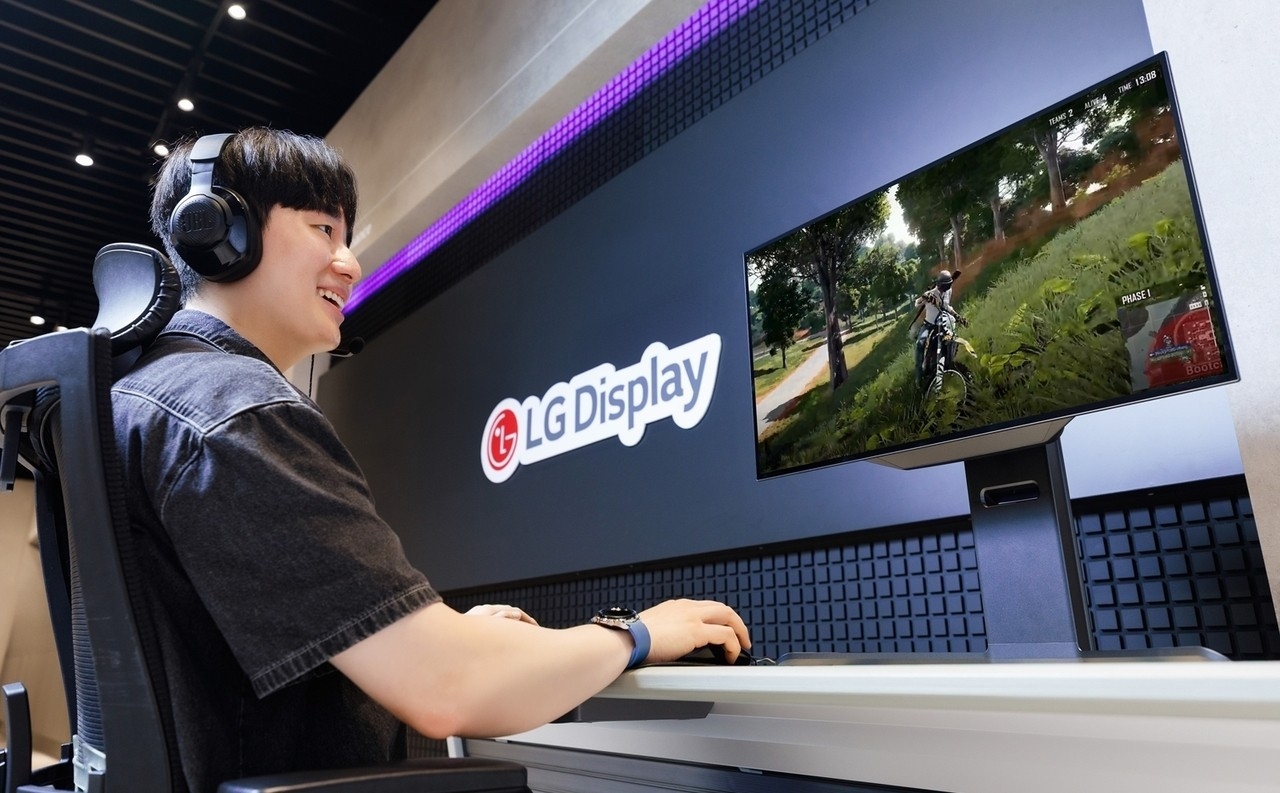
Samsung Display and LG Display are pursuing the opportunity with different technologies and product mixes. Samsung Display is leaning on QD-OLED, targeting ultra-high-end gaming and premium monitors with products such as 27-inch UHD 240Hz and 27-inch QHD 500Hz panels introduced last year.
LG Display is expanding monitor OLED shipments based on WOLED while accelerating its broader shift from LCD to OLED. In its 2025 earnings release, LG Display said OLED products accounted for a record 61 percent of annual revenue, with panels for IT devices — including monitors, laptops and tablets — making up 37 percent.
The market remains small in absolute terms, helping explain the eye-catching growth rates. Estimates cited by China-based AVC Revo put OLED monitor penetration at about 3 percent of the total monitor panel market in 2026, even if shipments rise to 5.4 million units. That suggests the current boom is still driven mainly by premium gaming and creator-focused products rather than the broad replacement of LCD monitors.
For now, Korea’s two panel makers remain firmly in control, though Chinese rivals are gearing up for a challenge. BOE is reportedly investing 63 billion yuan ($9.1 billion) in a new AMOLED line in Chengdu aimed mainly at high-end IT applications such as laptops and tablets, while Omdia said new Gen 8.6 IT OLED fabs from BOE are expected to ramp up from 2026. TrendForce has also said TCL CSOT is moving ahead with Gen 8.6 OLED plans.
mjh@heraldcorp.com