
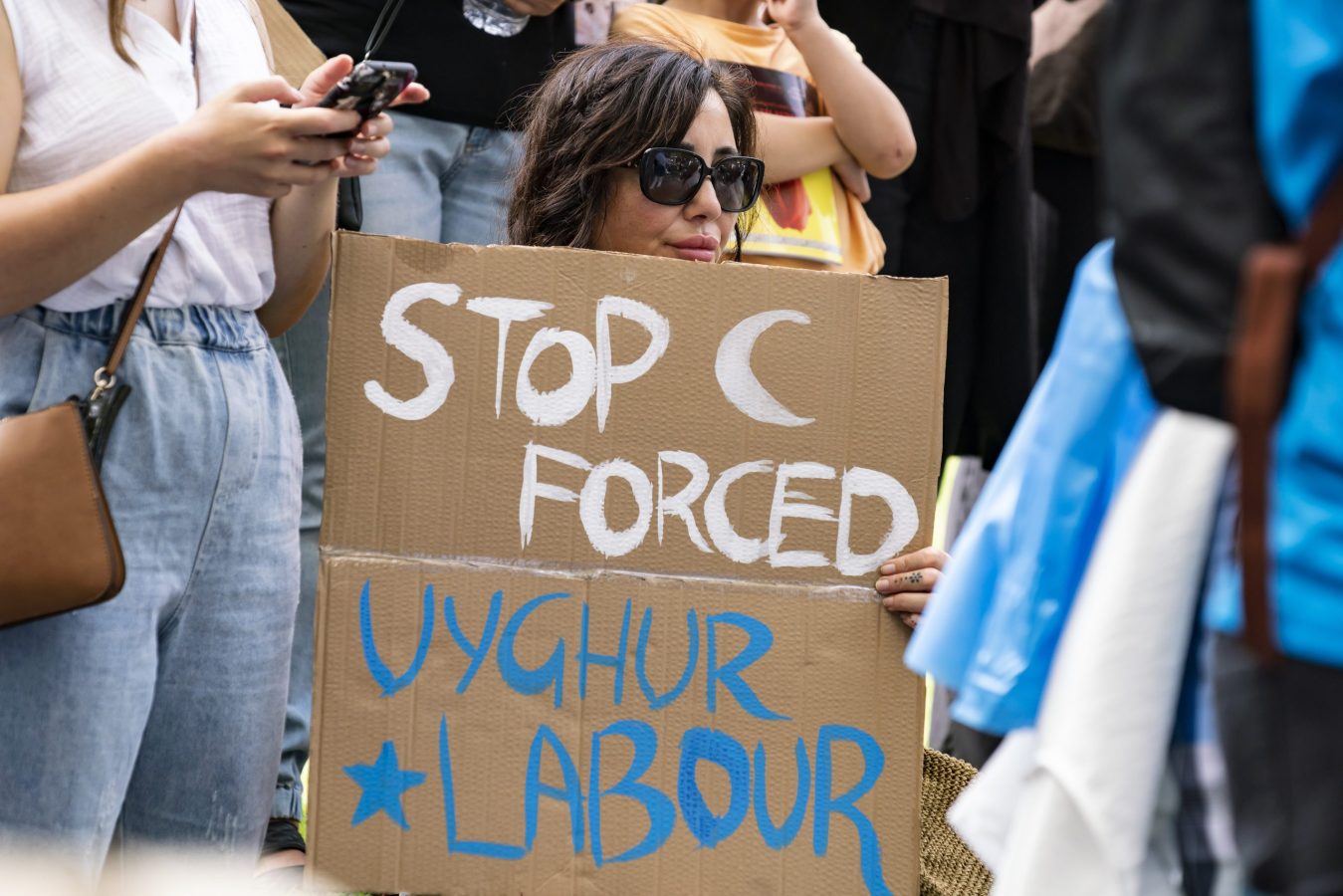
A question for the Insta-baddies, those who are perpetually online shopping, and friends: Have you ever wondered why Temu, Shein, and other such fast fashion sites offer clothing at such rock-bottom prices? Don’t get it twisted: I love a good deal as much as the next person (I know the art of a good Taiwanese haggle) but, please note that purchasing from these factory-direct online retailers comes at a great human cost—forced labor, i.e. slavery—and ask yourself if morally, it’s truly worth the savings.
When I was 16, I learned about sweatshops and unsafe labor conditions for children in Gap factories. Ever the naif, I walked directly into a Gap and said to the retail worker, “What’s the deal with your sweatshops?” She stared at me blankly. I tried to explain and continued my line of righteous indignation via inquiry: “What is with the children who are making your clothing?”
The worker then asked me, “You want to work here?” Frustrated, I gave up the line of questioning and likely went back to Zumiez or Mr. Rags or Pacific Sunwear and my enlightened “informed” shopping. As if awareness of the sweatshops and my inane inquiry to the retail worker would somehow fix a global gap of developing world versus developed world and the predatory capitalist arc of society. Silly me!
Last week, thanks to my last-minute Eid al-fitr shopping (Eid Mubarak!) at local Northgate Muslimah fashion shop Barakah Beauty Collective/Michaela Corning Designs (Michaeala sold me a beautiful upcycled abaya which I rocked at Eid), I got into a conversation about the Uyghur labor that powers the ultra cheap clothing we use and quickly dispose of. Not only are Uyghurs in these factories unpaid and subject to deplorable conditions in CCP-run detention camps, but the subjugation of Uyghurs is part of China’s ongoing colonial domination project, and meets the conditions of genocide.
Why? How?
The Uyghurs are a Turkic ethnic group (one out of 55 ethnic minorities in China defined by the government) from central and east Asia. Around 80% of Uyghurs live in Xinjiang, which means “New Frontier” in Chinese, a region that the Chinese Communist Party seeks to dominate, control, and colonize due to its importance in trade. Uyghurs reject the CCP’s colonial designs and have their own claim to autonomy pre-dating the People’s Republic of China by centuries, with Islam being a part of Uyghur culture and identity since at least the 10th century. The Uyghur diaspora also lives in Kazakhstan, Kyrgyzstan, Uzbekistan, Turkey, Saudi Arabia, Jordan, Australia, Japan, Canada, Russia, Sweden, New Zealand, and the United States.
Since at least 2014, governments and watchdog groups have assessed and reported on China’s crimes against humanity, forced labor, and mass detention of Uyghurs. This includes the United Nations’ Office of the High Commissioner for Human Rights (OHCHR) 2022 assessment, leaked classified state documents from the China Cables as reported in 2019 by the International Consortium of Investigative Journalists, and a 2021 report from Human Rights Watch. Internal Xinjiang police files leaked in 2022 include photographs of detained Uyghurs and shooting orders.
A 2020 study found, using satellite imagery, government documents, and corporate filings, that 83 companies benefit from Uyghur slave labor. Temu and its parent company PDD Holdings is under active Department of Homeland Security investigation for forced labor links, and has admitted it cannot bar third-party sellers from sourcing from Xinjiang. Shein executives refused to address forced labor allegations when questioned directly. Thus, there is a tacit acknowledgment among those in the know that any clothing and goods coming from Xinjiang is cheap due to the use of forced Uyghur labor. Yet as all of this has been happening, consumers may be blithely unaware of or simply unfazed by the plight of detained Uyghurs. As of 2023, Temu had over 50 million app installs in the U.S., and Shein doubled its UK profits in 2023, with sales up 40% to 1.5 billion pounds ($1.73 billion USD)
De minimis loophole
In December 2021, President Joe Biden signed the Uyghur Forced Labor Protection Act (UFLPA) into law, creating a “rebuttable presumption” that goods from Xinjiang are presumed to be made with forced labor unless proven otherwise. However, it has an exemption called the Section 321 de minimis exemption. Intended for items purchased for tourists bringing back souvenirs after travel, under current US trade law, any shipment valued under $800 enters the U.S. without customs inspection. Temu and Shein therefore use the de minimis exemption to bypass UFLPA enforcement entirely. This has allowed their business to skyrocket by shipping individual packages directly from Chinese warehouses rather than traditional or legitimate bulk shipping that would require inspection. The fact that Section 321 shipments exploded from 140 million in 2013 to over 1 billion by 2023 exemplifies the scale at which these and other fast fashion companies utilize and profit from this loophole.
Modern enslavement and ongoing genocide
When you buy something at an impossibly low price, remember that it is impossibly low for a reason. That reason is exploitation and enslavement. That $5 Temu turtleneck I bought last month was $5 because when labor is forced, prices can undercut any legitimate competitor. The Walk Free Foundation’s Global Slavery Index estimated in 2023 that 27.6 million people are in forced labor worldwide, with China ranked among the highest for government-imposed forced labor.
In a rare show of bipartisan agreement, under both the Trump and Biden administrations, the US State Department determined in 2021 that the Uyghur persecution qualifies as a genocide. Multiple national parliaments, including Canada, the UK, Netherlands, Belgium, Czech Republic, and Lithuania, have passed genocide motions. Finally, in 2021 the Newslines Institute and its more than 50 global experts independently concluded that the crisis is an ongoing genocide under the 1948 Convention, which defines genocide as acts committed “with intent to destroy, in whole or in part, a national, ethnical, racial, or religious group.
What can we do?
Evidence is documented, genocide has been declared—so what are we the consumers to do? In good conscience, I have to stop chasing those rock-bottom deals. It’s not worth it to me. Unlike the teenaged me, I won’t be able to self-righteously walk into a brick and mortar store and chastise the confused retail worker, but I can be more mindful about my purchases, avoid buying fast fashion, and track what is happening legally and globally to stop this genocide.
There are a few possible actions you can take: knowing before you buy (using resources such as KnowTheChain, Good On You, and Fashion Revolution’s Transparency Index); handmaking clothing as a political act of resistance (see Betsy Greer’s Craftivism); and educating yourself (see Andrew Morgan’s The True Cost to learn more about the human cost of fast fashion). Shop locally and handmade. And take organized action, for example, checking out resources such as The Coalition to End Forced Labour in the Uyghur Region (enduyghurforcedlabour.org) and Fair Trade USA.
