
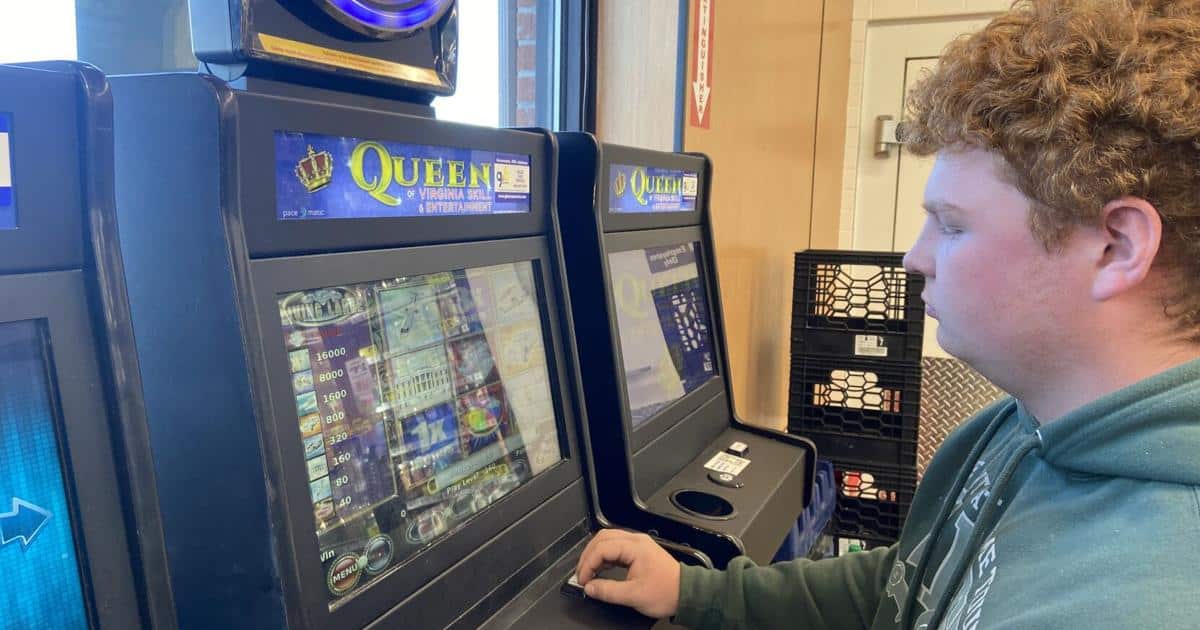
Virginia’s Democratic-controlled legislature passed SB661 to legalize skill game machines after a Pace-o-Matic, the leading company in that space, donated over $1.7 million to party lawmakers.
There are roughly 90,000 illegal skill game machines currently operating in Virginia. They sit in convenience stores, truck stops, and restaurants across the commonwealth, taking money from players in a legal grey area that the state’s Supreme Court effectively shut down in 2023.
Nobody seriously disputes that they need to be dealt with. The question is whether the legislature that just dealt with them did so as a matter of public policy or as a return on investment.
The donation trail makes that question uncomfortable to answer.
Money Greases the Legislative Apparatus
Pace-O-Matic, the Georgia-based company behind the popular “Queen of Virginia” skill game terminals, and its executives contributed over $1.7 million to Virginia Democrats since 2023, including large sums during the 2025 elections when Democrats retook control of the legislature. Practically the first thing those Democrats did when they arrived in Richmond for the 2026 session was file legislation in both chambers to legalize the machines.
The architects of that legislation were among Pace-O-Matic’s biggest beneficiaries. State Sen. Aaron Rouse, the Senate patron of the bill, received over $140,000 in direct contributions from Pace-O-Matic and its executives, plus an additional $195,000 from a Pace-O-Matic-funded PAC.
Senate President pro tempore Louise Lucas accepted $165,000 in donations. House Speaker Don Scott received just over $75,000 between 2023 and 2026. Many rank-and-file legislators who voted for the bills also received campaign checks from the manufacturer.
Then there is the governor. Pace-O-Matic donated $50,000 to Governor Abigail Spanberger’s 2026 inaugural committee. The bill now sits on her desk awaiting signature.
Delegate Cliff Hayes, a co-patron of the House version, offered the standard defense: his support is grounded in policy concerns that predate any contributions and is not based on any single contributor. That may well be true. It is also exactly what everyone in this situation always says.
What SB661 Will Do for Virginia Skill Games
To be fair to its sponsors, SB661 is not without policy merit. The bill would reduce the number of skill game machines in Virginia by over 60%, capping authorizations at 25,000, while imposing a 25% tax on gross profits. More importantly, it establishes a regulatory framework where none currently exists.
The machines would accept a maximum bet of $5 and a maximum win of $4,000, with a minimum age of 21. No business within 10 miles of a casino could host them, and the Virginia Lottery Board would inspect all machines before they are offered for play.
The proponents’ argument is not irrational. Replacing 90,000 unregulated machines with 25,000 regulated ones, generating an anticipated $300 million annually in tax revenue, is a defensible approach to a problem that prohibition has clearly failed to solve. Banning something that is already everywhere and generating no tax revenue is a policy position, but it is not obviously a good one.
The Virginia Council on Problem Gambling sees it differently. It was written to Spanberger, warning that the bill’s lack of a minimum payout requirement raises serious concerns, and that the ubiquitous placement of these machines in convenience stores and gas stations will expose children daily to gambling devices in environments where age enforcement is tenuous at best.
The Framing Problem is Bigger Than Virginia
Here is what makes the Virginia situation particularly instructive for the broader industry. Skill games occupy the same semantic battlefield that prediction markets have colonized.
Their proponents insist they are not gambling because outcomes involve an element of skill, just as prediction market operators insist their contracts are financial instruments rather than bets. Both framings are partially true and strategically motivated. Both are doing the work of keeping products in a more favorable regulatory category than a plain reading might suggest they deserve.
The final version of SB661 includes no hard-coded minimum or maximum payout percentage, which means a machine could, in theory, be calibrated to return almost nothing to players. That is a significant omission in legislation intended to establish consumer protections, and it is the kind of detail that gets lost when the political energy behind a bill is driven primarily by the industry it regulates.
Spanberger has previously signaled that she would consider gambling expansion only if Virginia first established a unified regulatory agency with clear authority and consistent standards. That agency, House Bill 271, stalled in the Senate and has been carried over to 2027. The governor is now being asked to sign a gambling expansion bill without the regulatory infrastructure she said she wanted in place first.
Whether she does will say something about the half-million dollars Pace-O-Matic and its affiliated entities directed toward Virginia Democrats.
It will also say something about how gambling gets legalized in America: not through a considered public debate about costs and benefits, but through a sustained, expensive, and carefully targeted campaign to make sure the right people are in the room when the votes are called.

Players trust our reporting due to our commitment to unbiased and professional evaluations of the iGaming sector. We track hundreds of platforms and industry updates daily to ensure our news feed and leaderboards reflect the most recent market shifts. With nearly two decades of experience within iGaming, our team provides a wealth of expert knowledge. This long-standing expertise enables us to deliver thorough, reliable news and guidance to our readers.