
It’s been 17 years since the bright yellow Panamanian golden frog (Atelopus zeteki) hopped through its native habitat. But after nearly two decades of hard work, conservationists are finally reintroducing a new generation of the tiny, fluorescent amphibians back into the tropical island’s ecosystem.
It wasn’t that long ago that golden frogs were staring down almost certain extinction. The saga began in the late 1980s, when an invasive fungus called Batrachochytrium dendrobatidis (Bd) arrived in lower Central America. Soon, Bd spores spread throughout Panama. The fungal spores had no difficulty traveling through water—and because golden frogs only live close to streams, they soon encountered the fungus themselves.

Golden frog recently released into the wild | Rana dorada liberada recientemente a la naturaleza
While Bd isn’t a problem for humans, it’s devastating to many amphibians like the golden frog. After infecting a host’s skin, the fungus disrupts the body’s electrolytes through a disease called chytridiomycosis. Before long, a frog’s salt and water imbalances result in heart failure and death. The chytridiomycosis crisis finally reached Panama’s last concentrated population of golden frogs at El Valle de Anton in 2004. By 2009, the animals had completely disappeared from the region.
But the species wasn’t extinct just yet. Wildlife biologists at the Smithsonian-affiliated Panama Amphibian Rescue and Conservation Project (PARC) worked for years to continue breeding both golden frogs and related species in controlled facilities. Only recently were lab populations stable enough to move on to the next stage.
“We provide care for some of the most endangered amphibians in Panama, and now we are entering a new phase of our work to study the science of rewilding,” PARC director Roberto Ibañez said in a statement.
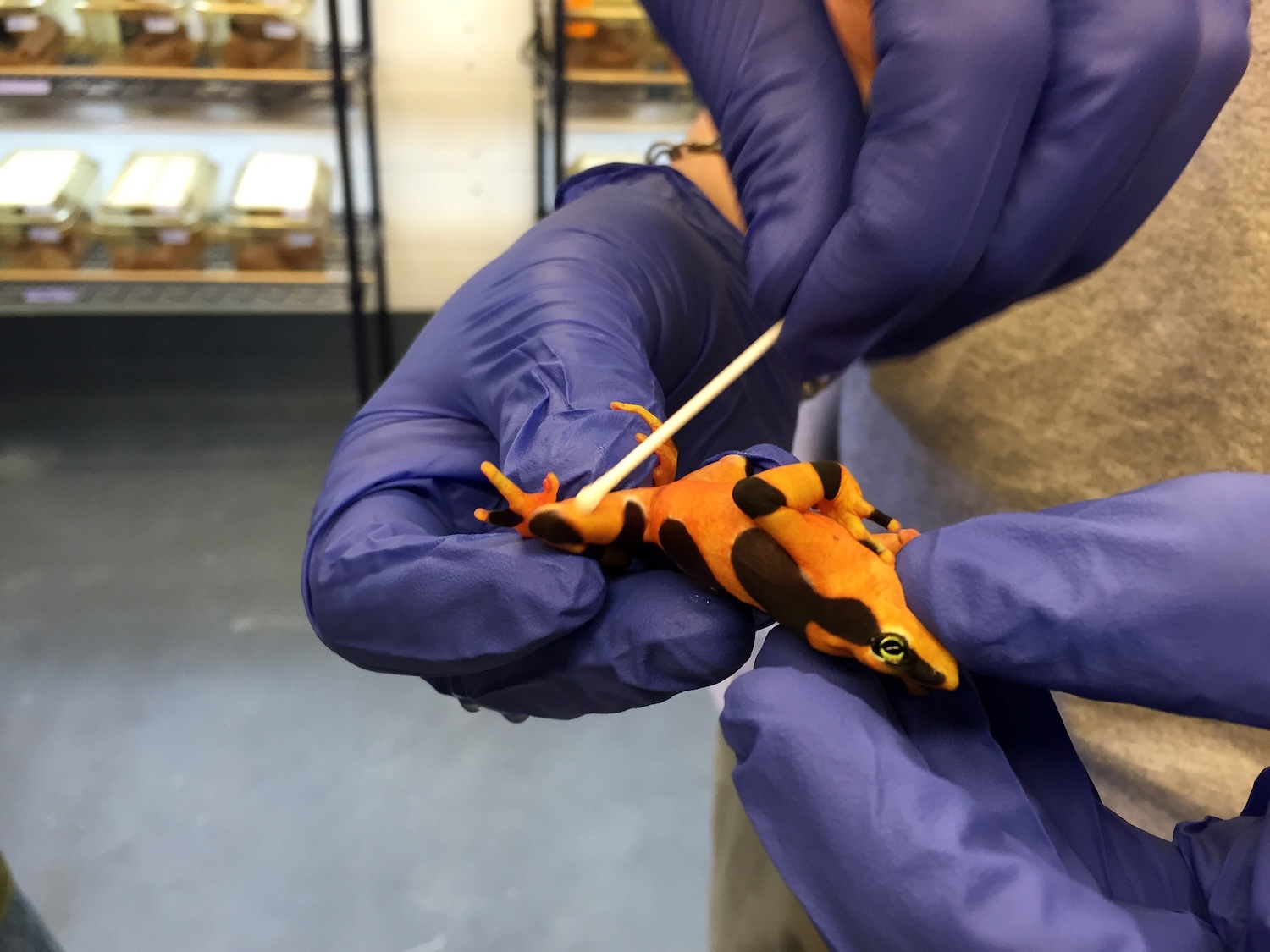
The process is a harsh one. Chytridiomycosis still exists in multiple regions around Panama, and remains a problem for the frogs. Researchers estimate about 70 of the 100 golden frogs died from the disease during the initial, 12-week soft release. Fortunately, many of the surviving frogs were eventually rewilded, and the new data allows conservationists to better understand how the disease works.
“These crucial data will inform our conservation strategy moving forward,” said conservation biologist Brian Gratwicke. “Our earlier modeling suggested there may be release sites we can select that will be climatic refuges—places that are suitable for the frogs but too hot for the fungus.”
Those who worry about the outcome only need to review the team’s track record. Last year, three other frog species were released back into their habitats—the crowned tree frog (Tripion spinosus), Pratt’s rocket frog (Colostethus pratti) and the lemur leaf frog (Agalychnis lemur).
But if you happen to encounter a golden frog near a Panamanian stream in the future, make sure to only admire from a distance. The amphibians infamously produce a number of deadly toxins, including steroidal bufadienolides and guanidinium alkaloids.

2025 PopSci Best of What’s New