
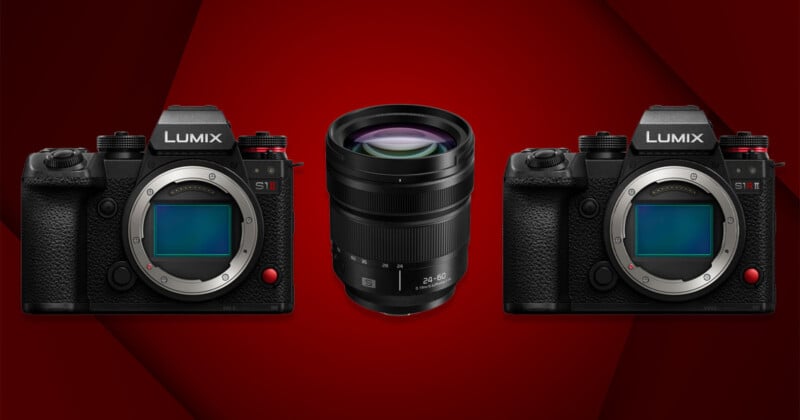
2025 was an excellent year for Panasonic’s full-frame Lumix S system and an eerily quiet one for Micro Four Thirds. The year was headlined by the Lumix S1 II, a dynamite full-frame hybrid camera, and the S1R II, the long-awaited high-res update.
Before getting to the good news, and Panasonic delivered plenty of it this year, let’s get the bad news out of the way first. Micro Four Thirds was ignored entirely this year: no new cameras, no lenses, nothing. Panasonic’s Micro Four Thirds releases have been fewer and farther between in recent years, but 2024 still saw the GH7 and G97 (plus the FZ80D and ZS99 point-and-shoot cameras, by the way). But 2025 had no new Micro Four Thirds camera at all. Will 2026 have the GM-5 successor Chris so desperately wants? Fat chance. 2025 and 2024 have this in common, at least: No new Micro Four Thirds lenses.
The writing for Panasonic’s Micro Four Thirds ambitions, or lack thereof, is not just on the wall anymore. It’s big, bold, and surrounded by flashing lights.
I personally like Micro Four Thirds quite a bit and think it still warrants attention as a legitimate photographic system for enthusiasts and even some professionals, but Panasonic doesn’t seem to agree. So let’s see what the company had in store for full-frame shooters in 2025.
Panasonic Released Excellent Full-Frame Cameras in 2025
I will have to fight hard against recency bias in this one, because Panasonic released all its new cameras by mid-May this year. That feels like a lifetime ago.
The company’s first camera of the year was the long-awaited S1R II. The camera debuted a new 44.3-megapixel image sensor, 40 frames per second shooting, AI-powered autofocus, and 8K video recording. The video recording recently got even better thanks to firmware, by the way.
The S1R II was a very long time coming. The original S1R was announced alongside the S1 way back in February 2019, marking Panasonic’s entry into the full-frame photography space. The S1R was quite good, but a bit bulky, clunky, and sluggish. The S1R II, arriving six years later, solves all these issues and then some. It is a powerhouse of a hybrid camera.

“The S1R II is the most well-rounded Panasonic full frame body so far, and takes a crack at cameras like the Nikon Z8 and Canon R5 Mark II. Although the lack of a stacked sensor makes it less capable for sports and action, the usable mechanical shutter speeds still allow it to handle some faster shooting situations,” Chris Niccolls wrote.
While the S1R II remains Panasonic’s most well-rounded full-frame camera to date, the S1 II (and S1 IIE) that arrived in May went all-in on video-first hybrid performance. The cameras feature a 24-megapixel partially stacked sensor, like the Nikon Z6 III, but extract even better imaging performance out of the sensor using a groundbreaking technique: Dual Gain Output.
We have now seen similar technology in the new 33-megapixel Sony a7 V, and it shows that Panasonic is a genuine leader in the technology department. Frankly, Panasonic has always managed to extract a lot out of its camera’s image sensors, although the innovations have primarily focused on video performance. This time around, it’s photographers who benefit. However, the S1 II has tons of features for videographers. It faces stiff competition, but it may very well be the best video-first full-frame hybrid camera in its class, especially after recent firmware updates.

“It is easy to like the Lumix S1 II. Panasonic has made a capable and reliable hybrid camera that can handle many different kinds of photography and, at the same time, provides possibly one of the best video-based mirrorless cameras ever,” Niccolls wrote. Niccolls speculated that it would prove especially popular with videographers, and considering just how many of PetaPixel‘s YouTube episodes were shot on the S1 II this year, it’s clear Niccolls was spot-on.
There was also the Panasonic S1 IIE, released at the same time as the S1 II. We did not review this specific model, but here’s an overview of what makes it different. The S1 IIE’s list price is $800 less, although it is actually $1,000 less than the S1 II right now. The significant compromise is that the S1 IIE doesn’t have the new partially stacked sensor, opting instead for a standard 24MP BSI CMOS chip. This makes the S1 IIE much slower for both continuous photo shooting and video recording. The S1 IIE is still a good camera, but it doesn’t offer anything special, unlike the S1 II. For the same price, users can get the Nikon Z6 III, which is a much easier sell.
Two New Lumix S Zooms
Panasonic heavily benefits from the L-Mount Alliance when it comes to glass. Its users can get mostly identical performance and features from the many great Sigma and Leica lenses on the market, so it’s easy to wonder if that has enabled Panasonic to focus more on its cameras and less on glass. I’m not sure if that’s true, but 2025 wasn’t an especially prolific year for Lumix S lenses. We got just two, but at least they’re good.
First up was the Lumix S 24-60mm f/2.8 announced alongside the S1 II and S1 IIE cameras. This is a nice, affordable compact zoom lens with a fast constant aperture. For just $899, L-Mount shooters get most of the same range as a 24-70mm f/2.8, but at a fraction of the price and weight. It’s hard to go wrong with an affordable f/2.8 zoom, right?
“I find the Panasonic Lumix S 24-60mm f/2.8 to be excellent value for the dollar. Sure, it has some softer corners at the telephoto range and middling bokeh but it also gives you a compact, lightweight travel lens that delivers sharp results at f/2.8. If travel and destination photography is a passion of yours, this lens will provide professional quality with a healthy dose of convenience. If you want a well-built lens for general-purpose photography and you need the faster f/2.8 aperture, this lens will give you the goods at a very low price,” Chris Niccolls said.

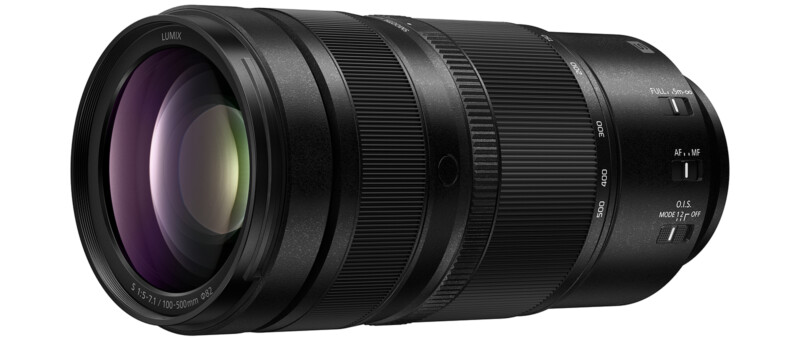
We fully intend to review Panasonic’s second and final lens of the year, the telephoto zoom Lumix S 100-500mm f/5-7.1. Panasonic’s first full-frame ultra tele zoom is the first Panasonic Lumix S lens to hit the 500mm threshold, and is aimed at wildlife and sports photographers.
Grading Panasonic in 2025
Well, Panasonic certainly delivered less diversity this year than last, but there’s no question that the Lumix S1 II and S1R II are excellent cameras.
If I were to grade Panasonic’s Micro Four Thirds efforts, the company would earn an F. Nothing happened. No work was turned in. The lack of Micro Four Thirds products affects the final grade below, but I’m not giving each system equal weight. Panasonic clearly doesn’t give both its systems equal weight, so why should I?
Panasonic’s full-frame Lumix S system will always be somewhat niche and specialized, but the company makes great cameras with interesting features and technology. With the addition of the S1 II, S1 IIE, and S1R II in 2025, the Lumix S system has great options across the entire spectrum of price points and use cases. The S1 II is arguably the best hybrid camera on the market for demanding videographers, and the S1R II is a dynamite camera for photographers. The company’s two new Lumix S zoom lenses are also welcome additions, even if they aren’t all that exciting.
Grade: B-
Image credits: Panasonic. Header photo created using assets licensed via Depositphotos.