
PROVIDENCE, R.I. [Brown University] — The 2026 Brown Brain Fair brought a burst of brightness to a cool, overcast Sunday in mid-March, drawing hundreds of local children, families and community members to Brown University for a day of scientific discovery, hands-on learning and family fun.
Held on March 15, the free, all-ages event filled Sayles Hall with scientists, researchers and volunteers from more than 25 Brown laboratories and centers. Together, they transformed the space into a lively hub of interactive stations, experiments and games where visitors could test their knowledge of neuroanatomy, watch their brain waves appear on a screen, and explore how the brain powers memory, movement and more.
For more than a decade, the fair has turned complex brain science into activities designed to spark curiosity in learners of all ages. Luc Gagne, who traveled from Warwick, Rhode Island, said he has attended the event for years, bringing his two kids — now 10 and 16 — to campus again this year.
“The Brain Fair always has a lot of engaging things for the kids, and you learn something new every time,” Gagne said. “The talks are usually really good, and it’s fun to discover new things and keep up with science in general.”
The annual event is organized by the Brown Brain Bee student group in collaboration with the Carney Institute for Brain Science and held in partnership with Brain Waves Rhode Island. Brown undergraduate Eric Jiang, co-president of the Brown Brain Bee, has helped to organize the fair since 2024. This year, more than 100 student volunteers set up stations, welcomed visitors and ran demonstrations throughout the day, he said.
“My favorite part of the fair is running the popcorn machine,” Jiang said. “Families and kids come over after interacting with robotic arms from BrainGate, seeing their brain waves scanned with EEG electrodes, or getting neurons painted on their faces. When we ask their favorite station or brain fact they learned, we hear everything from how memory works in the hippocampus to how long the longest neuron in the body is.”
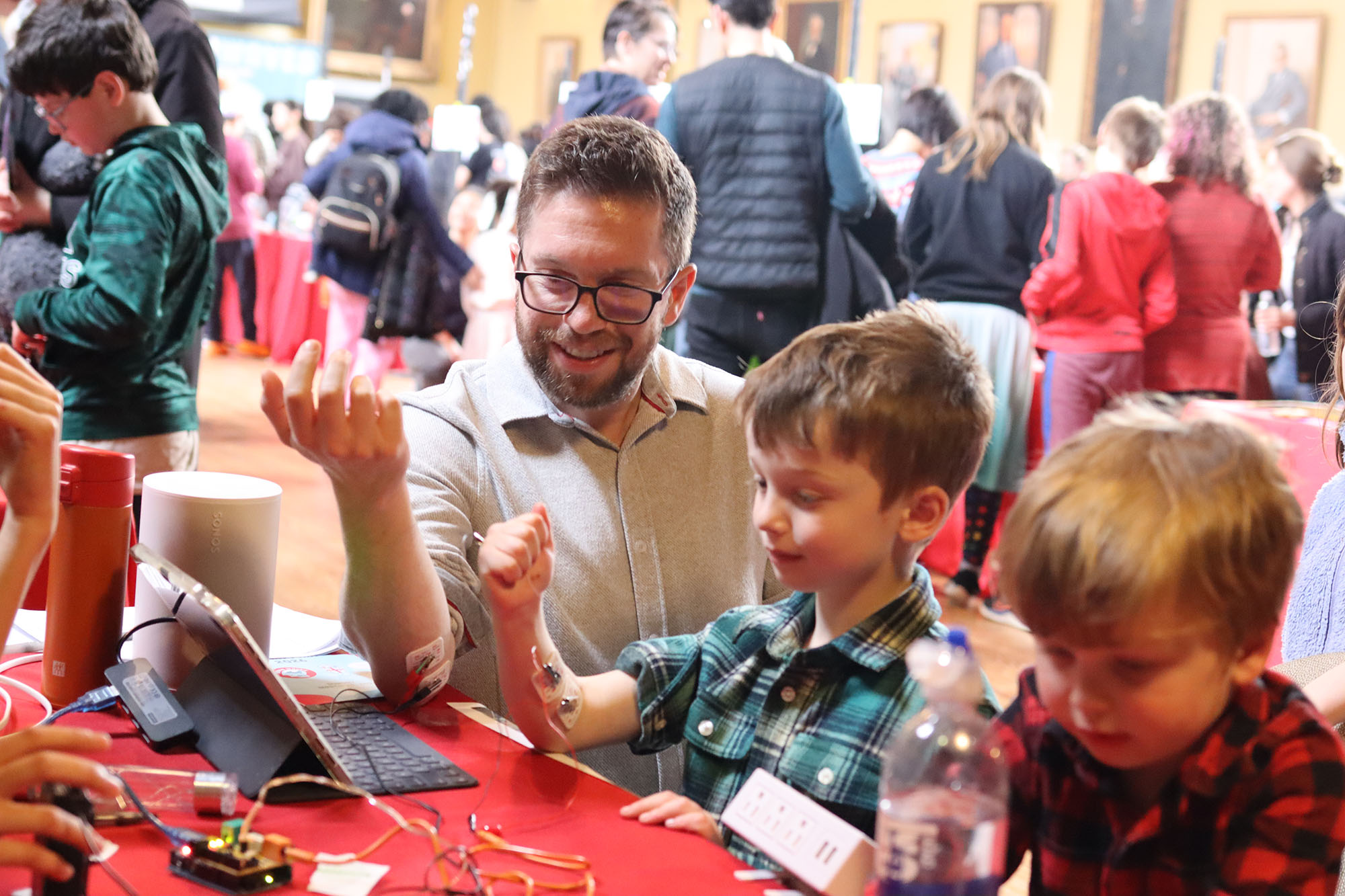
At one of the fair’s busiest stations, participants watched the brain’s electrical signals in action. When one volunteer clenched their fist, sensors detected the electrical activity in their arm and transmitted the signal to another participant, causing their fingers to twitch — a surprising demonstration of how the brain uses electricity to communicate with muscles.
Ashley Bentley of Barrington, Rhode Island, watched while her husband tried the experiment with their 6-year-old son.
“You could see my son’s little eyebrows furrow as he tried to figure out what in the world was going on,” Bentley said. “Moments like that are exciting — you know they’ll remember them forever. Anything that surprises them and makes them pause, look a little closer and explore a little deeper, it’s such a joyful way to spark curiosity and it’s fun that we can experience that curiosity together.”
Another game challenged visitors to guide a growing nerve fiber through a Pac-Man–style maze, following helpful magnetic signals while avoiding opposing, repelling ones. The activity demonstrated how developing neurons find their way through the brain to form the connections that power thinking and movement.