
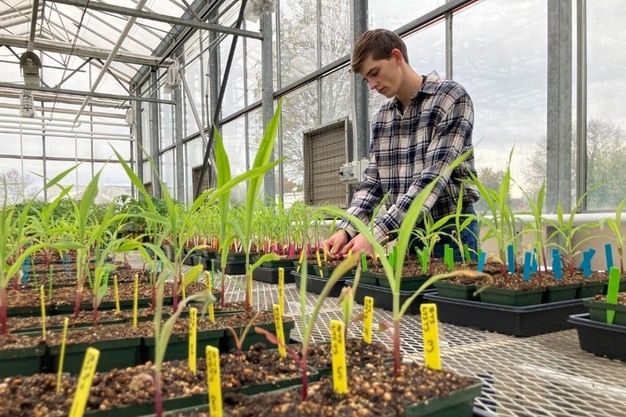
Joseph Romano, an honors plant science major at the University of Delaware, cultivated an interest in plants while working alongside his father and grandfather, both avid gardeners. His relatives brought a passion for plants when they immigrated to Pennsylvania from Italy more than 100 years ago.
“I’ve been working in the greenhouse since I was a kid,” Romano said. “I enjoy growing exotic plants. I have an orchid collection.”
 © UDaily
Romano’s early start in plant perfection led him to seek out other opportunities ahead of his peers. He was the first high school student to intern at Burpee Seeds in Doylestown, Pennsylvania. When it came time for college, Romano chose UD’s College of Agriculture and Natural Resources (CANR) — and he came to the University ready to dive into research.
“I looked at different programs,” Romano said. “I decided that plant science was the best bet for me because I can focus on plants, as well as the biological systems involved in them.”
Romano met Qi Mu, assistant professor of molecular plant breeding and genomics, during an orientation event in the Department of Plant and Soil Sciences. He mentioned his eagerness to do research. Mu had an opportunity available, and before he knew it, Romano was on his way.
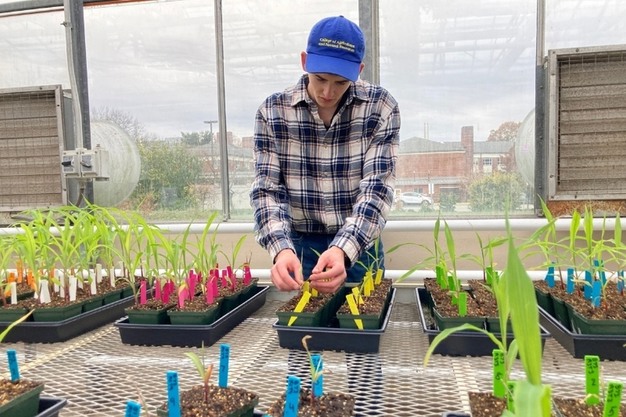
“Within the first two weeks of my undergraduate program, Dr. Mu got me started on a Quantitative trait locus (QTL) mapping experiment,” Romano said of the statistical method of analysis that links two types of information. “That’s looking at different loci [the specific positions of genes or DNA sequences on a chromosome] associated with a trait. In this case, it was plant height and sorghum.”
 © UDaily
The Mu Lab aims to understand the genetics, development and environmental regulation of agronomically important traits in maize and sorghum. The ultimate goal is to genetically improve crop resilience and production under climate variability.
“Joe joined my lab as a first-year undergraduate student with a strong curiosity about research,” Mu said. “Over the past three years, he has developed into a confident and capable researcher, progressing from assisting with basic experiments to independently designing analyses, interpreting data and contributing meaningfully to manuscripts and presentations.”
In CANR’s Fischer Greenhouse Complex, Mu and Romano study the interaction between the fungus-like pathogen Pythium and maize plants.
“Pythium is most prevalent in high moisture, wet conditions in the soil,” Romano said. “So in the early spring months when farmers are planting their crops, if they plant in areas infected with Pythium, they could see symptoms ranging from root rot and necrosis to damping off and seedling death.”
Pythium root rot causes millions of dollars in annual economic losses to corn production across the United States and is a major constraint on maize seeding establishment in the Mid-Atlantic region.
 © UDaily
“Joe’s work lays the groundwork to understand how different maize varieties respond differently to Pythium diseases,” Mu said. “It also supports the development of practical, large-scale methods to identify and select stronger, more disease-resistant maize plants for breeding. This research addresses an urgent agricultural challenge with clear implications for yield stability and long-term food security.”
In collaboration with Alyssa Betts, associate professor and Extension specialist in plant pathology, Mu and Romano are also working to answer the question: Do different species and strains of Pythium vary in their aggressiveness toward maize plants?
“Several species of Pythium are common to Delaware and can even infect the same field,” Romano said. “What that means is it’s important to screen your field and find out which species you have before you consider treatment options.”
Bett’s Lab found that the most aggressive species, Pythium graminicola, is also the most prevalent in Delaware.
Last summer, Romano completed the UD Envision program, funded through the National Institute of Food and Agriculture (NIFA). The program offers intensive, hands-on research education and experiential learning projects to help students envision themselves as agricultural scientists.
 © UDaily
Romano studied the infection dynamics between the Pythium pathogen and maize plants, attempting to deepen the understanding of ideal greenhouse growing methods for plant-pathogen interaction research. He collected information on plant survival rate, shoot and root biomass and length, and infection level. Romano gained hands-on experience, using a dissecting microscope to capture images of root systems and specialized software to image approximately 30 quantitative root features.
“Getting the opportunity to design and carry out my own experiment was a dream come true,” Romano said. “Last summer was full of new learning experiences, as I spent time working across the greenhouse, field and molecular lab on a variety of different projects in addition to my own work.”
Mu says the hands-on research experiences available in the College of Agriculture and Natural Resources are what turn students into scientists.
“Research experiences train students to think critically, ask meaningful questions and integrate theory with real-world problem solving,” Mu said. “Early immersion in research fosters independence, resilience and scientific identity, preparing students to contribute productively to science-driven challenges facing agriculture and society.”
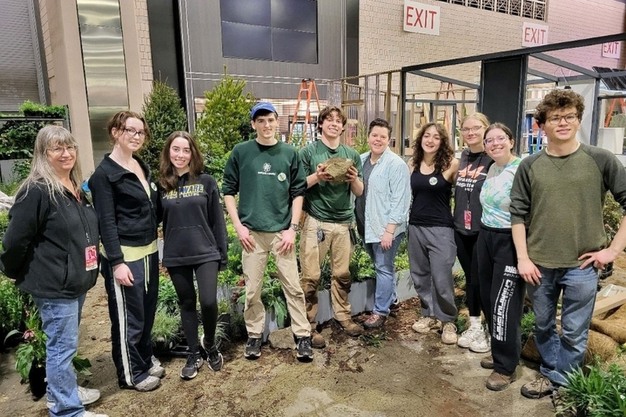
Romano complements his studies and research with active roles in several student organizations, including the UD Philadelphia Flower Show Club, where he currently serves as treasurer. In 2025, Romano was the club president when the team won a gold medal for their exhibit “From Lab to Landscape.”
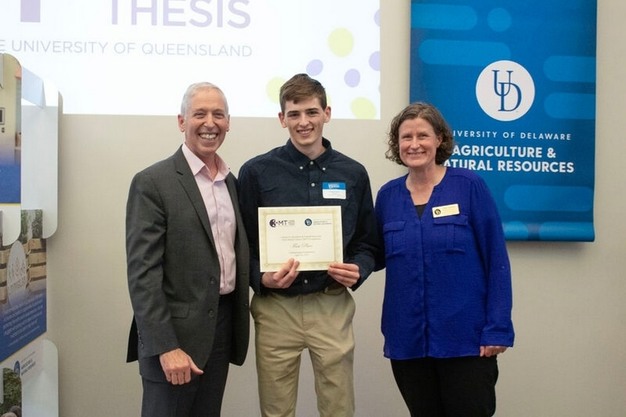
Romano’s work with Mu’s lab took him to new heights last year when he flew for the first time to attend the Maize Genetics Meeting in St. Louis, Missouri. Gaining valuable experience by presenting his research, Romano applied those skills during the 2025 College of Agriculture and Natural Resources (CANR) Student Research Symposium in November. The judges awarded Romano first place in the undergraduate category for presenting his poster titled “Assessment of Pythium storage stability through maize plant infection assays.”
This spring, Romano will uphold his tradition of being ahead of schedule when he receives his diploma a year early.
Source: www.udel.edu