

Photo: Photo-Illustration: by The Cut; Photos: Courtesy of Marni, Prada, Max Mara
In the end, the game was not so hard to work out. Miuccia Prada and her co-creative director, Raf Simons, had put four layers of clothing on 15 models. Every time Bella Hadid, Julia Nobis, or one of the other women finished a trip down the runway, her dresser would remove a layer — and out she’d go again, a woman not exactly transformed but different in her ski sweater and skirt or gawky shorts. It was like Russian dolls, one figure concealed inside another. Or Mr. Potato Head in reverse.
Yet watching the show was something else. It was frenetic, the harried movements and thoughts of a day compressed into ten minutes, a kind of Mrs. Dalloway rather than Mr. Potato Head.
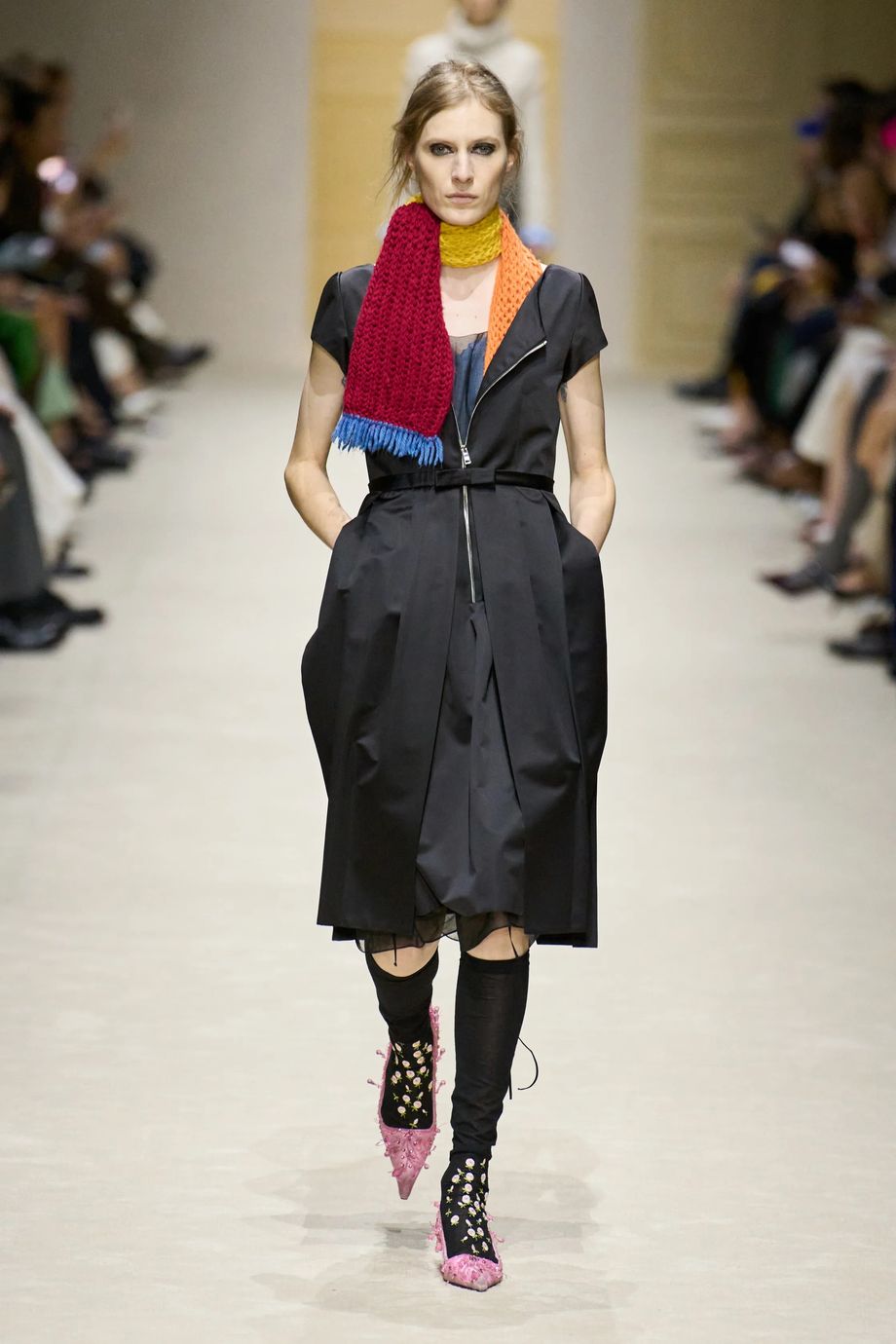
In the cavernous Prada show space — at the Prada Foundation — the walls were covered with classical paintings and window frames, like those of a Milan palazzo. But the music expressed the opposite sensation: hard-core techno and house tracks. And some of the girls had a post-rave look, with smudgy dark-rimmed eyes (the work of Lucia Pieroni) and messy ponytails (by Guido Palau). Though Nobis has one of the most mutable faces in the industry, I didn’t at first recognize her, buttoned into a slim black coat with a knitted striped scarf around her neck and pink, embellished heels and black knee-high socks. Or perhaps I was looking at the tech mogul Mark Zuckerberg across the way as she sprinted by.
Prada and Simons coolly, brilliantly made their point about layering. It isn’t only a sartorial exercise or a historical fact, cities with the traces of ancient civilizations, but it also relates to the stuff of individuals, their complicated sediment. As Prada said backstage, “It’s personality, sentiments, and sexuality. She lives them together, in a day, in a life.”
The idea of using 15 models, rather than the typical 50 or 60, has long intrigued the designers, Simons said. “We related in a different way to 15 women because you’re seeing them more times, and you see different ways of dressing them.” It’s also another way for Simons and Prada to bring a key aspect of the runway closer to reality and to convey the personal.
Much of the collection followed the recent Prada men’s show and, in contrast to that show, did not have a driving focus — namely, its lean silhouette, a silhouette that seemed to clear the fashion air. The cut did appear in women’s tailoring. Other repeated elements from the men’s show were scratched-off areas of a garment, like a trench worn through in places to the lining, dress shirts with extra-long cuffs, and a kind of close-fitting capelet in canvas. Think of a tea cozy for the shoulders. Or a hacked-off trench.

Photo: Courtesy of Prada
Newer elements for women were thick, zip-front sweaters, wool wrap skirts split in front, white cotton lingerie-inspired dresses with the fuzzy imagery of a Roman statue head and a porcelain vase, and a kind of dirndl in black silk (again, worn by Nobis) that peels partway down the body with a zip and is very Prada, rooted in her own obsessions and now given a new shape and attitude.

From left: Photo: Courtesy of PradaPhoto: Courtesy of Prada
From top: Photo: Courtesy of PradaPhoto: Courtesy of Prada
To be sure, some of the layered looks conjure the flea market, and not many women can pull off the indifference of a scuffed brown leather coat worn over a floral sack skirt with brogues without looking like a sad sausage. Nor would they want to.

Photo: Courtesy of Prada
But to dwell on the layers or styling is to miss, I think, the real import of the show. It was as political as any Prada show has been in recent memory — or, anyway, as political as Miuccia Prada, as head of a major fashion brand, cares to be. But, as she told me, referring to politics, “I’m only thinking about that.”
Let’s consider some of the subtle ways that Prada and Simons expressed this. During the ready-to-wear shows last fall, and again at Paris couture in January, we saw a lot of fancy clothes. We saw a lot of technique. The Paris costume curator, Olivier Saillard, recently remarked to me that too many designers are making “bourgeois clothes.” I think the Prada show is a response to that. And, yes, there’s a contradiction in the statement because Prada sells expensive clothes. No one understands that better than Miuccia Prada.
But she and Simons are both intuitive designers, and it’s hard for them to ignore the political and cultural shifts happening that have put other designers in a blind stupor. In Julia Nobis’s first look, she wore a striped scarf of many colors. I didn’t see any symbolism at first. Nor did my colleagues, who “saw” Harry Potter in the wooly scarves — which are actually attached to their dresses. Backstage, Prada had said, “We were interested in how things change without knowing it.” Later, when I watched a video of the show, I saw the rest of Nobis’s scarf trailing down her back, and I read into the stripes gay pride. The colors were not the same as the flag, but there was ample room for interpretation and certainly the good ground.
Photo: Courtesy of Prada
Max Mara was also history-minded, its design team turned on by the nowness of Dark Ages design, spirited forward in the figure of a woman named Matilde di Canossa, an 11th-century diplomat and a military leader. I don’t know about old Matilde, but this was a shrewd Max Mara show as it toggled deftly between voluminous shapes and close-fitting ones, all done in fine wools, cashmeres, and alpacas. The richness of the collection was in its plainness and its varied browns and deep reds.


From left: Photo: Courtesy of Max MaraPhoto: Courtesy of Max Mara
From top: Photo: Courtesy of Max MaraPhoto: Courtesy of Max Mara
So Marni has a new designer. Her name is Meryll Rogge, and she’s from Belgium, only the second designer to follow Marni’s founder Consuelo Castiglioni. Rogge said she first connected to the brand as a teenager, captivated by its independence, humble fabrics, and, of course, its famous prints. If Rogge’s clothes seem a little downbeat, there’s reason. She said that she found images of Marni’s first collections from the early ’90s — which aren’t online — and was surprised by the palette: brown, black, white, and gray.
Rogge was also influenced by some of the cuts from the late ’90s and early 2000s, in particular small-shoulder coats and knee-length skirts. Hence her trim, repetitive silhouette. It was a promising start, but I hope she loosens up — in shape and color. One of the qualities of the Consuelo years was its incredible lightness in fit and spirit.


From left: Photo: Courtesy of MarniPhoto: Courtesy of Marni
From top: Photo: Courtesy of MarniPhoto: Courtesy of Marni
Marni could use a little of that now. So could fashion.