
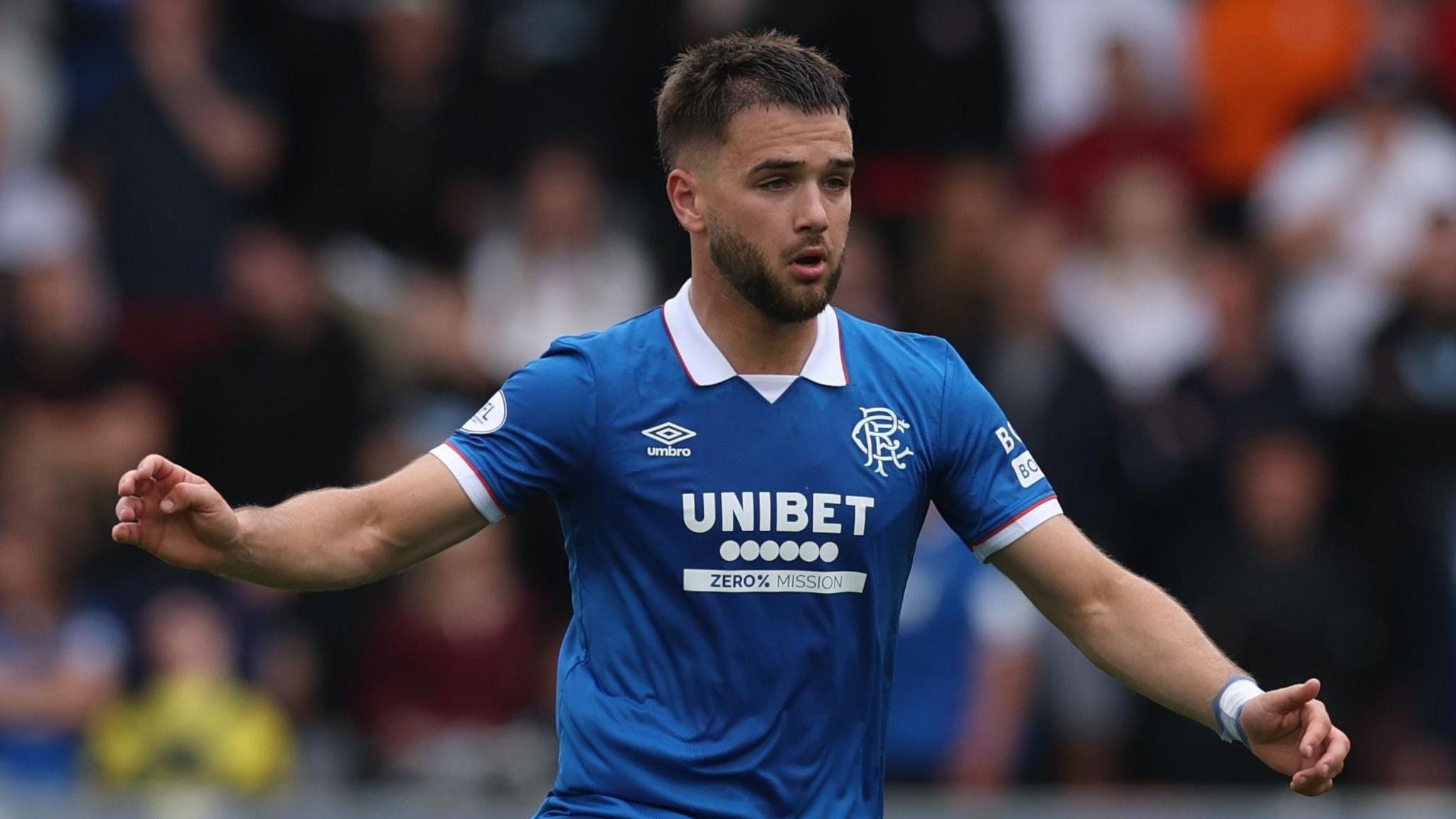
It’s fair to say that this has not been a great start to the season for Rangers, as they are a long way behind leaders Hearts in the Scottish Premiership, while they dropped down to the Europa League after a 6-0 humbling by Club Brugge in the Champions League play-off.
This sealed the fate of head coach Russell Martin, who was sacked just four months after taking charge.
Chairman Andrew Cavenagh and vice chairman Paraag Marathe did not exactly pull their punches when announcing the departure of the former Southampton manager, “When we took over the club this summer, we shared what we want to build for Rangers – to win trophies in Scotland and be able to compete at a high level in Europe. We know achieving these goals will take time, but our performances and results have not been good enough.”
In their letter to fans, they added, “We know you are frustrated – we are too. We did not get this right, and it’s our responsibility to fix it and get us back on track.”
Even the process to replace Martin did not exactly inspire confidence, as the top two choices, Steven Gerrard and Kevin Muscat, both backed out of discussions, leaving the former Sheffield Wednesday manager Danny Röhl as the third choice.
In fact, since Steven Gerrard was tempted away by the Premier League, moving to Aston Villa in November 2021, Rangers have had no fewer than six different managers, which has not exactly helped matters, as they have all had different playing styles, requiring significant turnover in the squad.
As a result, Rangers have consistently finished behind their great rivals Celtic in recent years, only bucking the trend in 2020/21. That said, the club has at least fought back from being relegated to the third division in 2012 after entering administration.
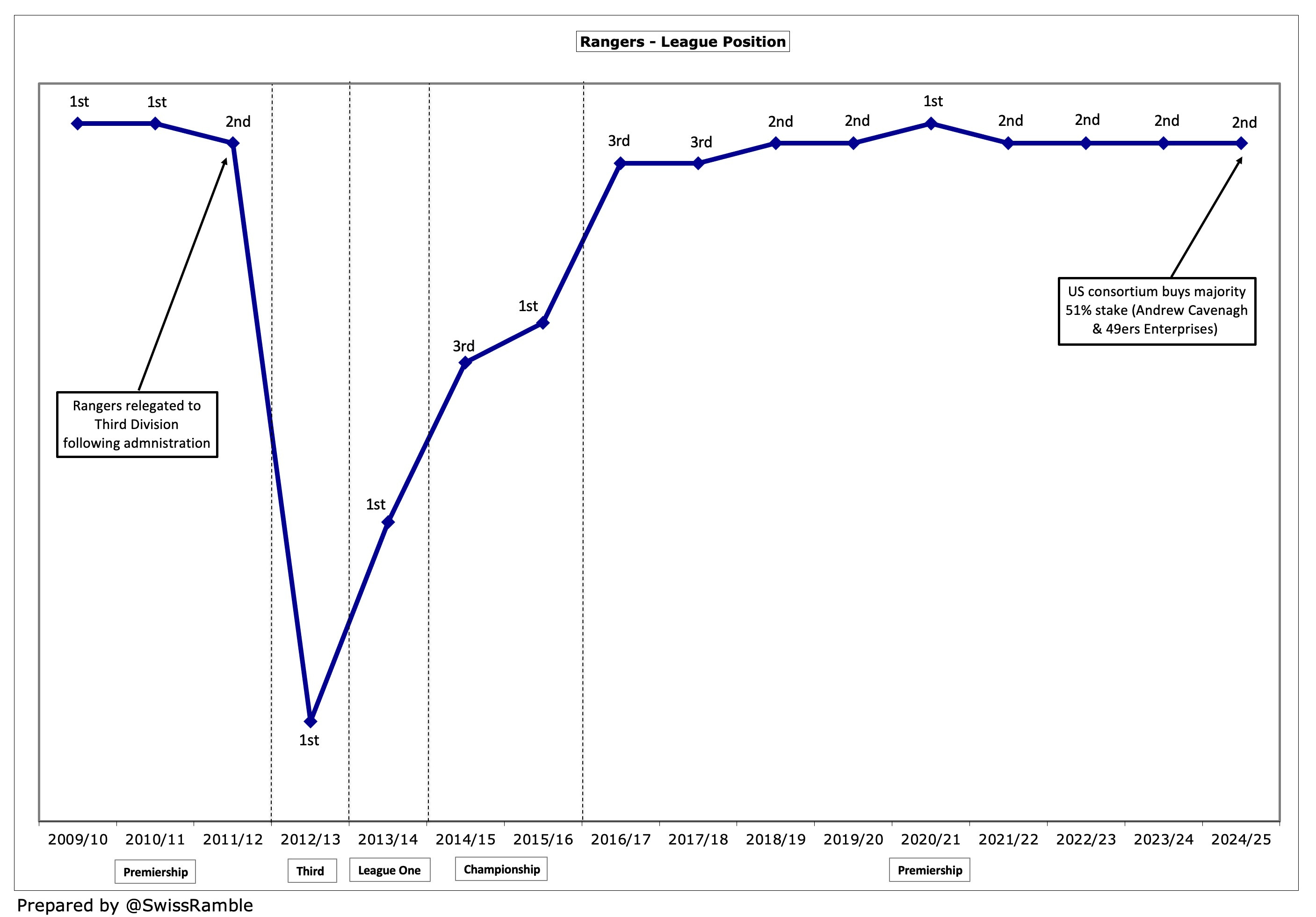
It wasn’t meant to be this way after new investors arrived with much fanfare last May, when an American consortium acquired 51% of the share capital of Rangers International Football Club Limited. As part of the acquisition, they invested £20m in new equity.
The consortium is led by Andrew Cavenagh, the co-founder of a Philadelphia insurance company, ParetoHealth, and 49ers Enterprises, the investment arm of the San Francisco 49ers NFL team. Cavenagh has taken on the chairman’s role at Ibrox, while Paraag Marathe, the president of 49ers Enterprises, is the vice chairman.
Marathe is also chairman of Leeds United, owned by 49ers Enterprises since a £170m takeover in 2023, though Rangers and Leeds will apparently not sit within a multi-club ownership group. That should prevent any problems if both clubs qualify for the same UEFA competition in the future.
The other shareholders include former chairman Douglas Park, George Taylor and Stuart Gibson, who all hold at least a 5% stake. Dave King, who had been the largest individual shareholder since leading the regime change in 2015, and John Bennett, chairman from 2023 to 2024, both divested their entire shareholding.
On his arrival, Cavenagh said, “This club’s history and traditions speak for themselves, but history doesn’t win matches. We know that the true way to honour the club’s heritage will be to drive performance. Our focus is simple: elevate performance, deliver results, and bring Rangers back to where it belongs – at the top.”
Fine words, but he will hope that things significantly improve after a fairly chaotic first few months at the helm.
In fairness to the new owners, they have certainly put their money where their mouth is, backing significant transfer spend this summer with no fewer than 14 players arriving, either permanently or on loan.
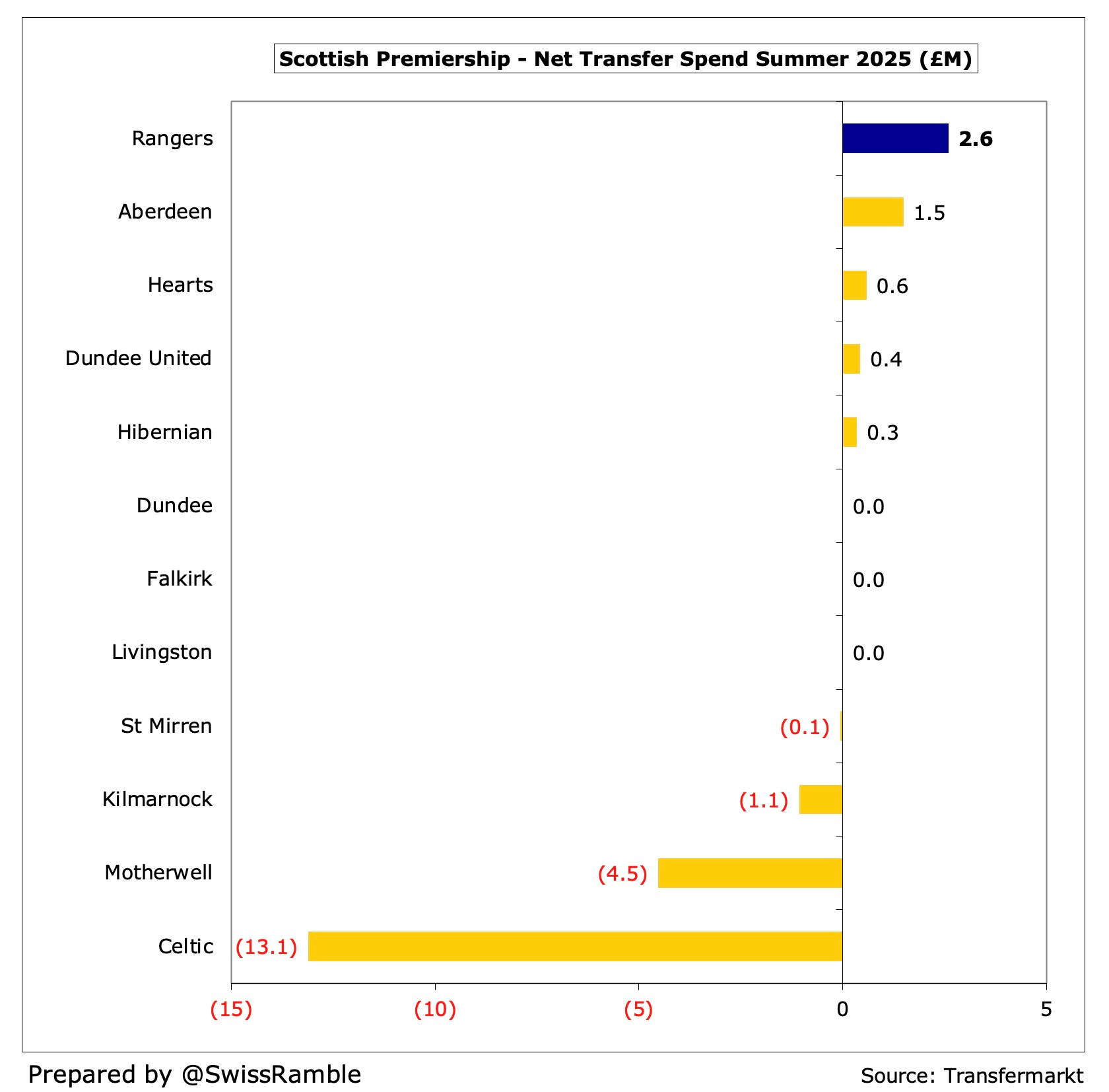
According to Transfermarkt, the club had £2.6m net spend, which might not sound like much, but was the highest in Scotland, well ahead of Celtic’s £13m net sales.
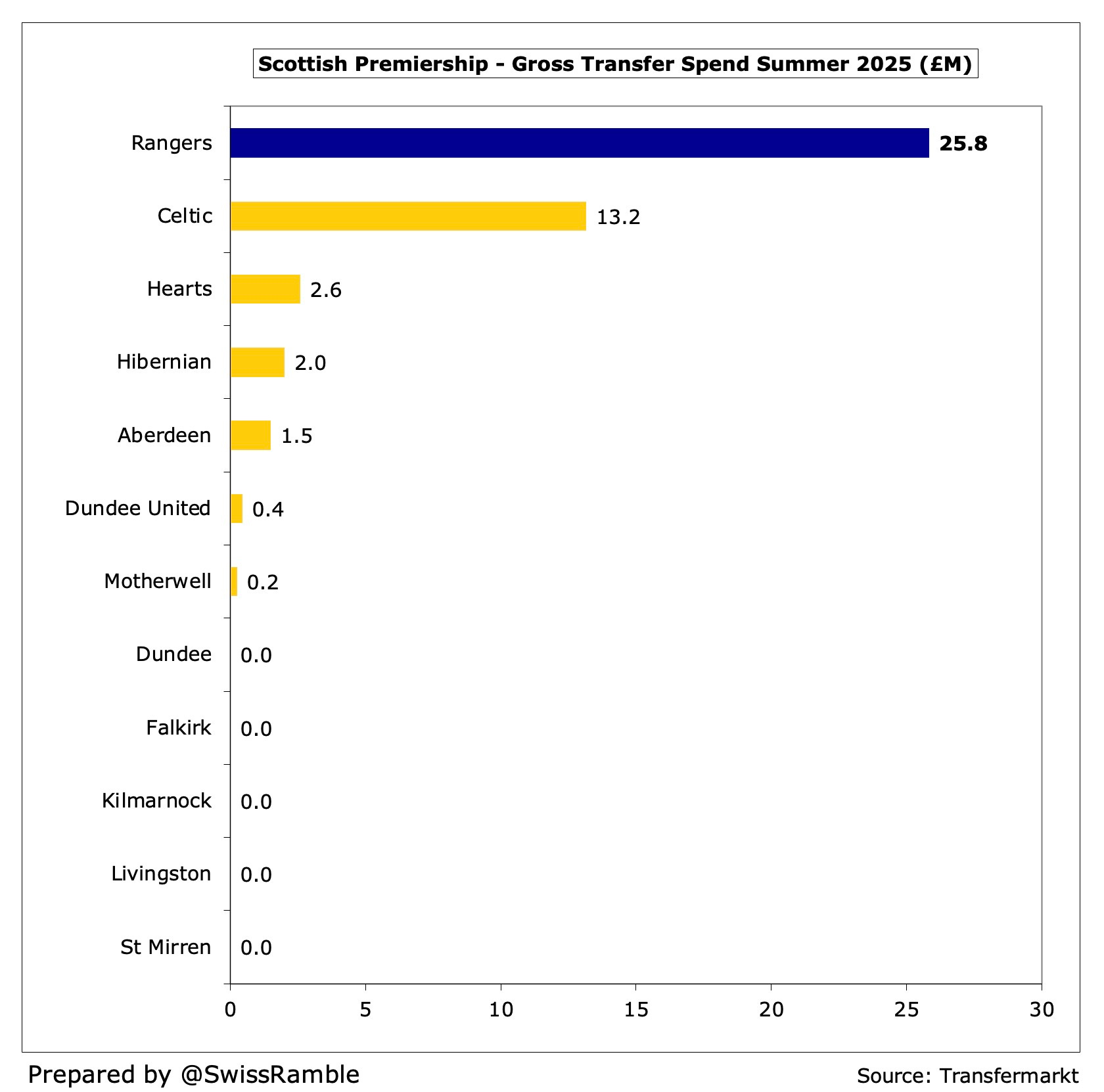
Rangers were also top of the pile in terms of gross spend, as their £25.8m was almost twice as much as Celtic’s £13.2m.
Singings included Youssef Chermiti from Everton, Oliver Antman from Go Ahead Eagles, Oscar Cortes from Lens, Thelo Aasgaard from Luton Town, Bojan Miovski from Girona, Emmanuel Fernandez from Peterborough United, Djeidi Gassama from Sheffield Wednesday and Joe Rothwell from Bournemouth.
In addition, there were quite a few arrivals on loan, including Max Aarons from Bournemouth, Mikey Moore from Tottenham, Derek Cornelius from Marseille, Jayden Meghoma from Brentford and Nasser Djiga.
However, it has clearly proved difficult to integrate this many additions into the team, so the new owners have discovered that it’s not enough to throw money at the project, but they also need to spend it well.
Interestingly, the club said that the net financial commitment from this summer’s transfer dealings will be around £21m, made up of £38m gross spend less £17m player sales.
That figure also includes agent fees, expected contingency payments and various other associated costs, casting some doubt on the Transfermarkt values, but either way the point is abundantly clear: Rangers spent a lot of money this summer, much more than the other clubs in Scotland.
The American consortium said that it “will chart a new strategic vision for the club’s future prioritising on-pitch performance and long-term financial sustainability”.
So what is the current state of Rangers’ finances in terms of sustainability?
Let’s dig into the recently published accounts for 2024/25, which cover a season when Rangers once again finished as runners-up in the SPFL Premiership behind Celtic, for the fourth year in a row.
They also lost to their great rivals in the Scottish League Cup final, but suffered an embarrassing defeat to lowly Queen’s Park in the Scottish Cup fifth round.
Although they were beaten by Dynamo Kyiv in the Champions League qualifying round, they did manage to reach the Europa League quarter-finals, where they were eliminated by Athletic Bilbao.
The latest figures will show that the new owners have a real challenge on their hands, although there are a few chinks of light.
Ranger’s pre-tax loss narrowed by £2.4m (14%) from £17.3m, but it still came in at a hefty £14.9m. Revenue rose £5.8m (7%) from £88.3m to a club record £94.1m, but this was more than offset by a worse result in player sales, which swung from a £5.6m profit to a £0.6m loss.
In addition, other operating income dropped by £4.1m (85%) from £4.8m to £0.7m, while there was no repeat of the previous season’s £1.1m gain from asset sales.
However, the club managed to cut operating expenses by £4.9m (4%) from £109.8m to £104.9m, while exceptional charges decreased by £2.9m from £3.4m to £0.5m. Net interest payable was slightly lower at £3.8m.
The loss after tax was slightly smaller at £14.8m, thanks to a £0.1m tax credit.
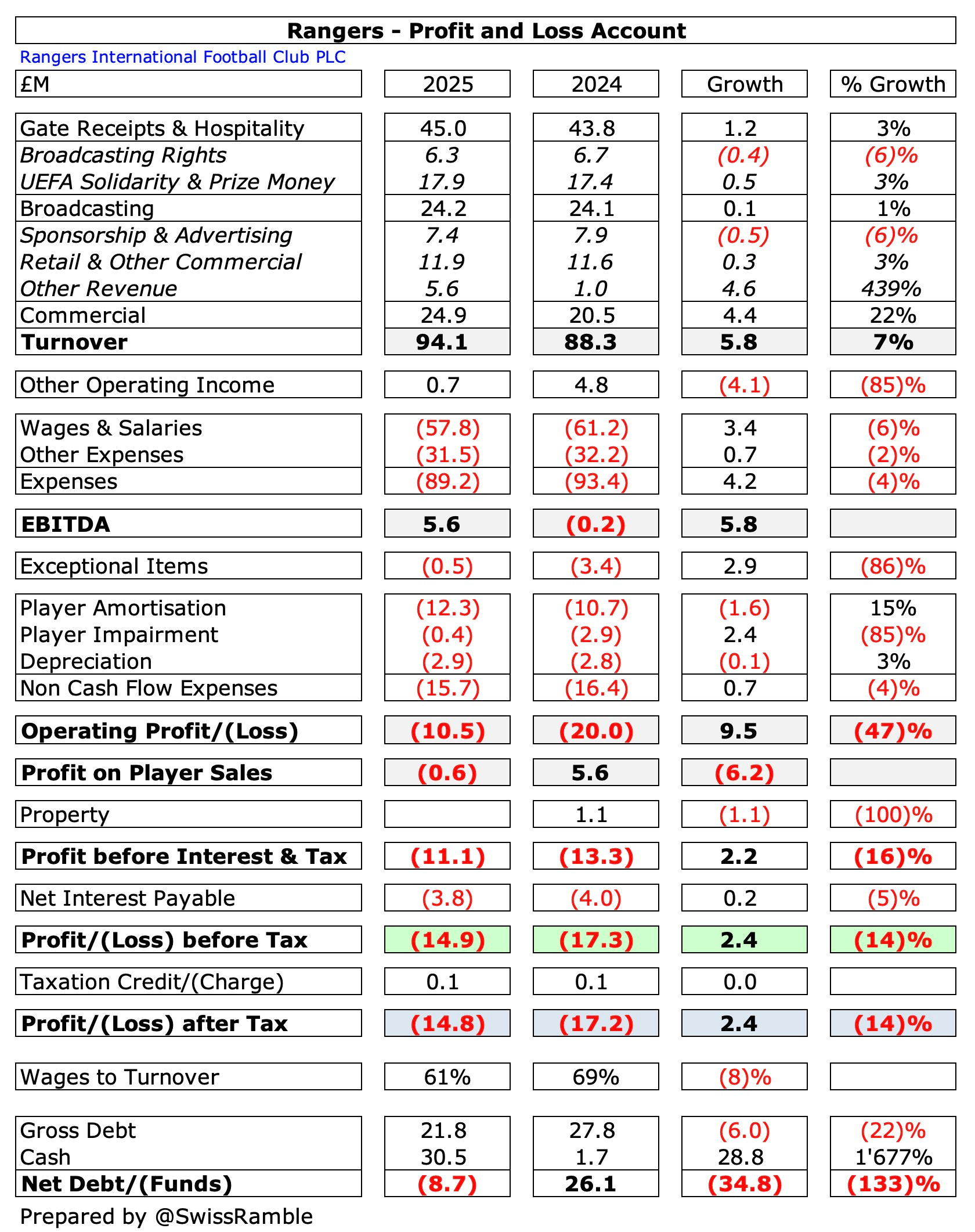
Rangers’ revenue growth was largely driven by commercial, which rose £4.4m (22%) from £20.5m to £24.9m, through there was also a decent increase in gate receipts & hospitality, up £1.2m (3%) from £43.8m to £45.0m. Broadcasting was virtually unchanged at £24.2m.
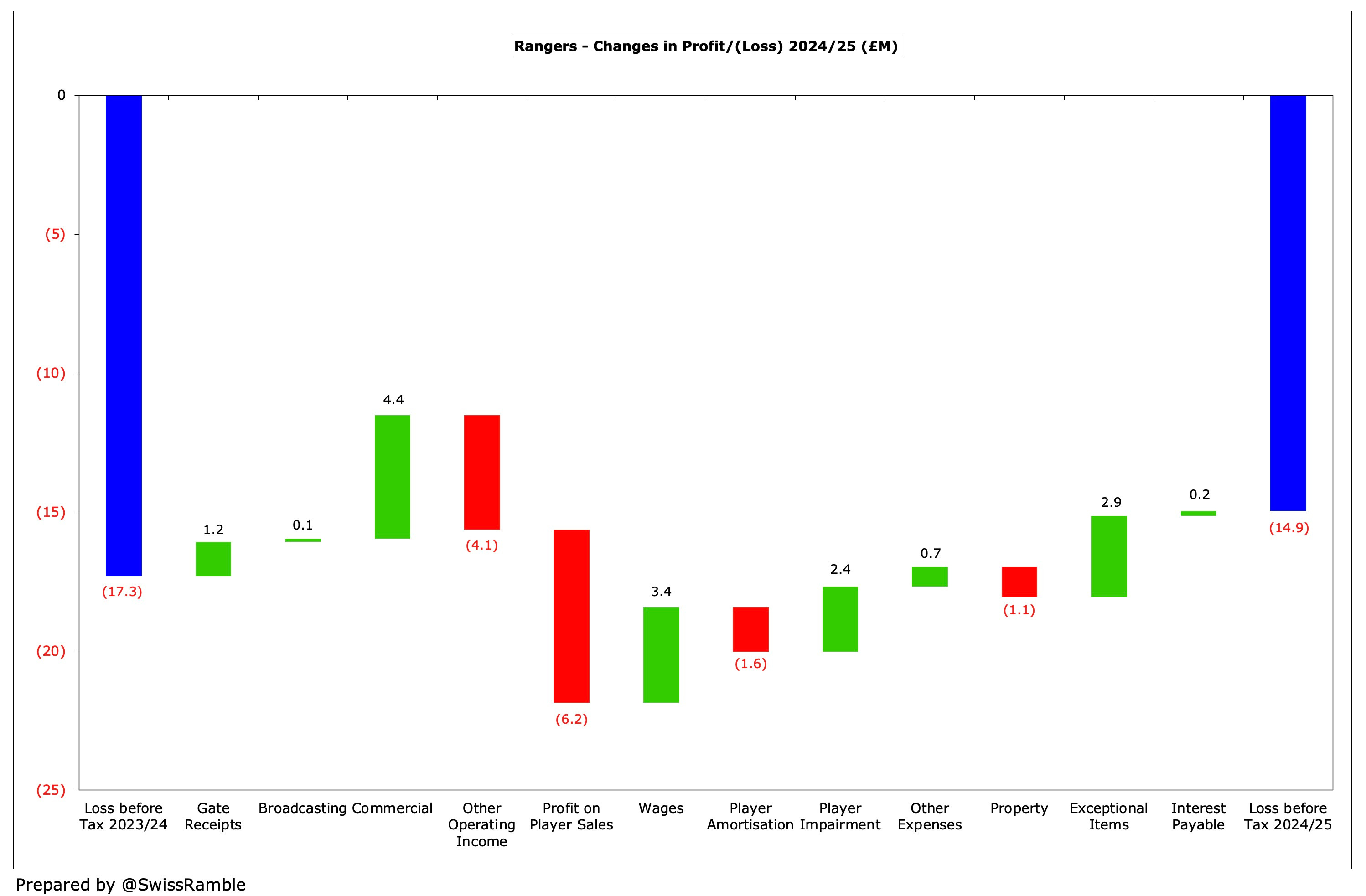
Rangers are clearly making efforts to get their cost base under control, as wages reduced by £3.4m (6%) from £61.2m to £57.8m, while other expenses fell £0.7m (2%) from £32.2m to £31.5m.
However, player amortisation rose £1.6m (15%) from £10.7m to £12.3m, though this was compensated by player impairment, which was down £2.5m from £2.9m to £0.4m.
Once again, Rangers’ £14.9m pre-tax loss was the worst financial result in Scotland by some distance.