

The fall of Constantinople in 1453 remains a defining chapter in Greek history and marks the end of the Byzantine Empire and the beginning of centuries of Ottoman dominance. Strongly associated with this historical event is the “self-surrender theory,” a concept stemming from the Byzantine refusal to accept union with the Catholic Church during key moments of Ottoman expansion.
Despite desperate appeals for military aid, attempts at reconciliation, such as the Council of Florence (1439), ultimately failed due to strong resistance from the Orthodox clergy and general populace. This resistance is often seen as a deliberate choice to uphold religious purity over political survival—a form of “self-surrender” that prioritized spiritual integrity over pragmatic alliance-building.
However, this interpretation oversimplifies historical complexities, overlooking the resilience and pragmatism of the Byzantine state. By reclaiming this nuanced legacy of the Byzantine Empire, modern Greece can move beyond a narrative of ideological rigidity and internal betrayal and pave a path rooted in practical diplomacy and strategic adaptability.
A flawed historical narrative
The “self-surrender theory” has become a powerful myth, suggesting that Byzantium’s refusal to reconcile with the Catholic Church left it isolated and vulnerable to the Ottomans. Yet, this narrative fails to consider broader economic and military factors.
By the 15th century, the empire was already weakened by territorial losses, economic decline, and internal conflicts. The defeat of two major Western-led crusades—the Battle of Nicopolis (1396) and the Crusade of Varna (1444)—demonstrated the limits of Western military support.
Even with a union, Western Europe was unlikely to provide the decisive aid needed, as it faced its own conflicts. Thus, the fall of Constantinople was less about religious disputes and more about external Ottoman strength and internal structural weaknesses.
In modern Greek politics and culture, the narrative of “self-surrender” has contributed to an ideological divide over Greece’s relationship with the West. Throughout the two centuries of its existence, the modern Greek state has grappled with this debate.
On one the one hand, pro-Western factions argue that Greece must fully embrace European integration, aligning domestic policies with Western standards in areas such as economic reform, defense, and human rights. These proponents view Western alignment as essential for ensuring long-term prosperity and stability.
Western alignment and the ideological divide
The pro-Western stance of modern Greek politics dates back to the Greek War of Independence (1821-1829), when Greece sought the backing of European powers like Britain, France, and Russia. The new state embraced the ideals of the European Enlightenment, aiming to rejoin the cultural and political sphere of the West after centuries of Ottoman rule.
This aspiration laid the groundwork for Greece’s Western alignment, driven by a desire for modernization and international recognition. During the Cold War, this orientation was solidified through membership in NATO (1952) and accession to the European Economic Community (EEC) in 1981, now the EU.
These alliances symbolized a commitment to economic growth, political stability, and a counterbalance to Soviet influence, embedding a pro-Western stance deeply into Greek strategy and public discourse.
Conversely, a growing movement perceives this alignment as a form of cultural and political surrender, echoing historical fears associated with the self-surrender narrative. This faction often advocates for a stronger emphasis on Greek sovereignty, Orthodox values, and an independent foreign policy, warning against the potential erosion of Greek cultural identity through deeper Western integration.
Rather than being constrained by the divisive myth of self-surrender, modern Greece could benefit from embracing the political pragmatism that defined much of Byzantine history. For over a millennium, the Byzantine Empire maintained influence through sophisticated diplomacy, strategic alliances, and adaptive governance, balancing relations with both Eastern and Western powers.
By reviving this legacy, Greece could adopt a more balanced foreign policy, engaging constructively with the EU, NATO, and regional neighbors like Turkey, while strengthening its strategic autonomy.

Reclaiming the Roman legacy: The continuity of Greek identity
A critical yet overlooked aspect of Greek heritage is the Roman identity of the Byzantine Empire. The term “Byzantine” is a modern construct; the people of the empire considered themselves “Romans” (Ρωμαῖοι), reflecting a blend of ancient Greek culture, Roman political identity, and Christian Orthodox faith.
This Roman heritage is a vital component of Greek identity, offering a path to strengthen national pride and cultural continuity. As historian Steven Runciman noted, “Modern Greeks are no more Hellenic than their Byzantine (Roman) ancestors.”
Such historical continuity shows that ancient Greece and the identity of the Byzantine Orthodox Empire are not mutually exclusive but complementary facets of Greek heritage. Byzantium represented an evolution of Hellenic and Roman traditions, seamlessly integrating Greek philosophy, Orthodox spirituality, and Roman governance.
Embracing this synthesis would allow Greece to reclaim its ancient and Byzantine roots as core elements of its national identity, redefining its role in Europe and the Mediterranean as the inheritor of a sophisticated imperial legacy.
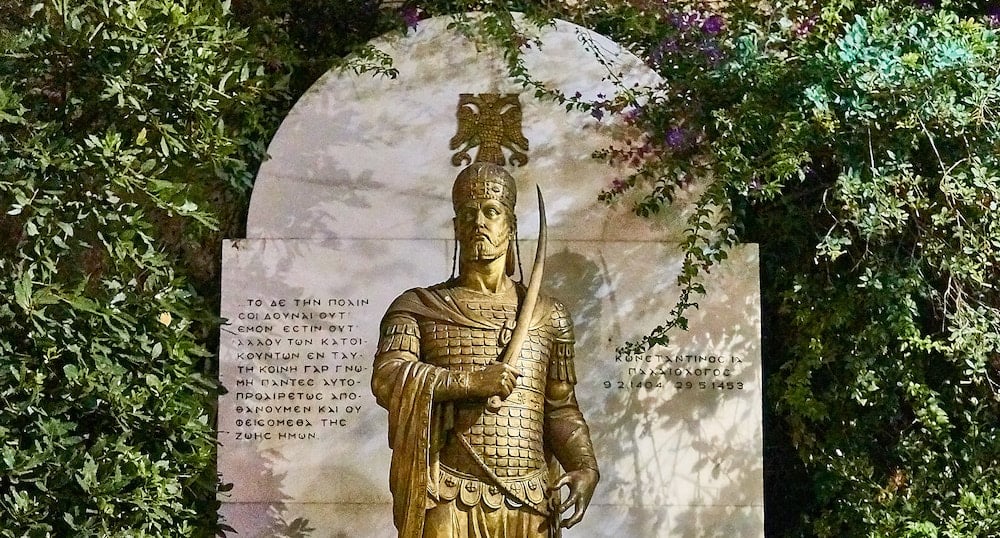
A new path forward: Strategic lessons for modern policy
The diplomatic strategies of the Byzantine Empire offer valuable lessons for the contemporary foreign policy of Greece. Byzantium often favored negotiation and alliances over direct military confrontation. Modern Greece could draw on this tradition of pragmatic diplomacy, guiding its interactions with the EU, particularly during economic or political crises.
Instead of treating Western alignment as an ideological mandate, Greece could pursue a more independent policy, leveraging its unique cultural and geopolitical position as a bridge between East and West. The myth of self-surrender has long acted as a cultural burden, reinforcing narratives of internal division and missed opportunities.
However, the deeper history of Byzantium reveals a legacy of resilience, adaptability, and sophisticated governance. By embracing the true pragmatism and Roman heritage of the Byzantine Empire, Greece can forge a new path forward—one that honors its unique historical identity while engaging effectively with modern challenges.
This approach would strengthen national unity and enhance Greece’s role as a stabilizing force in the region.
Guest article written by Theodoris Rakkas, historian and cultural diplomat.