
At Tel Aviv’s fourth Latino America Music Festival, international artists arrived despite cancellations, political pressure in Europe, and renewed Israeli anxiety over Iran, bringing rhythm and memory into the ceasefire period
“Cubans always experience music as a bridge for us. It’s a bridge of joy and tradition,” Cuban singer Arahí Martínez Carranza told The Media Line. “Our rhythms are very joyful, but also a little nostalgic, because almost all the music we make keeps our roots alive.”
The idea of music as a bridge was evident over three days at the fourth Latino America Music Festival held in February at the Tel Aviv Museum of Art. The program moved quickly from salsa to son Cubano to Afro-Cuban jazz, with musicians from Cuba, Peru, Brazil, Venezuela, Spain, and the Netherlands sharing the stage with Israeli performers.
The country is in a ceasefire with Hamas, and daily life has largely resumed. Cafés are open. Flights arrive. Cultural venues operate. But conversations still drift back to the last two years, and the atmosphere still carries the memory of the conflict, especially in the same complex that hosted thousands of protesters, hostages’ families, and former hostages over two years.

Arahi Martinez Carranza. (Gabriel Colodro/The Media Line)
Martínez Carranza, who previously sang with the all-female Cuban orchestra Anacaona, builds her repertoire around traditional son and bolero. She grew up in a musical family in Santa Clara and has performed alongside Celia Cruz and Omara Portuondo. In Tel Aviv, she included “Jerusalem of Gold” in her set. The audience reaction was immediate and sustained.
I feel happy keeping alive a song that should never die. It reminds people where they come from and what they are. That essence must never be lost.
“I feel happy keeping alive a song that should never die,” she said. “It reminds people where they come from and what they are. That essence must never be lost.” According to several performers, the reception this year felt particularly charged. “We feel very fortunate to have brought a little joy through our music to people who need it,” Martínez Carranza added. “So they never lose their faith.”
Behind the visible celebration, the effort to assemble the lineup reflected the broader political climate. The festival is produced by Shamayim–Creative Management & Production, founded by Ziv Ben, who has overseen cultural projects in Israel for three decades. Alongside artistic adviser Fernando Knopf, the team has spent years cultivating relationships with Latin musicians willing to perform in Israel.
Speaking with The Media Line, Knopf acknowledged the difficulty of doing so under current circumstances. “The context influences a lot,” he said. “Most artists do not want to come to Israel right now. If you are not Jewish or openly pro-Israel, almost no one wants to come.” Many of the festival’s musicians are based in Spain, Germany, Belgium, France, and the Netherlands, where appearing in Israel can generate backlash. “There are artists who are afraid they will be ‘burned’ at home if they come,” Knopf said. “There are places in Europe where anti-Semitism is very strong, and they are under pressure.”
That pressure has translated into cancellations. “Last year, two singers said ‘Yes, yes, yes,’ and in the end they canceled because of the situation,” Knopf said. “If rockets start falling, everything is canceled. And then how do you explain that now things are more normal?”
Most artists do not want to come to Israel right now. If you are not Jewish or openly pro-Israel, almost no one wants to come.
In the weeks leading up to this year’s edition, Israeli media coverage of possible escalation with Iran heightened public anxiety. Knopf said the atmosphere influenced ticket sales and the general mood. “For three weeks, the media kept the whole country in fear,” he noted. “That influences everything.” Despite this, he described the current lineup as the strongest since the festival’s inception. “It’s a blessing that artists of such high musical and human level come here,” he said. “They bring happiness and positive energy. Latin music brings optimism and hope. That is so necessary here.”
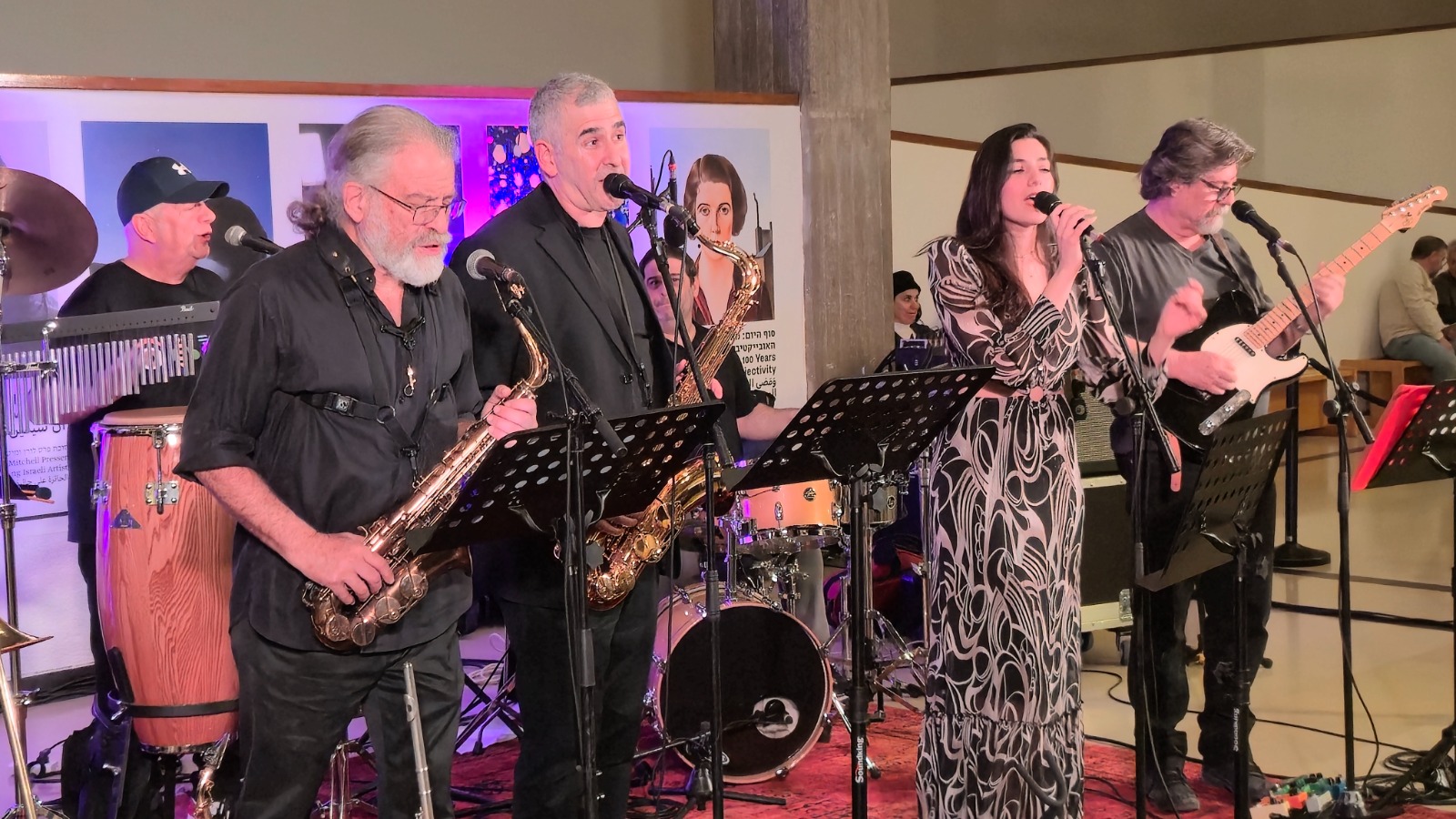
Band El Puenta at Tel Aviv’s fourth Latino America Music Festival, Feb. 2026. (Gabriel Colodro/The Media Line)
Spanish-Cuban trumpeter Manuel Machado, participating for the second time and visiting Israel for the fourth time, framed his decision in artistic rather than political terms. “Music is above any difficulty,” he told The Media Line. “It is a universal language. We come to bring joy.” He highlighted the connection with Israeli musicians, many of whom have collaborated internationally. “When we play together, you feel it on stage,” he said. “The public receives it with so much love.”
Bobby Martínez, a saxophonist and flutist based in Spain, first arrived in Israel in the weeks following October 2023. “People in Spain told me, ‘Are you crazy? You’re going to Israel?’” he recalled in an interview with The Media Line. During that stay, a siren sounded while he was in his hotel room. “I had to run to a safe room,” he said. “That was the only thing.” He has since returned twice. “The Israeli public loves Latin music,” Martínez said. “They know how to appreciate music. Not only Latin music. They know jazz. They have very good musicians here.”
The Israeli public loves Latin music. They know how to appreciate music. Not only Latin music. They know jazz. They have very good musicians here.
Mariella Köhn, the Peruvian singer who led tributes to Mercedes Sosa and performed material rooted in Andean and Afro-Peruvian traditions, encountered similar reactions before boarding her flight. “People asked me, ‘How can you go to Israel?’” she told The Media Line. “I have been singing for 40 years with a clear mission: to bring joy and peace. If I am going to live with fear, then I should not sing.”
People asked me, ‘How can you go to Israel?’… If I am going to live with fear, then I should not sing.
Köhn said the decision to travel was personal and rooted in conviction rather than politics. “There are decisions that are totally personal,” she said. “If I am going to walk around with fear doing something I love, which is singing, then I should not sing.” She added that some people even questioned her on social media about her political position. “They asked me, ‘Which political side are you on?’” she recalled. Her answer, she said, was consistent: she stands on the side of music.
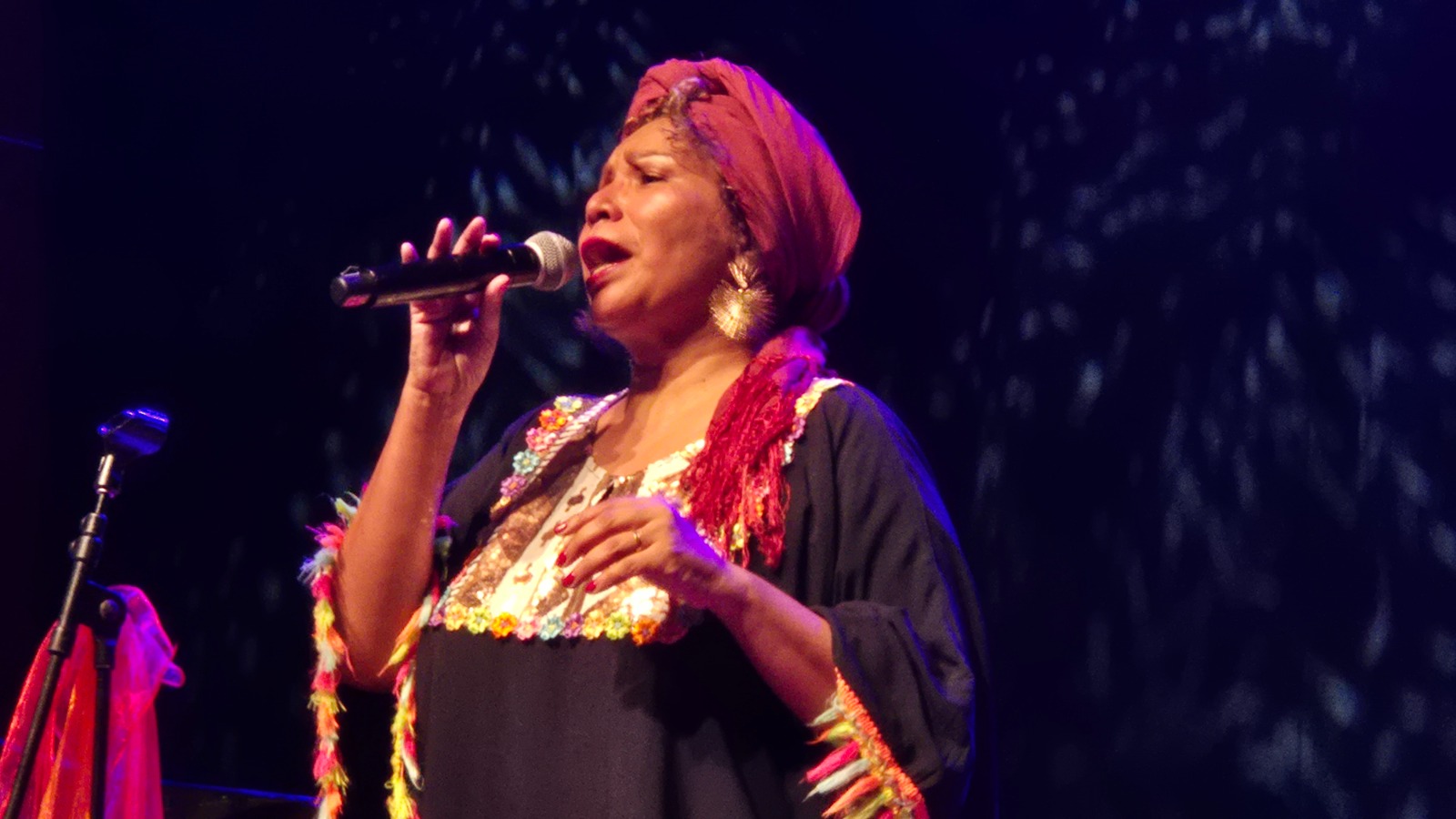
Mariella Kohn performing at Tel Aviv’s fourth Latino America Music Festival, Feb. 2026. (Gabriel Colodro/The Media Line)
Her program in Tel Aviv included two concerts dedicated to Mercedes Sosa, along with a performance focused on Peruvian repertoire. For Köhn, the material carries a message that transcends geography. “War and peace have always existed in humanity,” she said. “But singing rescues us.” She described the repertoire as timeless, music that “does not go out of style” because it speaks to human dignity and resilience.
Unlike artists who arrive, perform, and leave, Köhn said she prefers to walk the streets of the cities where she sings. In Tel Aviv, she spoke with hotel staff, entered shops, and engaged with people outside the concert hall. “That is how you know a place,” she said. “If I only stay on stage and then return to the hotel, then I am not really here.” She also noted the warmth of the local production team and musicians, mentioning that the festival’s musical director has lived in Peru and understands her cultural background.
“I cannot live with fear,” she said. “If something happens, it can happen anywhere. I believe in what I sing.”
From a production standpoint, the festival compresses complexity into three days, with more than 20 performances, including tributes to Celia Cruz, Buena Vista Social Club, Juan Luis Guerra, and Antônio Carlos Jobim, as well as cross-national collaborations.
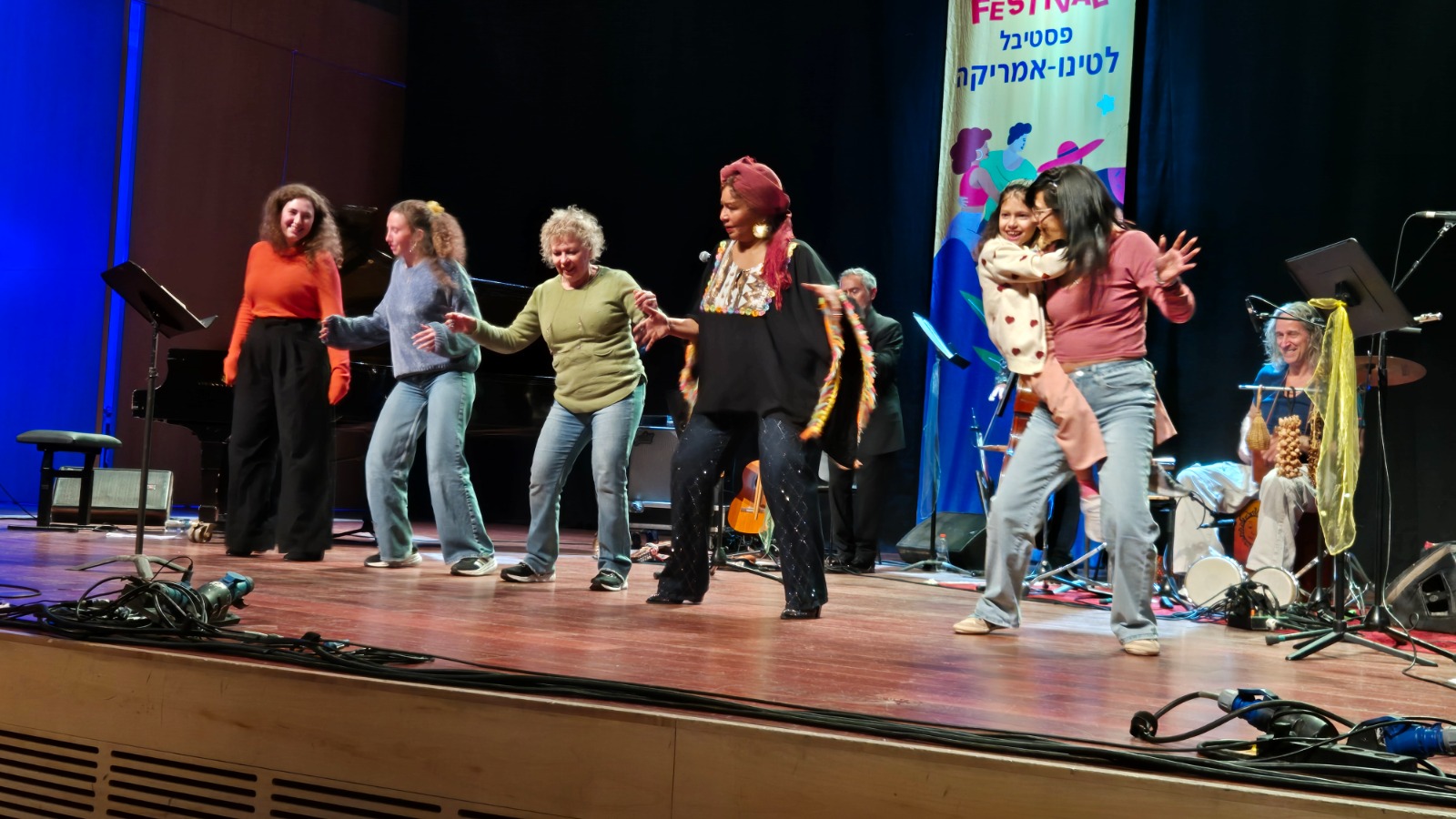
Mariella Köhn dancing with crowd, Tel Aviv, Feb. 2026. (Gabriel Colodro/The Media Line)
Knopf described a year of preparation, with musical arrangements written in advance and rehearsals often limited to one or two sessions before performance. “You work with highly professional musicians who know how to read music, who speak the musical language,” he said. “You make it happen.” A tribute to Celia Cruz featuring four Cuban vocalists stood out for him. “It was historic for me,” he said. “Almost all of them were Cuban. That kind of authenticity is very special.”
What ultimately unfolded inside the museum halls was cultural continuity. Trumpets cut through percussion, boleros slowed the tempo of the room, and samba rhythms lifted it again. Musicians who had weighed whether to come stood alongside Israeli colleagues who had endured mobilization and loss. Latin music did not undo the war or silence the headlines. Yet during a ceasefire, when daily routines are returning, the festival offered a few hours in which attention shifted from news alerts to sound, and from analysis to music. For many in the hall, that shift was enough.