Robinhood Weighs Prediction Market Risks Against Expanding Financial Platform
Track your investments for FREE with Simply Wall St, the portfolio command center trusted by over 7 million individual investors worldwide.
Polymarket has filed a lawsuit against Massachusetts over the state’s approach to prediction markets, creating new regulatory questions for platforms offering similar services.
Robinhood Markets (NasdaqGS:HOOD), which has integrated access to prediction market style products, could face compliance and operational risks depending on how this dispute evolves.
At the same time, Robinhood is expanding its product ecosystem, including new banking services, a credit card, and international tokenized stock trading options.
These moves reflect a shift from a pure trading app toward a broader financial platform with different revenue drivers and regulatory touchpoints.
Robinhood started as a commission free trading app and now sits at the intersection of brokerage, banking, and digital assets. The company is rolling out products such as new banking services, a credit card, and tokenized stock trading abroad, which gives users more ways to interact with its platform. For you as an investor, this means the business mix is getting more complex, and so are the risks tied to regulation and operations.
The Polymarket lawsuit against Massachusetts brings that risk side into sharper focus for NasdaqGS:HOOD because of its links to prediction style markets. As this legal process unfolds, it could influence how regulators view similar products and the compliance burden on firms that offer or connect to them. The combination of broader offerings and evolving rules is likely to be an important theme to watch around Robinhood’s future business profile.
Stay updated on the most important news stories for Robinhood Markets by adding it to your watchlist or portfolio. Alternatively, explore our Community to discover new perspectives on Robinhood Markets.
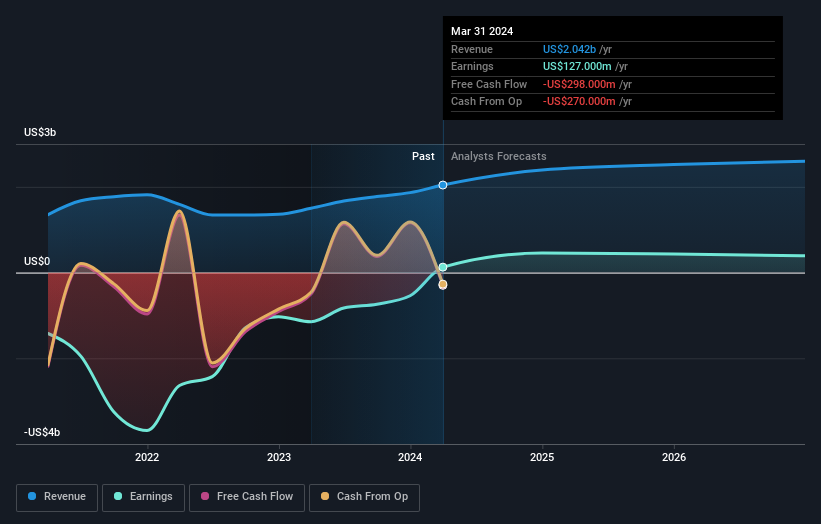
NasdaqGS:HOOD Earnings & Revenue Growth as at Feb 2026
For Robinhood, the Polymarket lawsuit lands just as the company is leaning harder into event contracts and prediction-style products and broadening its overall offering. The legal uncertainty around how states classify and police these markets adds a layer of compliance and reputational risk that sits alongside its existing exposure to options, crypto, and tokenized assets. At the same time, Robinhood is not a single-product story. In 2025 it reported full-year revenue of US$4.47b and net income of US$1.88b, with management pointing to 11 products each generating more than US$100m in annualized revenue and its Gold subscription, banking services, and credit card becoming more important to the mix. That diversification, together with inclusion in the S&P 500 and an ongoing buyback that has retired about 2.52% of shares under its current program, indicates a business trying to move from trading-sensitive earnings to more recurring, platform-based economics. For you, the key question is whether incremental regulatory costs and product complexity from prediction markets offset the benefits of a broader ecosystem.
The push into prediction markets via MIAXdx and related partnerships lines up with the narrative that these products could become an important future economic driver if Robinhood can own more of the exchange and clearing stack.
Regulatory pushback, highlighted by the Polymarket case and earlier restrictions on Kalshi, directly challenges the assumption that expansion into tokenized and alternative assets will progress smoothly and support long term growth.
The recent focus on subscription, banking, and international products like tokenized stock trading in Europe adds a layer of platform depth that is not fully captured by a narrative centered mainly on young traders and event contracts.
⚠️ Heightened regulatory and compliance risk around prediction markets and tokenized assets, which could increase costs or limit growth if rules tighten after high profile enforcement actions.
⚠️ Dependence on trading-sensitive revenue, including options and crypto, during a period when monthly active users have been under pressure and some analysts have cut price targets on concerns about earnings volatility.
🎁 A broader product set that now includes banking, a credit card, and a scaled Gold subscription business, which management reports as growing and helping diversify revenue away from pure trading.
🎁 Evidence of profitability at scale, with 2025 net income of US$1.88b, record annual revenue, and a completed US$909.51m buyback that signals management’s willingness to return capital.
From here, keep an eye on three things. First, how state and federal regulators treat event contracts and prediction markets, and whether Robinhood adjusts or reins in those offerings. Second, the mix of revenue between volatile trading lines and more recurring sources like Gold subscriptions, banking spreads, and card fees, especially as crypto transaction revenue has already seen a 38% decline in Q4 2025. Third, user trends and engagement relative to peers such as Coinbase, Charles Schwab, and Interactive Brokers, since the long term platform story still depends on customers using several products, not just trading occasionally. Together, these signals will show whether Robinhood is building a durable multi-product platform or staying tied to swings in risk appetite.
To ensure you’re always in the loop on how the latest news impacts the investment narrative for Robinhood Markets, head to the community page for Robinhood Markets to never miss an update on the top community narratives.
This article by Simply Wall St is general in nature. We provide commentary based on historical data and analyst forecasts only using an unbiased methodology and our articles are not intended to be financial advice. It does not constitute a recommendation to buy or sell any stock, and does not take account of your objectives, or your financial situation. We aim to bring you long-term focused analysis driven by fundamental data. Note that our analysis may not factor in the latest price-sensitive company announcements or qualitative material. Simply Wall St has no position in any stocks mentioned.