
For this year’s International Day of Women and Girls in Science, the Royal Society has created an interactive map that explores the contributions of historical women to science, technology, engineering and mathematics across the UK. So far, landmarks, monuments and locations linked to around 50 female scientists have been plotted. The Royal Society has called on the public to add other connections to famous female scientists in the UK to help map science history.
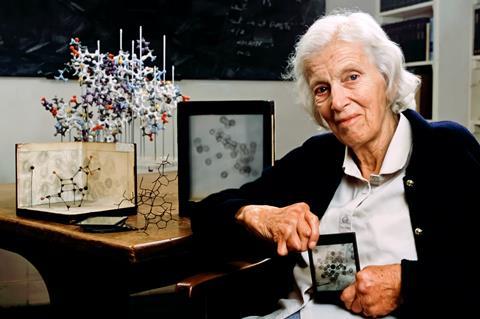
Several of the landmarks are near the Royal Society’s headquarters in London. This includes a portrait of Dorothy Hodkgin (1910–1994) in the National Portrait Gallery and a statute of Florence Nightingale (1820–1910) at Waterloo Palace. The Royal Society of Chemistry’s Burlington House features too, as this is where x-ray crystallographer Kathleen Lonsdale (1903–1971) and microbiologist Marjory Stephenson (1885–1948) became the first two female fellows of the Royal Society in 1945.
Most of the other monuments on the map can be found throughout the UK. One of the northernmost is a plaque at the University of Dundee in Scotland that honours Williamina Fleming (1857–1911), an astronomer who discovered the first white dwarf star, over 50 nebulae and advocated for women in science. In north Wales, a National Trust house that belongs to the family of Anna McLaren (1927–2007), an embryologist whose work on fertility in mice was a step towards human IVF treatment, is open to the public.
Rebekah Higgitt – a science curator at National Museums Scotland – noted on Bluesky that ‘there are just a handful of women marked so far [on the map].’ The Royal Society is calling on the public to send in their recommendations of other landmarks, locations or monuments connected to historical female scientists in the UK, to showcase their often forgotten – but equally vital – work and help map science history.
There are just a handful of women marked so far, I’m sure the #histsci community on here can suggest many more (brief submission form via link below).
— Rebekah Higgitt (@rhiggitt.bsky.social) February 11, 2026 at 1:54 PM
Female scientists currently account for just over 30% of the global scientific workforce. While this is a much-improved figure compared with when many of the women found on the Royal Society’s map were fighting for a seat at the table, it is still some way from parity.
A recent report conducted by the International Science Council found that women still remain underrepresented in scientific organisations, such as scientific academies or international scientific unions. For example, among the 50 national academies, only a fifth of members are female, with a similar proportion of academies with female presidents.
The report highlighted that long-standing practices in scientific organisations still influence who is nominated, selected, recognised and heard, rather than there being a lack of qualified women.