
Science fiction is all about commenting on the present within a high-tech and occasionally futuristic setting. But the genre has been around for so long that the real world has actually passed the far-off future authors and screenwriters once envisioned. It’s easy to be dismayed at all the ways these projects get the future wrong, as alien invasions and flying cars still haven’t occurred — yet. But even if certain details haven’t panned out, it’s fascinating to look at the ways movies are accurate with their predictions.
The year is now 2026, which means we’re more than halfway through the 2020s. There’s political turmoil and artificial intelligence, albeit a different variety than what’s normally portrayed in science fiction. We can’t think of a single sci-fi film where AI is used to make images of pizza Nicolas Cage and shrimp Jesus. And believe it or not, several prominent sci-fi movies are set in 2026. The broad strokes might be off, but if you dive deeper into these films, you’ll find eerie similarities to what has actually transpired in our world.
Metropolis
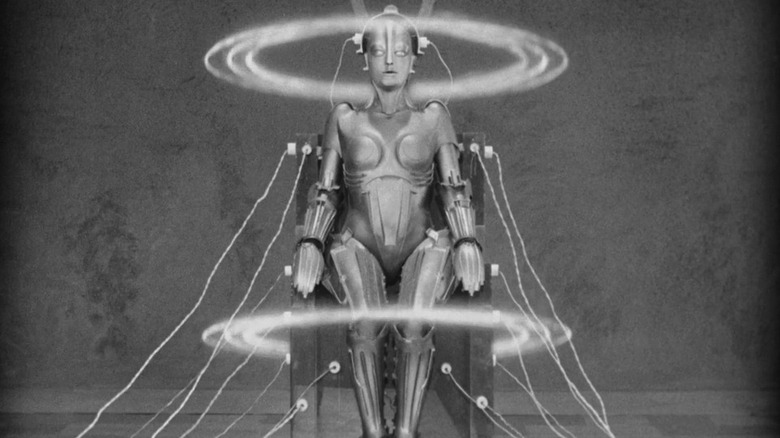
One of the most influential science fiction films of all time just so happens to take place in 2026. Fritz Lang’s “Metropolis” came out in 1927, and it’s a perfect case study of German expressionism. It heavily influenced Tim Burton’s “Batman” movies, but moving beyond the aesthetics, the film had a lot to say about the 1920s that still rings true today.
It takes place in a futuristic dystopia where there’s a massive income gap between the wealthy, who live in skyscrapers towering over the landscape, and the poor, who toil underground to work on massive machines powering the city. For anyone finding the modern economic culture difficult to navigate, the film feels particularly prescient, especially with a report posted in January 2026 that revealed how in 2025, the richest 1% of Americans held 31.7% of all of the wealth. For the vast majority of society, it’s hard not to empathize with the workers’ plight in “Metropolis,” where they can’t possibly hope to be the ones in the skyscrapers one day.
But that’s only part of the equation that makes “Metropolis” special. The film’s also crucial in the stunning evolution of AI in movies. Maria (Brigitte Helm) offers hope to the workers, wanting them to find better conditions amongst their overlords. One of the immensely wealthy, Joh Fredersen (Alfred Abel), builds a robot in Maria’s likeness to discredit her among those within her socioeconomic class. While human-like robots with AI are being worked on, it’s far more interesting to look at how “Metropolis” predicted AI being used as a tool of manipulation. AI slop is now flooding social media, making it harder to discern what’s real and what’s fake.
Dawn of the Planet of the Apes
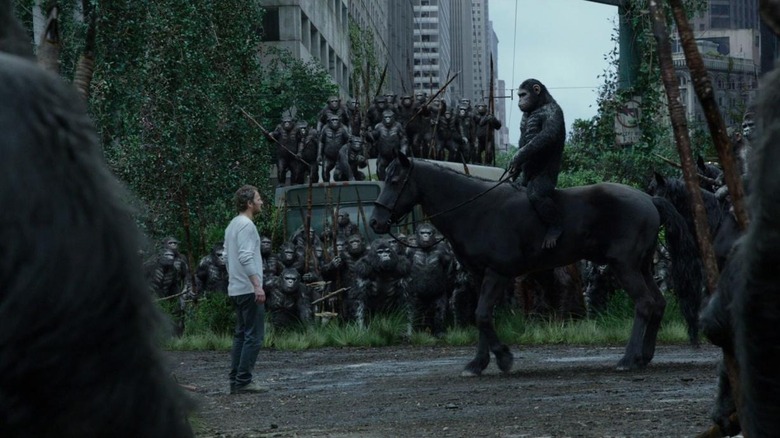
“Rise of the Planet of the Apes” came out in 2011, but is set in 2016, ending with Caesar (Andy Serkis) leading other apes who have been experimented on to freedom. There’s also the outbreak of the simian flu, ultimately leading to a pandemic that will wipe out much of humanity.
“Dawn of the Planet of the Apes” picks up 10 years later in 2026. The cognitive abilities of Caesar and the other apes have greatly improved, and the apes are on the brink of war with the final remnants of humanity. While Caesar hopes for peace, forging a brief alliance with the human Malcolm (Jason Clarke), Koba (Toby Kebbell) wants to accelerate the apes’ conquest of the planet. The “Planet of the Apes” franchise has always been fantastical, which remains true here. And while our real world doesn’t see us fighting with apes on a regular basis, the world did just experience a pandemic that escalated hostilities.
Even if COVID-19 didn’t wipe out as many humans as the simian flu, it revealed breaking points within our society. And if someone charismatic enough, like Koba, comes along, they can take advantage of people’s (or apes’) fears to rile them up toward violence. “Dawn of the Planet of the Apes” surprisingly got a lot right, making it easily the best of the “Planet of the Apes” films.
Doom

Even if they’re pretty farfetched, “Metropolis” and “Dawn of the Planet of the Apes” still have much to say about our modern world. That doesn’t necessarily hold true for 2005’s “Doom,” based on the influential ’90s first-person shooter that just so happens to be set in 2026 — at least in the beginning. That’s the year humanity in the film discovers a wormhole that allows them to instantly travel to Mars. From there, the movie jumps forward in time to 2046, where we get the demon-like creatures attacking a research facility, requiring an elite squad of marines to go in and take them out.
“Doom” is one of the many forgotten failures of Dwayne Johnson, still credited as “The Rock” when the movie first came out. It fails both in terms of its action and horror, and there’s not exactly a ton to glean for social commentary. The 2026 part of the film is mostly devoted to the discovery of the Mars portal. Humanity is interested in getting to Mars, and NASA has plans for manned missions to the red planet at some point. But the earliest those will take place is the 2030s.
The goal for these explorations of Mars is to learn more about how the planet could support human life one day. Hopefully, when the day comes that humans land on Mars, they don’t encounter a bunch of alien demons already living there.