
In the first week of March several embassies stepped forward to show the value of middle powers to boost policy items and agendas that are now under attack. The embassies of Spain, Italy, France, the UK, Sweden, Switzerland and Canada hosted an event on ‘Women in Science’, thus bolstering the key role of scientific diplomacy at a time when both science and women, and diversity at large, are under pressure.
Society is facing very complex challenges where the diversity of knowledge systems is a key foundation for a deeper understanding that should lead to more equitable and sustainable outcomes because it can help to break down reductionist silos and uncover hidden interdependencies to foster more sustainable, equitable solutions.
Gender is an integral element of the Paris agreement with the Gender Action Plan adopted at COP30 in Belem after 25 years of negotiation since 2001. Therefore, a gender tracker on the intergovernmental panel on climate change (IPCC) itself is proof of coherence. There has been a rise from a 2%-to-8% presence of female authors across the different working groups in the first IPCC report in the 1990s, to 33%-to-40% in the latest AR6 report published between 2022 and 2023, and finally to the current recently selected female authors in AR7, which now reach 46%. There is even better news if looking at the current IPCC Cities and Climate change report –currently under review–, which has slightly surpassed parity, a first in the IPCC’s 37-year history, to a majority-female authorship (51 out of 97 authors).
The MedEcc, a scientific body spanning the north and south Mediterranean led by the Union for the Mediterranean (UfM), the United Nations Environment Programme/Mediterranean Action Plan (UNEP/MAP) and Plan Bleu, has an equal number of female and male authors working on the MAR2 report currently under preparation. The latter will document the evidence on scientific knowledge of Mediterranean climate and environmental challenges. But it will also extend the focus to social sciences in order to also help consolidate the scientific evidence assessments on the urgent challenges in a well-recognised hotspot region –not just in political terms, but also due to climatic and environmental drivers–, with the object of strengthening environmental diplomacy and climate governance policies in these turbulent times.
Key characteristics of the world’s current problems –such as the environmental and climate crisis– are their complexity and the importance of supporting cultural change rather than boosting cultural wars. Society is facing very complex challenges where the diversity of knowledge systems is a key foundation for a deeper understanding that should lead to more equitable and sustainable outcomes because it can help to break down reductionist silos and uncover hidden interdependencies to foster more sustainable, equitable solutions.
In the case of women and science, the latter has to be more inclusive. Arecent workshop held by the IPCC at one of the oldest and largest meteorological institutes in the world, at the University of Reading –founded by a couple of meteorologists, female and male–, reflected on the importance for science to be open to diverse knowledge systems: indigenous, local and practice based. At the same time, it highlighted the revolution that digital technologies represent as regards methods of assessment for scientific evidence in view of the exponential growth of information. A key element was how science itself must reflect and consider the ethical principles and practical operation of AI use in scientific assessments and data collection.
The openness to other ways of knowing should span not only space but also time. Inclusivity must be seen in terms of what is known as the ‘Seventh Generation’ Principle, an Indigenous philosophy rooted in the Haudenosaunee Confederacy’s Great Law of Peace, which holds that decisions made today should be considered on the basis of their impact over the next seven generations. Thus, it is vital to emphasise long-term sustainability, environmental stewardship and the well-being of future descendants. This underlines the importance of intergenerational justice, allowing both youth and the elderly to offer new ideas in addition to valuing experience.
The substantive role of women in science, technology and economic development at large is well documented. As an example, 22 March will see the celebration of the 2026 Water Day, which this year has chosen water and gender as its theme: ‘where water flows, equality flows’. As highlighted with data and evidence, women and girls are ‘disproportionately affected by water-related challenges due to entrenched gender roles, inadequate infrastructure, underrepresentation, limited funding, restrictive social norms and systemic inequalities’. There are currently a number of initiatives; first, a Women and Water Group led by the Dutch embassy in Spain to help mobilise professional women, from academia to business around water and its value, particularly with regard to the next 2026 UN Water conference to be held at the end of the year. Secondly, an emergent female-led group around Cenas del Agua, which over two years has organically grown from nine to 170 women to offer support, mentorship and networking opportunities, especially for young women professionals, as well to celebrate the appointment of women in key decision-making positions in the water sector or as directors in technical universities. Finally, women in industry, which will reflect on the role of women in the water sector event to celebrate the world water day hosted by the CEOE and DAQUAS, and on future challenges and opportunities.
More formally, middle powers can therefore also lead –even in turbulent times– on the protection of transformative, rights-based approaches where women have an equal voice, leadership and opportunities in (water) decision-making, making water a force for a healthier, more prosperous, gender-equal future that will benefit all. This example can be replicated in other fields.
As with UNESCO, ‘culture and science’ can be included under the same umbrella. It is a cultural change that will drive a quiet revolution for inclusive science. Equity and access to all kinds of knowledge are at the core to fight disinformation and protect information integrity through critical thinking that leaves no one behind. This especially affects young men who feel excluded as shown in recent statistics, as they turn to extreme ideologies that further polarise and divide, fed by algorithms that oversimplify complex matters. Circumstances are not simple, yet simple messages prevail, and the antidote requires the diversity of visions and perspectives that science has learnt to respect and protect rooted in the scientific method. In a search for impartiality, science has now evolved to acknowledge its own position in a post-normal scientific world. Science itself must be inclusive of all types of knowledge and cultures.
In the context of polarisation and power politics it is even more important to protect and respect the scientific independence of researchers, including female ones, when speaking truth to power, when science in post-COVID times is under attack, in fields such as, eg, health and climate change. It is therefore even more imperative and to be commended and encouraged that middle powers step forward, in this case led by female diplomats to create safe and inclusive spaces for all to benefit and celebrate a culture of scientific enquiry that is inclusive of all types of knowledge and also of controversy itself, yet protected from structural power games.
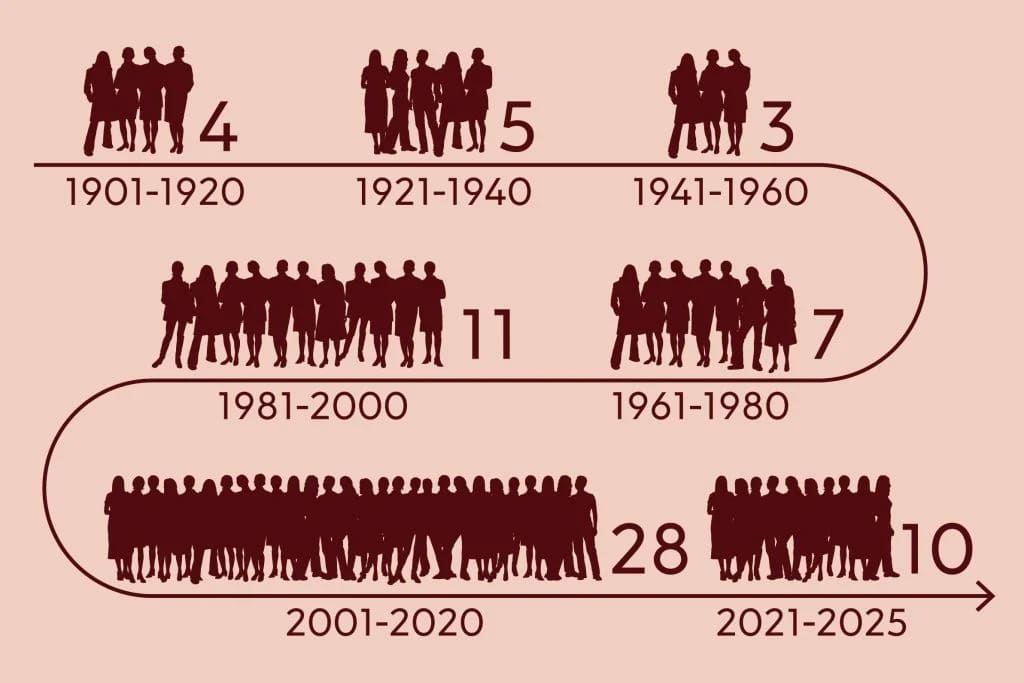
Women scientists are well represented in RAICEX, a strong Spanish scientific community spread across the world and supported by the country’s embassies, celebrating, among other issues, 100 female scientists in the world of AI and ethics through dialogues. A White Paper on gender policies in Science and academia supported by the Fundación Areces and RAICEX has documented ‘the leaky pipe’, a comparative study that has systematically compared and documented the evidence across countries to identify structural barriers in female scientific careers. The IPCC is a positive sign that equity is now within our reach, although other stalwarts of scientific recognition such as Nobel Prizes still have some catching up to do: only 67 of over 1,000 Nobel Prize recipients –or 6.6%– are women (with Marie Curie one of five laureates to have won a Nobel Prize twice).
Figure 1. Nobel Prizes awarded to women, 1901-2025
However, things are changing, as there are now female Ministers of Ecological Transition, female heads of Climate Change Offices and of Climate Delegations leading complex and tough negotiations at the UNFCCC conferences. This shows how great strides have been made, as they are when rules are applied and spaces created, for instance, in the recent COP30 Spanish pavilion that highlighted women’s leadership through specialised panels and a strong commitment to gender parity among its speakers (a 54% participation rate). Equally important are the funding streams such as NEOTEC and prizes such as the L’Oréal-UNESCO For Women in Science International Awards that honour five outstanding women researchers annually –one from each global region– and that has now supported 4,700 women worldwide, seven of whom have received a Nobel Prize. All these specific initiatives celebrate and encourage female-led companies and projects, with evidence showing that this brings fresh perspectives and insights into the resolution of real-life complex challenges. It is important to acknowledge the complex geopolitical landscape that can seem to detract from the urgency of protecting and accelerating science and gender achievements: ‘Since wars begin in the minds of men, it is in the minds of men that the defences of peace must be constructed’. The quote dates back to 1950, more than 75 years ago, and appears in Frederick S. Dunn’s War and the Minds of Men, which analyses the psychology behind international conflicts and the importance of communication to address fear. Furthermore, it is the first sentence of the Preamble to UNESCO’s Constitution, regarding the diversity of mankind. Translated into nine languages, it is carved in stone on a monument erected at UNESCO’s headquarters in Paris.
Figure 2. Stone placard on the Preamble of UNESCO’s constitution
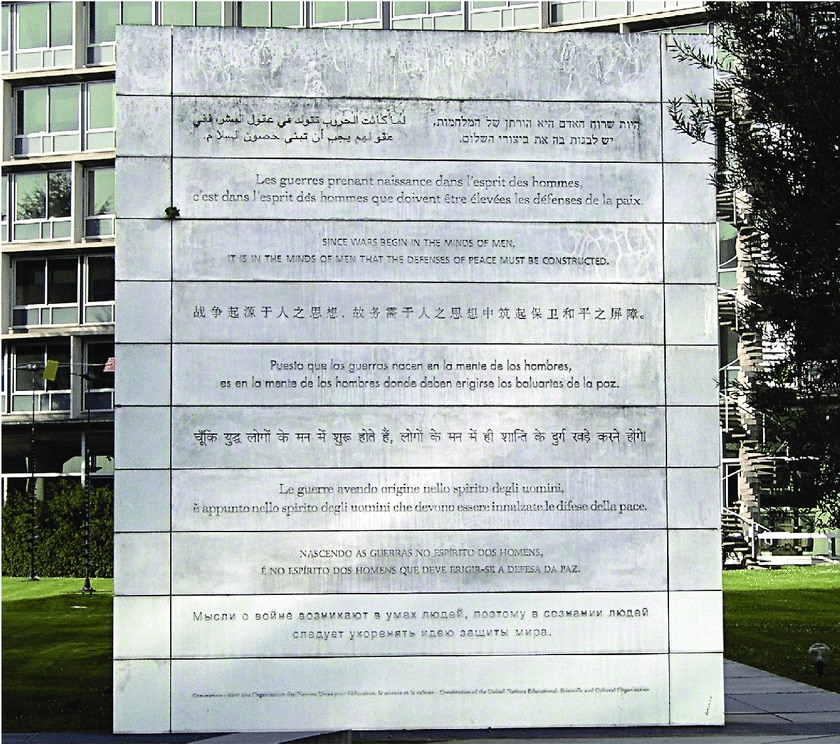
UNESCO’s doctrine was built on the basis of this axiom, which presupposes that wars are caused by ideas. It highlights that peace must be built through education, culture and mutual understanding rather than solely through political or economic agreements. The ‘intellectual and moral solidarity of mankind’ can now be reframed as the ‘intellectual and moral solidarity of humankind’. Cognizant of the current push towards defence and security, it is vital to protect what we seek to protect through these tools and not get lost or sideline the value of culture and diversity in the immediate fray.
To conclude, it would be appropriate to highlight some ideas: (a) the pivotal role of scientific diplomacy in championing women and diversity in science amidst current pressures; (b) the need for inclusive science that incorporates diverse knowledge systems (including Indigenous and local knowledge) to address complex challenges such as the climate crisis; (c) the importance of protecting scientific independence and promoting women’s leadership in science, technology and policy; and (d) protect and promote the intellectual and moral solidarity of humankind as the foundation for peace and sustainable solutions.