
Pollan: “How do you get from flesh — neural flesh — to subjective experience?”
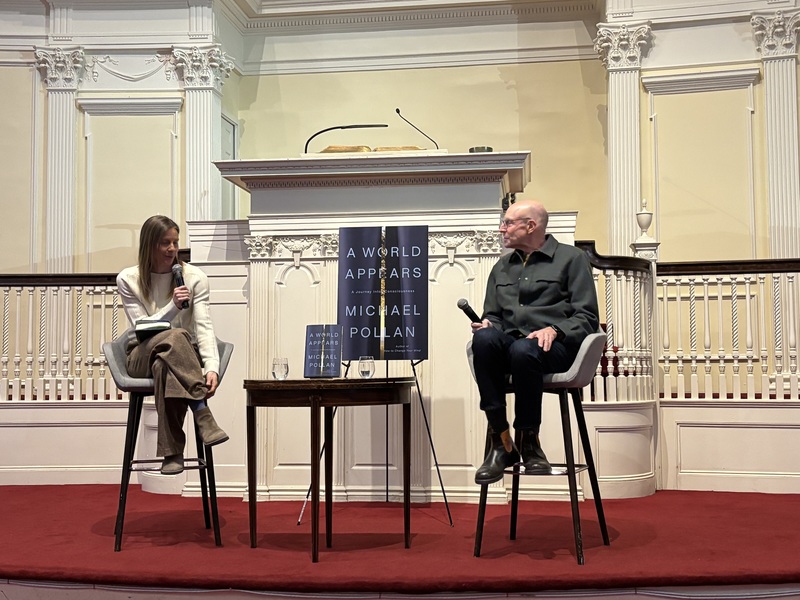
Vivian Hir–The Tech
How does one define consciousness? The answer depends on whom you ask. For a doctor, consciousness requires a person to stay awake and have a sense of awareness. For a writer, though, consciousness is an individual’s interior experience.
Science journalist Michael Pollan tries to answer this large and complex question in his new book A World Appears. In the book, Pollan investigates consciousness in four ascending levels of complexity: sentience, feelings, thoughts, and self (self-awareness). By gaining a better understanding of consciousness, Pollan argues, readers can develop greater insights about themselves.
On Thursday, Feb. 26, Michael Pollan talked about his new book at First Parish Church in Cambridge. Joining Pollan in conversation was Louisa Thomas, a staff writer for The New Yorker. Pollan is the author of ten New York Times bestsellers, including How to Change Your Mind and The Omnivore’s Dilemma.
Pollan began the talk by defining consciousness as a “subjective experience.” He cited philosopher Thomas Nagel’s 1974 essay, “What Is It Like to Be a Bat?,” which argued that consciousness is subjective and is not merely a physical experience. In the essay, Nagel asked readers to perform a thought experiment by imagining themselves navigating the world from a bat’s point of view. Nagel chose the bat in his essay because the mammal is special for using echolocation. Although humans can try to imagine themselves as bats, Nagel argued that they can’t truly know what it’s like to be a bat, suggesting that consciousness has a subjective quality. “It’s a kind of handy identifier of consciousness,” Pollan said.
The study of consciousness is a relatively new field. Pollan called the field a “taboo” in the past because it was “too elusive,” making it a “career killer.” One example of these early challenges was Francis Crick and Christof Koch’s work on “neural correlates,” a term they coined in a 1990 paper to describe the brain activity necessary for experiences like consciousness. They also proposed that 40-hertz oscillations of electrical waves in the brain were a neuronal sign of consciousness. However, they were unable to identify these specific neural regions and justify why 40-hertz was the frequency. This problem showed that studying this subject was more complicated than expected. “How do you get from flesh — neural flesh — to subjective experience?” Pollan asked. “That’s a huge gulf to cross.”
In the process of writing A World Appears, Pollan learned a lot of things about consciousness that surprised him, such as the differing theories on thoughts versus feelings. Initially, scientists believed that the cortex governed consciousness, which meant that thoughts came before feelings. Beginning in the ’90s, however, scientists including Mark Solms argued the opposite: feelings preceded thoughts and the upper brain stem was responsible for consciousness. Pollan stated that feelings include hunger and suffering, sensations that both humans and animals experience. “You have to realize that there are many creatures that are conscious,” Pollan said.
Pollan also shared his experience of participating in an experiment about consciousness. The experiment focused on capturing the inner experience, a concept in which inner thoughts capture a person’s consciousness. In the experiment, Pollan wore an earpiece that delivered random beeps five times a day. After he heard that beep, Pollan had to write down what he was thinking at the moment.
Pollan admitted that he did not have “a single profound thought” during the experiment. For instance, Pollan was salting salmon for dinner when the beeper went off. “I just [thought], ‘shit, I forgot the pepper,’” Pollan admitted, which made the audience laugh. Throughout the experiment, Pollan got to talk to psychology professor Russel Hurlburt about the experience. From these conversations, Pollan learned that only about 30 to 50% of people think in words; there are also visual thinkers and unsymbolized thought thinkers.
Besides being fascinated by the scientific research of consciousness, Pollan also appreciated the subject’s interdisciplinary nature, as it integrates many different fields, including philosophy, neuroscience, and psychology. “This is one area where the humanities are respected in science, which is not often the case,” Pollan said.
Although Pollan primarily interviewed scientists for the book, he also underscored the importance of thinking about consciousness not only from a scientific lens, but also from a humanities lens. Pollan was struck by the profoundness of psychologist William James’s 1892 essay “The Stream of Consciousness,” which approached the topic from a nuanced perspective which he didn’t find in science. “There’s no scientist you can query about that, and that’s just not the way they are approaching the problem,” Pollan explained.
He also found novelists like Marcel Proust to be a major source for learning about the qualitative dimension of consciousness. He asked the audience to picture a rose, stating that each person has a “different rose” in their mind because everyone has distinct associations and histories with a rose. As a result, this makes consciousness have a “familiarity” and “intimacy” that science cannot explain. “I felt it would not have done justice to the subject to stick with the science of consciousness,” Pollan said.
Later in the talk, Pollan applied his understanding of consciousness to argue that AI is not conscious. He found human-AI relationships to be “alarming” and “dehumanizing,” since he considered AI tools like ChatGPT to be “frictionless” and “sycophantic.” Friction is important to human relationships because it helps people better understand themselves, according to Pollan. On the other hand, AI relationships prevent people from becoming emotionally attached to other people. Pollan acknowledged that even if he believes that AI is not conscious, his stance may not change anything because people will still think otherwise. “It’s very hard to prove they are not conscious at a certain point,” Pollan admitted.
Despite the book’s focus on consciousness, Pollan pointed out that one of the greatest human experiences is the dissolution of the self, which often invokes a sense of wonder and awe. Experiences that lead to dissolving the self include being immersed in a work of art and practicing meditation. In Pollan’s case, it came from attending a Zen retreat in a cave in New Mexico. For a few days, he was alone with no internet or electricity. Pollan noticed that his sense of self became more “permeable” and “softer” when he was alone because he was less focused on reinforcing his own sense of self.
Instead of thinking about consciousness as a problem to solve, Pollan thought more about how special it is. “It’s a miracle that we do have this space, this private space of complete mental freedom,” Pollan marveled. “What an amazing gift that is.”