
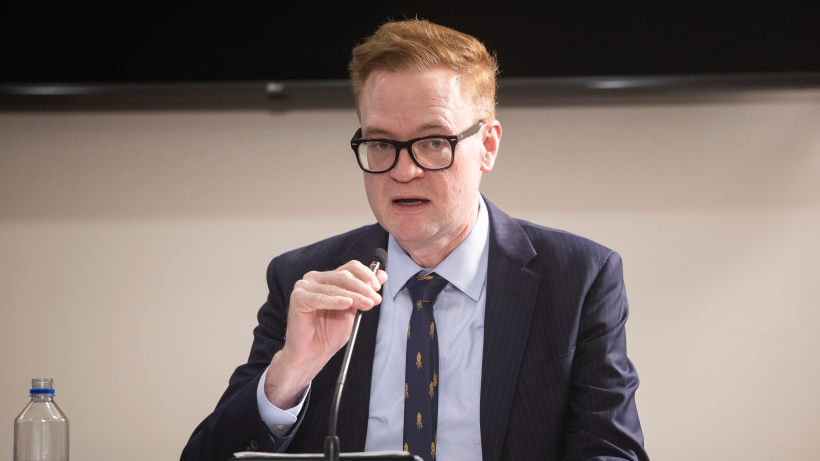
Former Health and Human Services Deputy Secretary Jim O’Neill speaks at a Make America Healthy Again event in September 2025.
Francis Chung / POLITICO via AP Images
Trump to nominate former HHS official to head NSF
The White House plans to nominate Jim O’Neill to be the next director of the National Science Foundation. Until recently, O’Neill was serving as acting director of the Centers for Disease Control and Prevention, a position now assumed by National Institutes of Health Director Jay Bhattacharya. O’Neill worked
for the Department of Health and Human Services during George W. Bush’s administration and later became an investor, including for the Thiel Foundation program Breakout Labs,
which funded early-stage commercialization of scientific research.
“Jim O’Neill spent over a decade in the private sector helping identify and finance cutting-edge technologies of the future. In the Trump administration, Jim O’Neill played a key role at HHS by slashing fraud and restoring the Gold Standard of Science over ideology as the driving factor behind agency decision-making,” White House spokesperson Kush Desai said. Previous confirmed NSF directors
have typically had experience conducting science or engineering research.
NSF has been without a director since Sethuraman Panchanathan resigned
in April of last year amid widespread grant cuts, a proposed 50% cut to the agency’s budget in the presidential budget request, and the threat of staff cuts. Brian Stone, the agency’s chief of staff, currently serves as acting director.
House Science Democrats probe new NIST restrictions on foreign researchers
Democrats on the House Science Committee are pressing
the National Institute of Standards and Technology for answers on policy changes limiting access for foreign researchers. Boulder Reporting Lab reported
earlier this month that the agency has begun implementing a three-year limit for international graduate students and postdoctoral researchers to conduct research at NIST. The letter from House Science Democrats says this “effectively prevents any foreign student from being able to complete a doctorate at NIST.” NIST did not reply to a request for comment, but the agency released a statement to some outlets
saying that the policy remains “under development.”
NIST said its change was a “proposed update to decision-making criteria for safeguarding U.S. science at NIST” that aligns with a presidential memo on national security and the agency’s own research security framework. The letter from House Science Democrats criticizes the reported changes, saying they “radically overstep… what is reasonable and appropriate to protect research security.” It asks for documentation of the policy or proposed change and how the policy has been communicated to NIST staff, adding that these questions were sent to NIST in late January with a deadline of Feb. 13 and were not answered.
House Science Republicans request review of AI laws
Republicans on the House Science Committee have asked the Government Accountability Office to review
federal and state AI regulations “to inform future legislative efforts.” A letter, sent by Science Committee Chair Brian Babin (R-TX) and Research and Technology Subcommittee Chair Jay Obernolte (R-CA), references an executive order
relating to AI issued during President Donald Trump’s first term, but not the president’s December order
seeking to block state-level AI regulations that do not use a “minimally burdensome national policy framework.” Meanwhile, NIST announced
the launch of its AI Agent Standards Initiative last week, which aims to “foster the emerging ecosystem of industry-led AI standards and protocols,” in collaboration with the National Science Foundation.
Also on our radar
- The Merit Systems Protection Board has issued a final rule
removing certain appeal rights for federal workers moved into excepted service positions. The rule is a response to a final rule by OPM that will allow agencies to reclassify
potentially thousands of federal jobs as Schedule/Policy Career positions. Both rules go into effect March 9. - Republicans in Congress are investigating
NASA’s compliance with the Wolf Amendment, which prohibits the agency from direct cooperation with China or Chinese-owned companies unless authorized by the FBI. - DOD formally established
its Science, Technical, and Innovation Board, which merges
the former Defense Science Board and Defense Innovation Board. - Alabama enacted
a law that sharply limits the research that state agencies can rely on when creating environmental regulations and prohibits those regulations from being more stringent than their federal equivalents. - Thirty-one universities agreed to end partnerships
with The Ph.D. Project, which supports business doctoral candidates from underrepresented backgrounds, following investigations by the Department of Education, which said the organization “unlawfully limits eligibility based on the race of participants.” - GAO issued a report
on march-in rights,
which allow a funding agency to grant third-party licensing of inventions from federally funded research. The report indicates that using march-in rights to lower prescription drug costs would affect only a small number of drugs.