
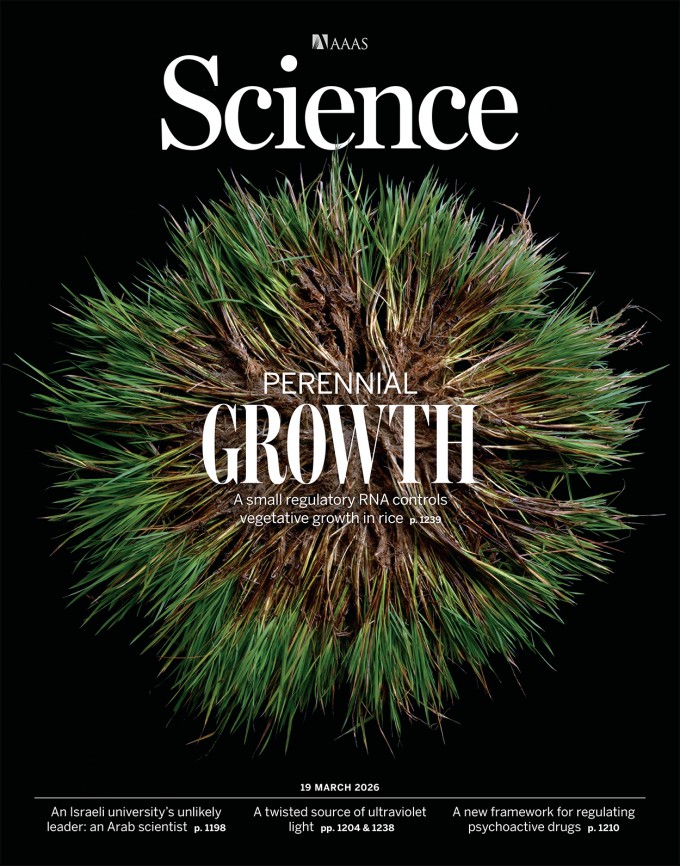
This week’s cover of the international journal ‘Science’ features an image of young rice seedlings, or ‘mo,’ gathered in a circle. Rice, a widely cultivated crop, is an annual plant. It is typically sown in the spring and ends its life cycle after the autumn harvest, meaning it must be replanted every year. Until now, scientists have primarily increased rice productivity by shortening its growing period.
A research team led by Dai Xinchen, Lü Danfeng, and Han Bin from the Center for Excellence in Molecular Plant Sciences at the Chinese Academy of Sciences has developed a perennial rice that can grow repeatedly for more than two years. They achieved this by transplanting a gene combination found in wild rice into cultivated varieties, publishing their findings in Science on the 19th (local time).
Wild rice can survive for multiple years from the same root system, as new tillers grow even after it flowers and produces seeds. It remains unclear how this perennial trait was lost during the domestication of rice.
By analyzing hundreds of lines from crossbreeding wild and cultivated rice, the research team identified ‘EBT1’ as the key gene that determines the perennial trait.
Two regulatory genes within EBT1 control the plant’s transition between growth stages. In cultivated rice, the gene’s activity ceases after flowering. In wild rice, however, the gene reactivates in the new tiller buds that emerge after seeding.
The analysis revealed that the difference between the two types of rice is determined not by the base sequence of the gene itself, but by its surrounding epigenetic environment. In wild rice, the DNA structure around the gene loosens in new tiller buds, allowing the gene to reactivate. In cultivated rice, however, inhibitory factors bind to the gene’s vicinity during the same period, keeping it in a ‘locked state.’ This environmental difference alone is what separates the annual and perennial traits.
The team transplanted the EBT1 gene from wild rice into cultivated rice, along with another gene that enables rooting at the nodes. The resulting recombinant rice was able to root from its stem nodes and continuously produce new tillers, surviving for more than two years in the tropical region of Hainan, China.
The researchers noted, “The developed rice line has the perennial trait, but it suffers from the limitation of reduced yield.” They added, “To fully realize the perennial trait while maintaining yield, additional genes must be identified.”
– doi.org/10.1126/science.adv218
Copyright ⓒ DongA Science. All rights reserved.