
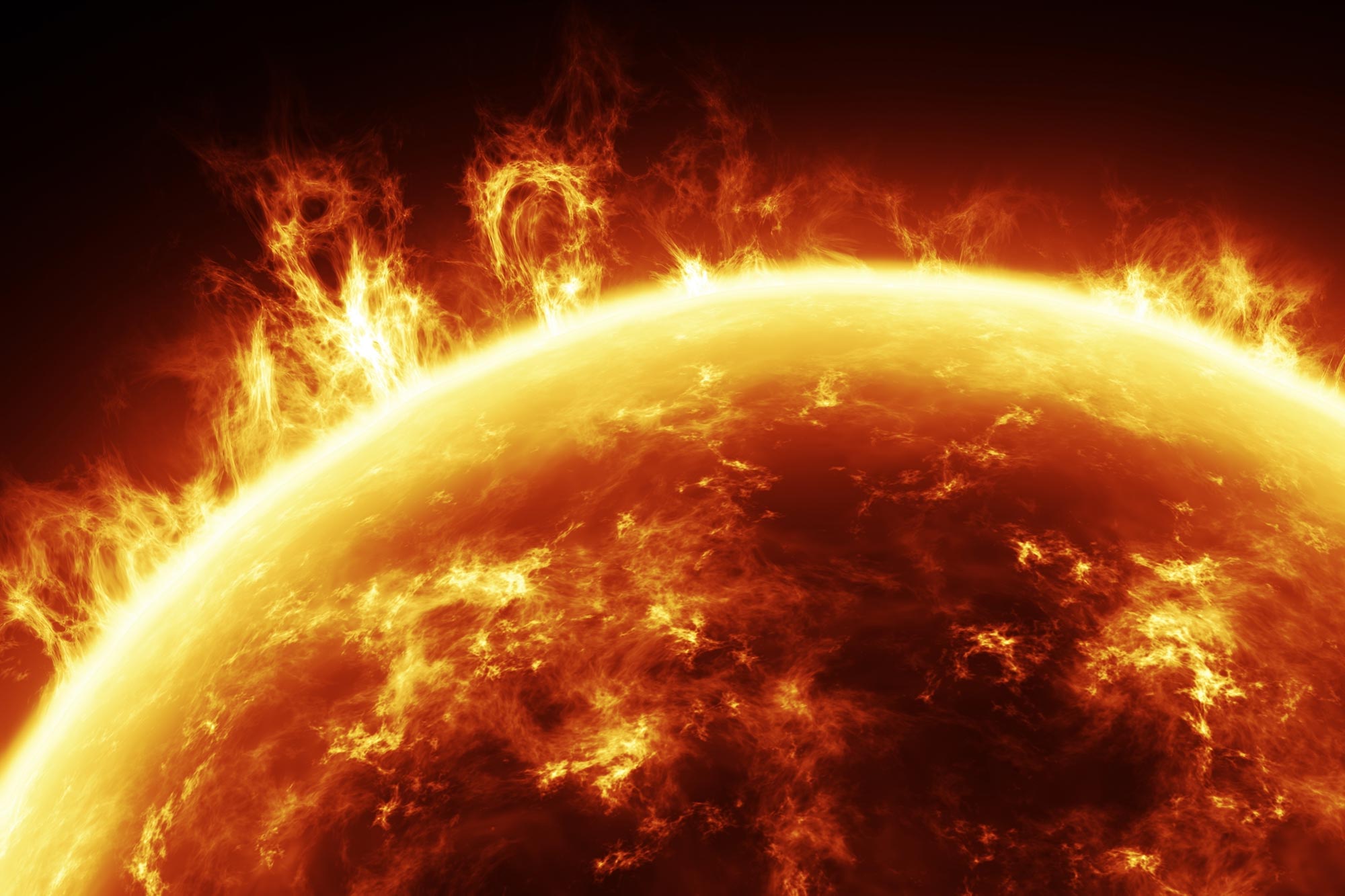
New observations are helping scientists peer beneath the Sun’s surface, revealing where its magnetic activity may truly begin.
Every 11 years, the Sun’s magnetic field reverses. As that cycle unfolds, sunspots appear at middle latitudes and drift toward the equator in a butterfly-shaped pattern before disappearing as the cycle starts over. These darker, cooler patches mark intense magnetic activity and are often tied to solar eruptions.
Astronomers have watched this surface pattern for decades, but the deeper origin of the cycle has remained out of sight until now.
Researchers at the New Jersey Institute of Technology (NJIT) analyzed nearly 30 years of solar oscillation data to map activity inside the Sun. Their results point to the likely location of the Sun’s magnetic engine far below the surface, about 200,000 kilometers (124,000 miles) down, or roughly the length of 16 Earths lined up end to end.
The study, published in Nature Scientific Reports, offers one of the clearest observational views yet of the solar dynamo, the mechanism that generates the Sun’s magnetic field. The findings help explain hidden processes that shape space weather linked to the solar cycle, both on the Sun and possibly on other stars throughout the galaxy.
“Until now, we simply hadn’t heard enough from inside the star to be certain where the Sun’s intense magnetic fields are organized,” said Krishnendu Mandal, lead author and NJIT research professor of physics. “Sunspots are the visible footprints of magnetic fields that drive space weather on the Sun’s surface, but what solar oscillation data tells us is that the actual ‘engine room’ responsible for generating them originates much deeper.”
Sounding the Sun’s Interior Across Solar Cycles
To investigate the Sun’s interior, the researchers combined about 30 years of observations from the Michelson Doppler Imager (MDI) on board NASA’s Solar and Heliospheric Observatory (SOHO) satellite, the Helioseismic and Magnetic Imager (HMI) on board the Solar Dynamics Observatory (SDO), and the ground-based Global Oscillation Network Group (GONG).
Since the mid-1990s, these instruments have recorded sound waves produced by turbulent plasma moving inside the Sun every 45 to 60 seconds.
Using this combined dataset, the team examined billions of individual measurements, building one of the longest and most detailed records ever assembled of the Sun’s internal vibrations.
“Helioseismology is still a young field … reliable observations only began in the mid-1990s when GONG first came online,” Mandal explained. “Now, with nearly three 11-year solar cycles of data, we’re finally seeing clear patterns take shape that give us a window inside the star.”
A Butterfly Pattern Beneath the Surface
Much like seismologists use earthquakes to study Earth’s interior, the team used sound waves traveling through the Sun to probe what lies beneath the surface. By tracking changes in how long those waves took to move through the Sun, they were able to identify how hot plasma flows and rotates, including bands of faster and slower motion.
Their analysis showed that these migrating rotation bands deep inside the Sun form a butterfly-shaped flow pattern that matches the sunspot pattern that later appears at the surface.
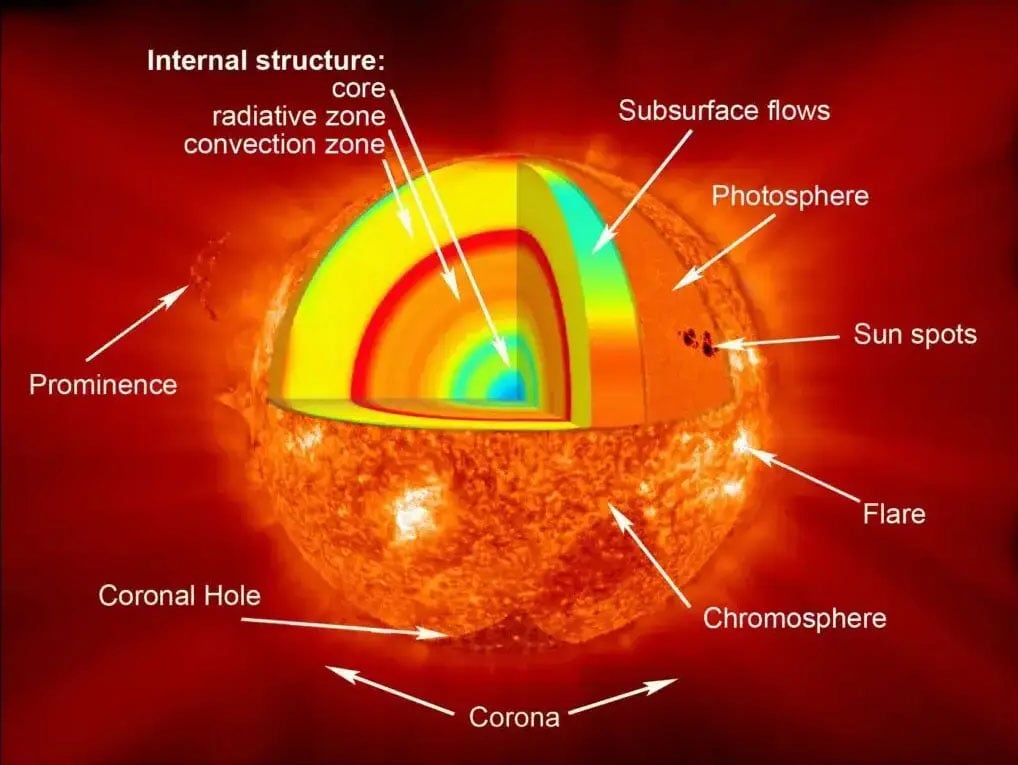
That pattern led the researchers to a key boundary layer about 200,000 kilometers (124,000 miles) below the surface called the tachocline.
This narrow region lies between the Sun’s turbulent outer convection zone and the stable radiative interior beneath it. Across the tachocline, the Sun’s rotation shifts sharply, creating strong shearing flows that can drive magnetic field generation.
“Rotation bands originating from magnetic structural changes near the Sun’s tachocline can take several years to propagate to the surface,” Mandal said. “Tracking these internal changes gives us a clearer picture of how the solar cycle unfolds.”
Why the Tachocline Matters
The close match between the internal flow patterns seen by all three instruments and the migration of sunspots at the surface suggests a strong link between deep solar dynamics and global solar activity.
“For years, we suspected the tachocline was important for the solar dynamo, but now we have clear observational evidence,” Mandal said.
Pinpointing where the dynamo operates could improve models used to forecast solar activity. Major eruptions from the Sun, including flares and coronal mass ejections, can interfere with satellites, communications systems, navigation signals, and power grids on Earth.
“While our findings do not yet enable precise predictions of future solar cycles, they highlight the importance of including the tachocline in space weather prediction models,” Mandal said. “Many current simulations account for processes only on near-surface layers, but our results show the entire convection zone, especially the tachocline, must be considered.”
Implications Beyond Our Star
The results could also matter far beyond the Sun.
“Many stars exhibit magnetic cycles similar to the Sun’s, but the high-resolution data achievable for the Sun due to its proximity to Earth is unattainable for others,” Mandal said. “Understanding the solar dynamo gives us a framework to study magnetic activity in other stars across the galaxy.”
The team at NJIT’s Center for Computational Heliophysics, led by study co-author and NJIT Distinguished Professor Alexander Kosovichev, plans to continue the work with further analysis and numerical simulations to better understand how the dynamo changes over time and drives solar activity.
“There’s still much we don’t know about how the Sun’s internal magnetism evolves,” Mandal said. “With longer datasets and better observations, we hope to track these patterns across this and future solar cycles, potentially giving us better forecasts of space weather that can affect our daily life.”
Reference: “Helioseismic evidence that the solar dynamo originates near the tachocline” by Krishnendu Mandal and Alexander G. Kosovichev, 12 January 2026, Scientific Reports.
DOI: 10.1038/s41598-025-34336-1
The study was supported by funding from NASA, including a grant “Consequences Of Fields and Flows in the Interior and Exterior of the Sun” from the NASA DRIVE Science Center — a collaboration of 13 U.S. universities and research centers that includes NJIT among its contributing institutions.
Never miss a breakthrough: Join the SciTechDaily newsletter.
Follow us on Google and Google News.