
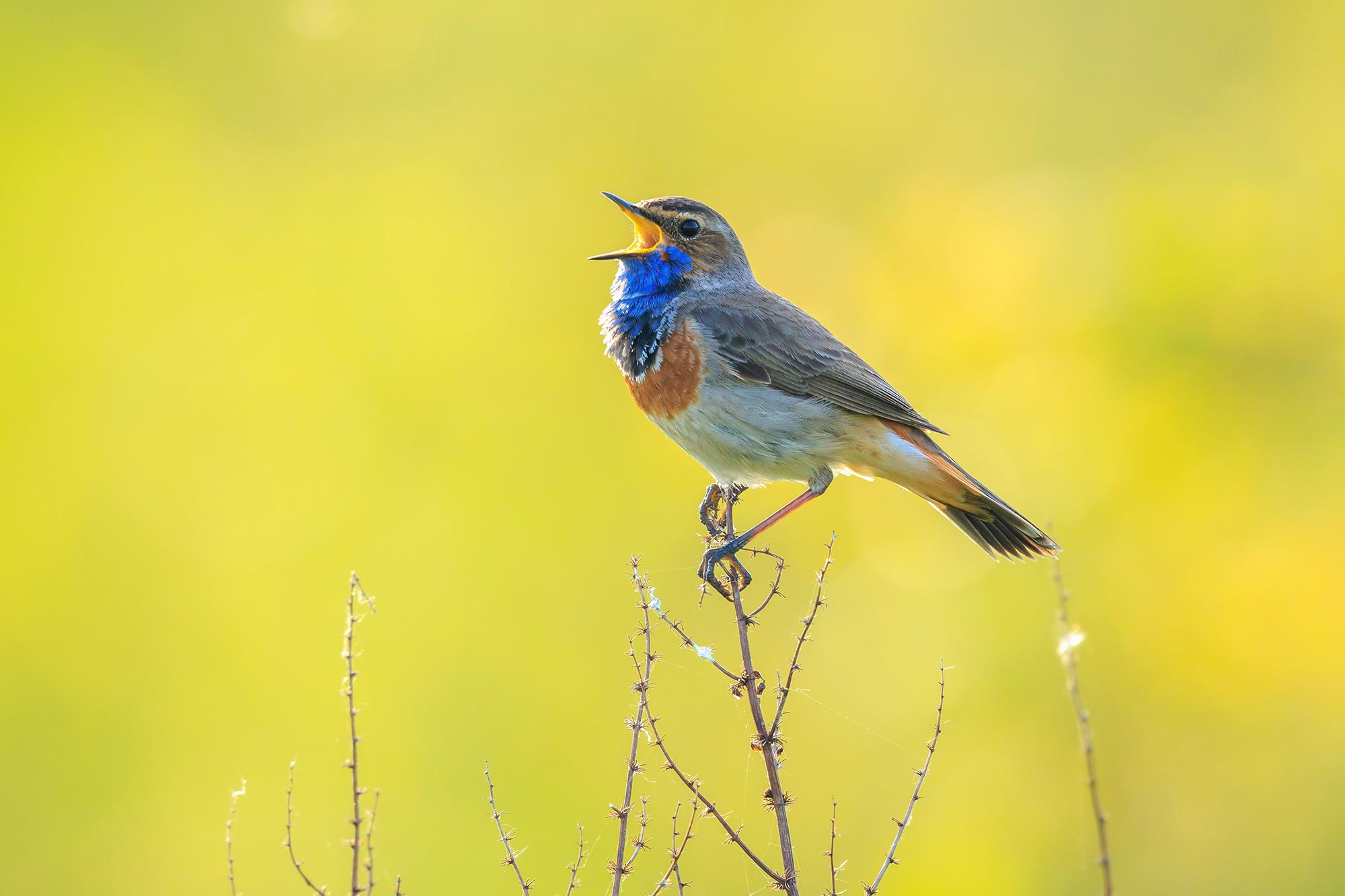
Birds across the planet share a learned warning cry that may echo the origins of language itself.
Bird species that live thousands of miles apart and diverged millions of years ago are using strikingly similar alarm calls to warn of parasitic threats near their nests, according to an international team of scientists.
The researchers found that this vocal signal is learned, yet it grows out of an instinctive reaction that appears across multiple species. It is the first documented case of an animal sound that blends an inborn response with learned use in this way.
The study, published in Nature Ecology and Evolution, sheds light on how natural selection can shape the evolution of communication. Led by researchers from Cornell University and the Doñana Biological Station in Seville, Spain, the project is among the most extensive investigations of brood parasites conducted so far.
Brood Parasitism and Nest Defense
Brood parasitism happens when birds such as cuckoos deposit their eggs in the nests of other species. The host birds then raise the intruder’s chicks, often at the expense of their own young. Because of this high cost, host species benefit from recognizing parasites quickly and preventing them from laying eggs in the first place.
The team discovered that more than 20 bird species across four continents produce almost identical “whining” calls when they detect a parasitic bird nearby.
A Global Signal With No Direct Contact
What puzzled the researchers was that birds in distant regions, including Australia, China, and Zambia, all rely on the same type of call, even though these populations have never encountered one another.
When a bird hears this alarm, it instinctively approaches to investigate. During that moment, the bird begins associating the sound with what it sees and experiences around it, a process Damián Blasi, co-author of the study and a language scientist at Pompeu Fabra University in Spain, describes as social transmission.
“It’s then, when birds are absorbing the clues around them, that the bird learns when to produce the sound in the future,” said James Kennerley, co-lead author and postdoctoral fellow at the Cornell Lab of Ornithology.
Between Instinct and Learned Language
According to William Feeney, an evolutionary ecologist at the Doñana Biological Station and co lead of the research, the whining call sits between pure instinct and complex learned speech. “The fascinating thing about this call is that it represents a midpoint between the instinctive vocalizations we often see in animals and fully learned vocal units like human words,” he said.
The study also found that species using this call tend to inhabit regions where interactions between parasites and hosts are especially intricate.
“With birds working together to drive parasites away, communicating how and when to cooperate is really important, so this call is popping up in parts of the world where species are most affected by brood parasitism,” Kennerley said. He added that the spread of this vocal signal is influencing patterns of cooperation among birds worldwide.
Clues to the Origins of Language
What makes the discovery especially notable is the connection between an innate sound and a learned response. “For the first time, we’ve documented a vocalization that has both learned and innate components, potentially showing how learned signals may have evolved from innate calls in a way first suggested by Charles Darwin,” Feeney said. “It’s like seeing how evolution can enable species to give learned meanings to sounds.”
These results challenge the long-standing view that animal communication and human language are sharply divided. The researchers suggest that sophisticated systems such as human language may have developed gradually, emerging from the combination of instinctive calls and learned meaning over evolutionary time.
Reference: “Learned use of an innate sound-meaning association in birds” by William E. Feeney, James A. Kennerley, David Wheatcroft, Wei Liang, Joleah B. Lamb, Niki Teunissen, Shelby L. Lawson, Janice K. Enos, Bo Zhou, Colleen Poje, Nicole M. Richardson, Thomas A. Ryan, Zara-Louise Cowan, Rohan M. Brooker, Mairenn Attwood, Jordan Boersma, Marissa Zamora, Alfredo Attisano, Roman Gula, Jörn Theuerkauf, Ros Gloag, Vanina D. Fiorini, Sharon A. Gill, Anne Peters, Marcel Honza, Claire N. Spottiswoode, Mark E. Hauber, Andrea Manica, Michael S. Webster and Damián E. Blasi, 3 October 2025, Nature Ecology & Evolution.
DOI: 10.1038/s41559-025-02855-9
Never miss a breakthrough: Join the SciTechDaily newsletter.
Follow us on Google and Google News.