
An international team involving Northwestern University announced Tuesday that it has reached a major milestone in its quest to detect dark matter.
Dark matter makes up around 85% of all the matter in the universe, but its nature is a mystery. It is so named because it does not interact with light the way regular matter does, but scientists know it’s there because of its gravitational effect — without which clusters of regular matter in the cosmos could not be held together.
But beyond that, scientists still don’t know too much about dark matter. The Super Cryogenic Dark Matter Search, or SuperCDMS, at SNOLAB has been set up to solve some of the mysteries.
SNOLAB is located 6,800 feet underground in an active nickel mine near Sudbury, Ontario, Canada. The location ensures that cosmic rays and other background particles in the atmosphere don’t interfere with the faint signals from the dark matter that the scientists are working to detect.
The big news out of SNOLAB is that it has now cooled to the operating temperature needed for its mission — nearly absolute zero.
What is absolute zero?
The average person knows 0 degrees Celsius is 32 degrees Fahrenheit — the temperature at which water freezes — which Chicagoans would likely say isn’t that cold. The forecast high for the day in Chicago on Tuesday was lower than 0 Celsius.
Zero degrees Fahrenheit — which is cold enough to warrant official warnings, yet traditionally in Chicago, not cold enough to close schools — is popularly thought to be the temperature at which seawater freezes. In a 2014 “Straight Dope” column, Cecil Adams posited that this isn’t quite accurate — the pseudonymous columnist wrote that Daniel Gabriel Fahrenheit based his temperature scale on an arbitrary system developed by Danish astronomer Ole Roemer, and then devised an explanation that it was the coldest temperature Fahrenheit could produce using brine.
Absolute zero is much colder than either of the above — there would be a lot more to worry about than throwing water in the air and watching it freeze if the air temperature were absolute zero. Defined as 0 Kelvin, or -459.7 Fahrenheit, absolute zero is the lowest possible temperature at which molecular motion stops and there is no heat transfer.
SNOLAB has not been cooled all the way down to absolute zero — that limit remains theoretical — but it is down to just thousandths of a degree above absolute zero, according to Northwestern. This is 100 times colder than even the temperature of deep space.
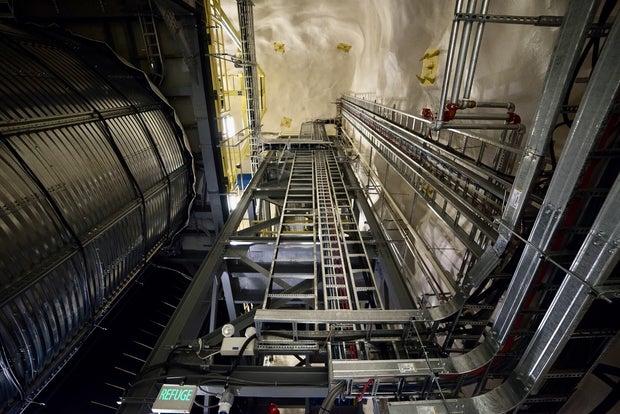
Without any thermal interference from vibrating atoms because the atoms are so cold as to be nearly still, scientists hope to isolate the minuscule signals from dark matter.
Now that the low temperature has been achieved, the project will move from building the experiment to preparing to search for dark matter. Scientists now fire up their detectors, which feature superconducting sensors that only work at extremely low temperatures.
If the equipment works, it should teach the highest level of sensitivity yet to find low-mass particles with half the mass of one proton, Northwestern said.
“Reaching this ultracold temperature means our experiment has crossed a major threshold,” Northwestern University professor of physics and astronomy Enectali Figueroa-Feliciano said in a news release. “The detectors are now cold enough to operate, so we can begin calibrating them to prepare for the first search for dark matter. Detecting dark matter would not only reveal the identity of most of the mass of the universe, and it would likely be the key to a new realm of particle physics.”
A total of 24 institutions were involved in designing the SuperCDMS. The system is set up to detect what are called light dark matter particles, which interact so weakly with regular matter that other methods of detecting them have failed.
The detection devices scientists are using feature ultra-pure silicon and germanium crystals with conducting sensors, which should be able to detect minute vibrations and electrical signals from dark matter particles.
SuperCDMS Collaboration 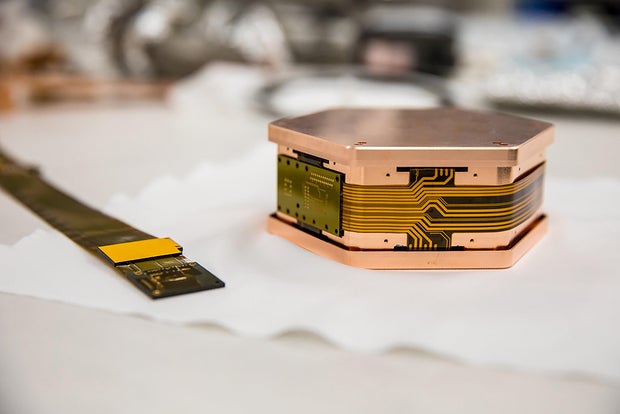
But scientists need to figure out how detectors respond when particles hit them to figure out whether they’re really detecting a dark matter interaction. Northwestern is specifically involved in this aspect of the project, along with the Fermi National Accelerator Laboratory, or Fermilab.
Northwestern and Fermilab are leading an experiment to determine how detectors respond to interactions with known particles — specifically neutrons from a neutron beam — to simulate how the detectors might interact with dark matter particles in the SuperCDMS. For the experiment, Northwestern and Fermilab are using the Northwestern Experimental Underground Site, or NEXUS, located 106 meters below Fermilab so cosmic rays don’t interfere.
Ryan Postel, Fermilab 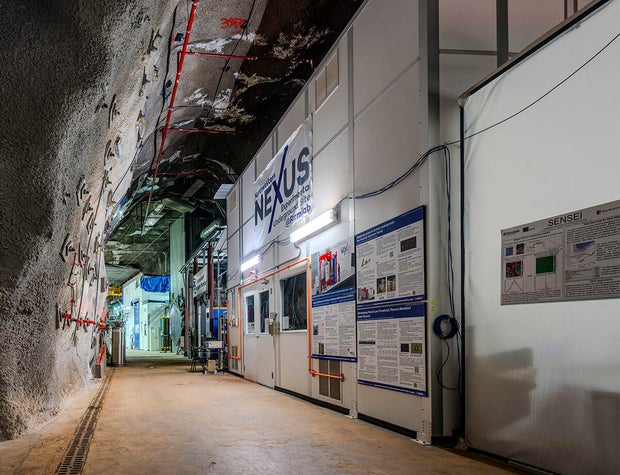
In addition to dark matter, the SuperCDMS will also allow scientists to investigate previously inaccessible energy scales, and maybe learn about as-yet-unknown types of particle interactions, Northwestern said.
The SuperCDMS experiment is a joint project of the U.S. Department of Energy Office of Science, the U.S. National Science Foundation, the Canada Foundation for Innovation, the Natural Sciences and Engineering Research Council of Canada, and the Arthur B. McDonald Institute in Canada.