

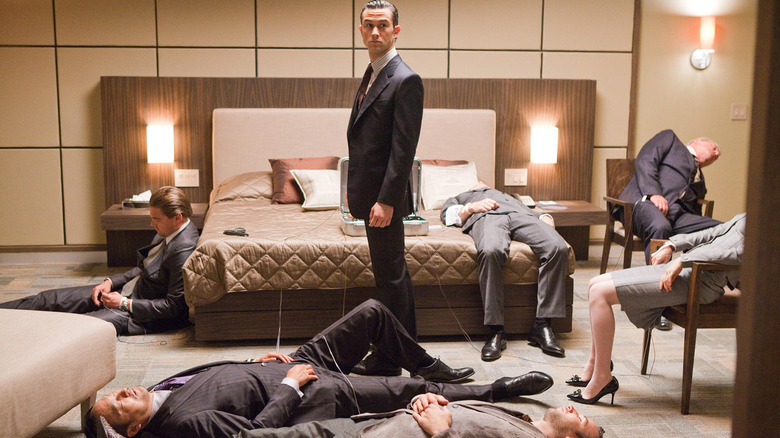
Christopher Nolan’s epic 2010 blockbuster “Inception,” which many believe was actually inspired by a sci-fi anime, might’ve just been a piece of fiction — a complex, stimulating, and intense piece of fiction, at that. But its core idea may be closer to reality today than ever before. In the film, Dom Cobb (Leonardo DiCaprio) and his team use an advanced technology to penetrate people’s dreams to steal information. However, on one occasion, they seek instead to plant an idea into a CEO’s consciousness during sleep to influence his behavior in waking life. That’s where real-life science and tech come into play.
According to a 2020 study published in Consciousness and Cognition — conducted by lead researcher Adam Haar Horowitz and his colleagues — influencing dreams is possible through a process known as targeted dream incubation (TDI). In the study, researchers fitted participants with a wearable Bluetooth-enabled glove-like device called Dormio, which uses sensors to track the wearer’s sleep patterns and outputs sensory cues to influence dreams. As Haar Horowitz states (via MIT News), “We showed that dream incubation is tied to performance benefits on three tests of creativity, by both objective and subjective metrics. Dreaming about a specific theme seems to offer benefits post-sleep, such as on creativity tasks related to this theme.”
The benefits of targeted dream incubation
To achieve TDI, Haar Horowitz and his team used the Dormio glove to induce hypnagogia, which can be defined as a transitional dream state between waking and sleeping. In this state, the human brain is more impressionable, which means that sounds and other external stimuli can be used to trigger ideas in subjects’ minds. Imagine you’re falling asleep, but you’re still somewhat awake. Suddenly, you hear a loud and unexpected noise in your immediate surroundings. In hypnagogia, the mind naturally interprets such outside stimuli in a way that makes sense in the dream scenario. 25 study participants were placed in a hypnagogic state using Dormio, and once each of them emerged from their hypnogogic state, they were required to perform various creativity tests. The results showed that they performed better at their tasks thanks to TDI.
TDI isn’t the only innovation that can change how we experience dream worlds — researchers have even explored how to stop humans from needing sleep to dream at all. TDI, however, has specific implications for human creativity. “Historical figures like Mary Shelley or Salvador Dalí … were inspired creatively by their dreams,” Haar Horowitz explains. “The difference here is that we induce these creatively beneficial dreams on purpose, in a targeted manner.”
We might still be a long way from what Dom Cobb and company achieved in Christopher Nolan’s Oscar-winning movie, but based on current research, the potential to someday attain their level of dream control exists. We might just need more time until the technology of Inception becomes a real-life invention inspired by science fiction.