
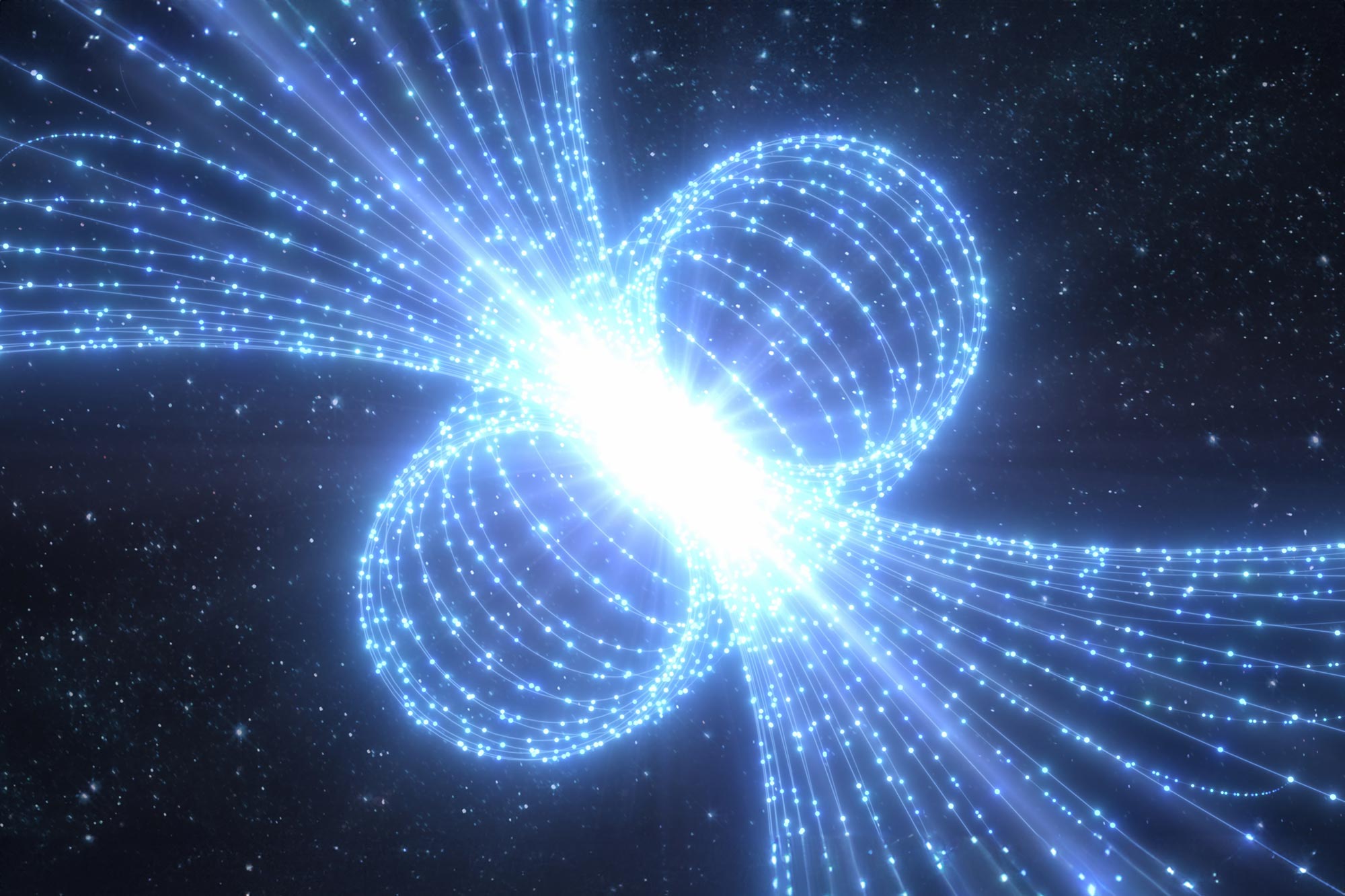
Researchers have identified a potential mechanism that explains how turbulent plasma can produce the vast, ordered magnetic fields observed across the universe
Cosmic magnetic fields are everywhere, but their origin has remained one of plasma astrophysics’ most persistent mysteries. Planets, stars, and galaxies all generate magnetic fields, and those fields help shape the solar wind, steer high-energy particles, and influence how galaxies grow.
At smaller scales, magnetic fields tend to be turbulent and chaotic. At larger scales, however, they appear organized and structured. Explaining how orderly magnetic fields arise from turbulent motion has remained a major challenge in plasma astrophysics for decades.
In a study published in Nature, researchers led by scientists at the University of Wisconsin-Madison used advanced computer simulations to investigate plasma flows. Their results show that turbulent plasma can also form structured motion through large-scale jets.
The simulations revealed a new mechanism that could explain how magnetic fields form and evolve. The process may apply across many astrophysical environments, with potential implications for space weather and multimessenger astronomy.
“Magnetic fields across the cosmos are large-scale and ordered, but our understanding of how these fields are generated is that they come from some kind of turbulent motion,” says the study’s lead author Bindesh Tripathi, a former UW–Madison physics graduate student and current postdoctoral researcher at Columbia University. “Given that turbulence is known to be a destructive agent, the question remains, how does it create a constructive, large-scale field?”
From Fluid Flows to Magnetic Structures
Before studying three-dimensional (3D) magnetic fields, Tripathi examined systems involving hydrodynamic flows and two-dimensional (2D) magnetic fields. While reviewing visualizations of 3D magnetic turbulence, he noticed that the shapes of large-scale plasma flows resembled the structures formed by large-scale magnetic fields.
However, translating ideas from fluid dynamics into magnetic field theory was not straightforward. Fluid flow problems can often be modeled in two dimensions, but magnetic field generation must be solved in three dimensions. This makes the problem significantly more complex and computationally demanding.
To address this challenge, Tripathi and his colleagues modified the approach used in earlier studies in two important ways.
First, they introduced a constantly replenished velocity gradient into their simulations. A simple analogy is a cyclist riding directly into a curb. The wheels stop suddenly, but the rider’s forward momentum can send them over the handlebars. This abrupt change in speed is an example of a velocity gradient.
Such gradients are common throughout the universe. They can occur between layers inside the sun or during extreme events such as neutron star mergers. The researchers suspected that including this effect might be essential for understanding how three-dimensional magnetic fields develop.
Massive Simulations Reveal Emerging Order
The second change involved computational scale. The team ran what may be the most detailed simulation yet of magnetic fields forming in plasma with an unstable velocity gradient. Their model used 137 billion grid points across three-dimensional space.
In total, the researchers performed about 90 simulations, producing roughly 0.25 petabytes of data. The calculations consumed nearly 100 million CPU hours on the Anvil supercomputer at Purdue University.
“We start our simulations with a flow that has a velocity gradient, then we add some tiny perturbations, like moving one fluid particle infinitesimally, we let that perturbation propagate over the system and grow, and then analyze the data over time,” Tripathi says. “Initially, these perturbations lead to turbulent flows and magnetic fields in small-scale structures, then, over time, they emerge into larger, ordered structures.”
When the team repeated the simulations but allowed the initial velocity gradient to weaken over time, the results changed dramatically. Instead of forming large-scale patterns, the system produced only chaotic structures at small scales.
“So that’s really the main key: to have a steady, large-scale gradient in velocity,” he emphasizes.
Resolving a 70-Year Dynamo Problem
Paul Terry, physics professor at UW–Madison and senior author of the study adds: “Magnetic field generation via dynamos has been extensively studied for 70 years, with the frustrating result that the generated fields almost always end up at small scales and highly disordered, unlike observations. This work, therefore, potentially resolves a long-standing issue.”
Although scientists cannot directly test the theory in distant cosmic environments, laboratory experiments provide supporting evidence.
In 2012, researchers at the Wisconsin Plasma Physics Laboratory carried out experiments to study how magnetic fields form. The results did not match predictions from existing theoretical models. The new mechanism proposed by Tripathi and his colleagues aligns much more closely with those experimental measurements and helps explain the earlier puzzling data.
“This work has the potential to explain the magnetic dynamics relevant in, for example, neutron star mergers and black hole formation, with direct applications to multimessenger astronomy,” Tripathi says. “It may also help better understand stellar magnetic fields and predict gas ejections from the sun toward the Earth.”
Reference: “Large-scale dynamos driven by shear-flow-induced jets” by B. Tripathi, A. E. Fraser, P. W. Terry, E. G. Zweibel, M. J. Pueschel and R. Fan, 21 January 2026, Nature.
DOI: 10.1038/s41586-025-09912-0
This work was supported by the National Science Foundation (2409206) and U.S. Department of Energy (DE-SC0022257) through the DOE/NSF Partnership in Basic Plasma Science and Engineering. Anvil at Purdue University was used through allocation TG-PHY130027 from the Advanced Cyberinfrastructure Coordination Ecosystem: Services & Support (ACCESS) program, which is supported by National Science Foundation (2138259, 2138286, 2138307, 2137603, and 2138296).
Never miss a breakthrough: Join the SciTechDaily newsletter.
Follow us on Google and Google News.