
Scientists have trained a computer made from living human neurons to play the classic video game Doom, marking a strange but important step forward in biological computing.
A clump of roughly 200,000 living human brain cells has learned to play the classic first-person shooter Doom in a new experiment that sounds like something pulled straight from a science fiction film, but is very real.
Researchers at Australian biotech startup Cortical Labs demonstrated how a culture of human brain cells grown on a silicon chip can interact with a video game environment and generate in-game actions such as moving, turning and firing weapons.
Right now, the cells play a lot like a beginner who’s never seen a computer.
Dr. Alon Lurl of Cortical Labs
In other words, a small cluster of human brain cells is now wandering the corridors of Doom, trying to survive.
The system runs on a platform called the CL1, a biological computer designed to keep living neurons alive while allowing software to stimulate and record their electrical activity in real time.
Living Human Brain Cells Play DOOM on a CL1
During the demonstration, signals from the game world were converted into electrical patterns sent to the neurons. Their responses were then translated into commands controlling the game’s character.
The result is a primitive player that behaves a bit like someone who has never touched a keyboard before. The neurons spin in circles, wander through levels and often die quickly. But they also show signs of learning.
How Human Brain Cells Can Play a Video Game
Inside the CL1 device, neurons grow on a microelectrode array, a chip covered with tiny electrodes that can both stimulate and record the electrical spikes neurons use to communicate.
Researchers essentially built a translation layer between two very different systems:
- the digital environment of a video game
- the electrical signaling language of neurons
When an enemy appears on one side of the screen in Doom, the system sends electrical stimulation to electrodes corresponding to that direction. The neurons react by firing electrical spikes, which are then interpreted as actions inside the game.

Different spike patterns correspond to different commands.
One pattern might mean “move right.”
Another might mean “fire weapon.”
The neural culture, therefore, becomes a biological controller for the game.
From Pong to Doom
The Doom experiment builds on earlier work in which neurons were trained to play the arcade game Pong.
The neurons’ ability to play Doom demonstrates the flexibility of biocomputation…
Dr. Alon Lurl of Cortical Labs
That earlier system, known as DishBrain, showed that cultured neurons could improve performance in a simplified game environment when they received structured feedback signals. The work was described in a 2022 peer-reviewed study and demonstrated what researchers called adaptive, goal-directed learning in a neural culture.
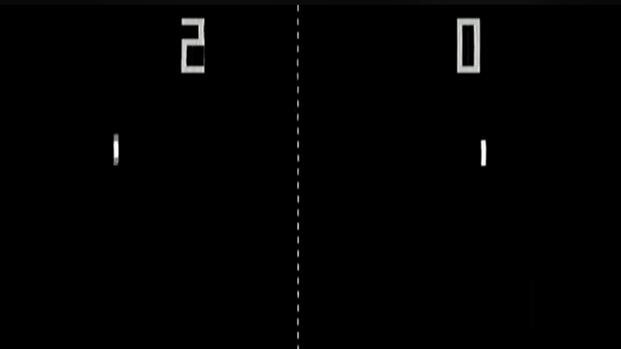
But Pong is a simple two-dimensional task. Doom is significantly more complex.
The game involves navigating a three-dimensional environment, reacting to enemies, and making decisions about movement and combat. Because of that complexity, the researchers had to translate the game’s visual information into electrical stimulation patterns that neurons could process.
What the ‘DOOM Brain Cells’ Experiment Actually Proves
Despite the dramatic headline, scientists emphasize that the neurons are not literally understanding the game the way a human player would.
Instead, the neurons respond to patterns of electrical stimulation tied to events in the game environment. If learning occurs, it manifests as improved performance under feedback conditions rather than through conscious decision-making.
The experiment demonstrates something important: a closed-loop interface between software and living human neurons that operates in real time.
That interface could eventually enable biological computing systems that combine living neural networks with traditional silicon hardware.
However, the current results remain preliminary. The Doom demonstration has not yet appeared in a peer-reviewed scientific paper, and researchers still debate how much of the learning occurs in the biological neurons themselves versus in supporting machine-learning software running alongside the system.
Why Researchers Are Interested in “Biological Computers”
Biological neurons are remarkably efficient processors.
The human brain runs on roughly 20 watts of power, far less than the energy required by modern AI systems or supercomputers performing similar tasks.
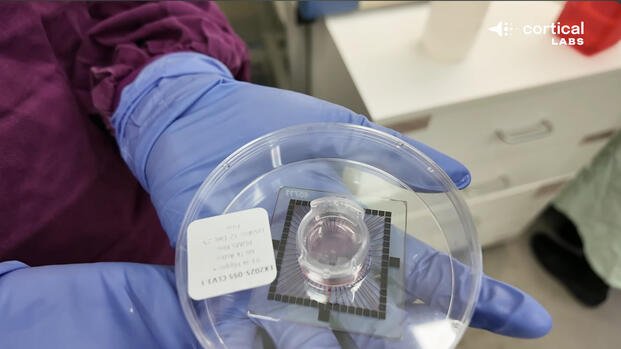
Scientists exploring biocomputing believe hybrid systems combining biological neurons with digital hardware could eventually tackle complex problems in ways traditional computers cannot.
The CL1 platform is part of a broader effort to make these systems accessible to researchers and developers. Cortical Labs has positioned the device as a programmable platform for running experiments directly on living neurons, with cloud access enabling remote testing.
The company says its next challenge is to improve how information is encoded into stimulation signals and how neural responses are interpreted, enabling biological networks to learn more complex tasks.
The Ethical Questions Behind the Technology
Experiments involving human neurons also raise ethical questions.
The cells used in systems like CL1 are typically derived from stem cells generated from donor tissue, such as skin or blood samples. These cells are then reprogrammed into neurons that can grow in laboratory cultures.
Current scientific guidelines state that there is no evidence that simple neuronal cultures can become conscious or experience pain. Still, researchers continue to monitor the field closely as biological computing systems become more sophisticated.
For now, the neurons in the CL1 system are simply clusters of cells that respond to electrical signals.
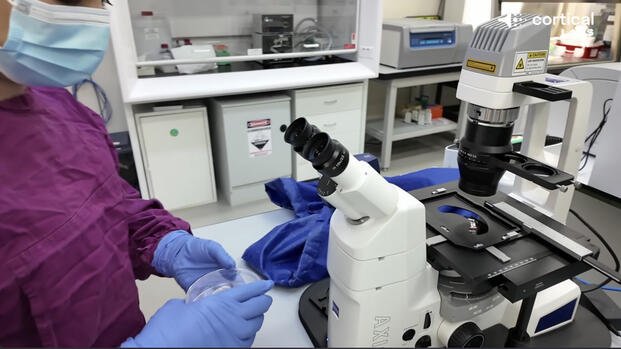
But the fact that those signals can now guide a player through the demon-filled corridors of Doom hints at a strange future where computing may rely not just on silicon chips, but on living neural networks.
If the technology develops further, biological computers could eventually help power AI systems, robotics or complex simulations while using less energy than traditional chips.
And if a dish of neurons can learn to play Doom today, researchers are already asking a bigger question:
What might they learn to do next?